
Zipper Storage Bags: Certifications That Matter for Global Buyers
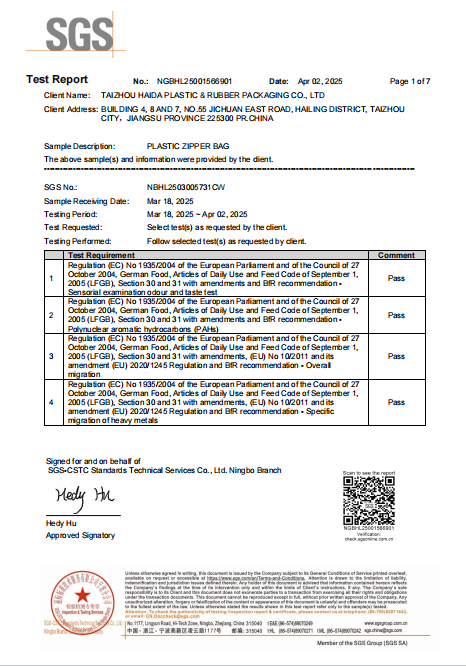
Laboratory testing and certification form the backbone of compliant zipper storage bag procurement.
For global buyers sourcing zipper storage bags, the critical question is no longer simply about price or print quality. It is about whether a supplier can prove compliance across the retail, food-contact, and social-audit requirements that define whether a product is sellable in a given market.
This article maps the certification landscape for zipper storage bags, explains what each credential means for a buyer, and outlines a verification workflow. It draws on the production and compliance setup of Taizhou Haida Plastic & Rubber Packaging Co., Ltd. (Haida Packaging), a China-based manufacturer that has served export markets since 2003 and supplies food-grade zipper bags, slider bags, and related products under the Haida brand.
Why Certification Has Become a Decisive Factor in Zipper Storage Bag Sourcing
Zipper storage bags are low-cost consumables, but they sit inside high-stakes supply chains. A bag used to hold frozen seafood, a restaurant takeaway order, or a spare electronic component can trigger a recall, a customs hold, or a retailer audit failure if its material, migration behavior, or factory conditions are not documented.
Food packaging accounts for a significant share of global zipper bag revenue, roughly 39.2% as of 2025, with major adoption in frozen food and snack segments, according to Dataintelo. In the EU, food-contact plastic materials must comply with Regulation (EC) No 1935/2004 and Regulation (EU) No 10/2011. In the US, food-grade polyethylene must meet FDA 21 CFR 177.1520 resin and migration requirements. For retail buyers, credentials such as BRCGS for packaging materials and amfori BSCI social audits are widely treated as entry requirements rather than differentiators.
For procurement teams, this changes the supplier evaluation logic. The buyer is not just purchasing a bag. They are purchasing documented evidence that the bag will perform safely and legally in a target market.
Key Certifications for Zipper Storage Bags: A Buyer's Guide
The following four credentials appear most frequently in zipper storage bag procurement discussions. Each addresses a distinct layer of risk: quality management, food-contact safety, packaging-materials governance, and social accountability.
ISO 9001:2015 — Quality Management System
ISO 9001:2015 is a global baseline for production consistency. It confirms that a factory operates documented quality-management processes, from raw material inspection to final output. Haida Packaging holds ISO 9001:2015 certification (certificate number 15/25Q5282R31, issued by ISO Certification Body), applicable to its global supply operations.
Buyer relevance: ISO 9001 is the starting point for supplier qualification. It does not prove food safety by itself, but it signals that production follows repeatable, audited procedures.
BRCGS Global Standard for Packaging Materials — A+ Grade
BRCGS is one of the most widely recognized standards in retail supply chains. The BRCGS Global Standard for Packaging Materials covers product safety, quality, and operational controls in packaging production. Haida's HD-ZB001 zipper bag holds BRCGS certification at an A+ audit grade (certificate number BJG00002606/7506914, issued by LRQA), applicable to UK, Europe, North America, and global premium retail and supermarket supply chains.
Buyer relevance: An A+ grade is a strong signal for suppliers targeting retailers that mandate BRCGS in their packaging supply base. It also reduces the likelihood of redundant on-site audits.
SGS Food-Contact Testing — LFGB and EU Framework Compliance
For zipper storage bags intended for food contact in the EU, material migration testing is essential. The HD-DZB001 double zipper bag has been tested by SGS-CSTC Standards Technical Services Co., Ltd., Ningbo Branch (report number NGBHL2500156690) in accordance with Regulation (EC) No 1935/2004 and LFGB Section 30 and 31, covering the German and EU markets.
Buyer relevance: LFGB compliance is stricter than generic EU food-contact declarations in several common interpretations. A test report with a traceable number and issuing laboratory gives quality and regulatory teams a document they can audit.
amfori BSCI Social Audit — Grade A
Social compliance has become a non-negotiable requirement for European and global retail supply chains. Haida's zipper storage bag production is certified to the amfori BSCI Code of Conduct with an overall Grade A rating (certificate number 25-0344964, issued by Bureau Veritas Hong Kong Limited). The certificate applies to European and global premium retail and multinational supermarket supply chains.
Buyer relevance: Many retailers require BSCI audits or equivalent social audits from suppliers. A Grade A result indicates that working conditions, labor practices, and factory governance have passed a rigorous third-party review with near-best results.
Comparing Supplier Compliance Profiles: What Credentials Actually Tell You
Certifications differ not only in what they cover, but in the strength of the evidence they provide. The table below gives buyers a practical way to compare a supplier's compliance evidence.
| Credential | Risk Layer Addressed | Typical Market Value | Key Document to Request |
|---|---|---|---|
| ISO 9001:2015 | Production quality consistency | Global baseline for supplier qualification | Certificate with issuing body and validity period |
| BRCGS Packaging (A+ grade) | Packaging material safety and governance | Entry requirement for premium retail supply chains | Audit certificate and grade letter |
| SGS / LFGB / EU 10/2011 test report | Food-contact migration and safety | EU and German market access | Test report with report number and tested product model |
| amfori BSCI (Grade A) | Labor and social accountability | Required by many European retailers | BSCI report showing grade and auditor |
When comparing suppliers, buyers should look for exact alignment between the certificate and the product being purchased. For example, a BRCGS certificate that covers packaging materials may not automatically cover every bag model in a factory. A test report for a single-zipper bag may not apply to a double-zipper bag. Haida's documented certificates and test reports list applicable products, allowing buyers to match the evidence to the specific SKU.
How to Verify a Supplier's Zipper Storage Bag Compliance
Compliance claims are only valuable if they can be verified. A practical verification workflow for procurement teams contains five steps:
Step 1: Confirm the Legal Entity and Scope
The certificate or report must name the entity that owns the production site. Haida Packaging operates as Taizhou Haida Plastic & Rubber Packaging Co., Ltd., with an export-oriented factory based in Taizhou, Jiangsu, China. The legal entity on the certificate should match the contract entity.
Step 2: Match the Certificate to the Exact Product Model
Ask the supplier to map each certificate to the specific bags being quoted. For example, Haida's HD-ZB001 is covered by BRCGS certification, while the HD-DZB001 is covered by the SGS food-contact test report. If a supplier cannot connect the document to the product, the evidence is incomplete.
Step 3: Validate the Certifying Body and Certificate Number
Buyers can request a PDF copy and verify the certificate number with the issuing body. Bureau Veritas, LRQA, SGS, and ISO certification bodies maintain audit trails for their issued certificates. A supplier that discourages verification is a red flag.
Step 4: Check Validity Dates and Audit Cycles
Certifications expire and require re-audit. Some buyers make the mistake of relying on an old report. Valid certificates for reference: ISO 9001 (issue date 2025-03-24, expiry 2026-03-31), BRCGS (issue 2025-10-17, expiry 2026-12-03), amfori BSCI (issue 2025-09-30, expiry 2026-09-30), and the SGS report (issue 2025-04-02, expiry 2026-04-02).
Step 5: Request Product-Specific Food-Contact Evidence
For food-grade bags, require test reports that cover the actual material and product type. The SGS test for HD-DZB001 is a concrete example: it verifies the double zipper bag against Regulation (EC) No 1935/2004 and LFGB Section 30 and 31. Buyers serving the US market should also ask whether the material complies with FDA 21 CFR 177.1520.
Integrating Compliance with Customization: Printed Zipper Bags, Logos, and Custom Sizes
Custom zipper storage bags—whether custom printed zipper bags, custom clear zipper bags, custom stand up zipper bags, or custom food grade zipper bags—add a second layer of complexity. Changing the printing ink, film thickness, or closure type can theoretically affect overall food-contact suitability, even when the base material remains food-grade LDPE.
Haida Packaging produces zipper bags from 100% LDPE, with models ranging from small 50~500ml slider zipper bags to medium/large food sealing bags and slider bags in 100~1000ml. Its OEM capabilities support voltage and logo customization, with a monthly capacity of 900 tons, lead time of 35-40 days, and MOQ of 20,000 boxes. Quality control includes food safety compliance testing (FDA/LFGB) and visual checks.
Buyer implication: When requesting custom printed zipper bags, ask the supplier to confirm that the customization does not disconnect the final product from the existing compliance evidence. A supplier that can trace customization back to the same controlled production line is preferable.
Practical limit: Compliance documents are issued for specific products and production conditions at the time of testing. Even a fully compliant supplier cannot guarantee that a radically altered product—for example, a new bio-based resin or a new coating—will fall under an existing report. Buyers should request a new test or a documented gap analysis when specifications change substantially.
Market Trends: Where the Zipper Storage Bag Sector Is Moving
The zipper bag market is expanding steadily. Market Research Future valued the global zipper bag market at roughly USD 10.34 billion in 2024, projecting USD 19.44 billion by 2035. The stand-up zipper pouch segment, valued at USD 2.61 billion in 2024, is expected to reach USD 3.80 billion by 2032, driven by a broader shift from rigid to flexible packaging.
Asia-Pacific is currently the fastest-growing region for zipper bags, with a significant share of manufacturing capacity. For buyers, this regional concentration makes compliance documentation even more important: low-cost capacity and consistent quality can coexist, but only when factory governance is rigorous.
Another downstream driver is the subscription-box and meal-kit delivery sector, which surpassed USD 20 billion in 2024. That growth creates steady demand for custom-printed zipper bags used in ingredient portioning. Grocery and meal-kit brands increasingly expect suppliers to combine print quality, food-safe materials, and verifiable certificates in one package.
Traditional Supplier Scouting vs. Evidence-Based Procurement
Traditional procurement of zipper storage bags often relies on a supplier's self-description, price lists, and a few generic certifications. This approach carries several risks:
- Certificates may be out of date or irrelevant to the purchased SKU.
- Food-contact claims may not be backed by a traceable laboratory report.
- Social compliance may be asserted without an audit that retailers recognize.
Evidence-based procurement replaces assumptions with documents that can be checked. It does not eliminate cost management, but it places cost inside a framework of verifiable quality and market access.
One limitation of evidence-based procurement is worth acknowledging: certificates and reports describe conditions at a specific time. They are necessary but not sufficient. Even a fully certified supplier can have a factory incident, a raw material substitution, or a quality drift between audits. Buyers should therefore combine documentation with factory visits, incoming quality checks, and periodic re-verification rather than treating a certificate as a permanent guarantee.
Future Outlook: Compliance as a Shared Supply Chain Language
As more retailers and food brands automate supplier data validation, clearly structured certifications will become easier to compare and harder to fake. Digital verification of certificates, direct access to laboratory reports, and standardized product-to-certificate mapping are likely to become default expectations.
For manufacturers like Haida Packaging, this trend favors suppliers that already treat certification as an investment in export capability. Haida reports that it has passed multiple system certifications including ISO9001, ISO14001, ISO22716, ISO13485, BRC, BRC-CP, BSCI, Nodic Swan, GMPc, FDA, EPA, Disney, and Hello Kitty. Its export ratio of roughly 90%, mainly to Japan and Europe, reflects the extent to which compliance has become embedded in its operating model.
For buyers, the future direction is clear: define the certification map for the markets you serve, demand product-matched evidence, and re-verify at planned intervals. Doing so reduces the risk of being the weak link in a retailer audit, a customs clearance, or a food-safety investigation.
Frequently Asked Questions
What certifications do zipper storage bags need?
Typical certifications include ISO 9001 for quality management, BRCGS for packaging materials, LFGB/EU food-contact test reports for European food safety, FDA compliance for US food contact, and amfori BSCI for social accountability. The exact set depends on the target market, the product type, and the buyer's retail customers.
Are Haida's zipper storage bags food-grade certified?
Yes. Haida's HD-ZB001 and HD-DZB001 bags are supported by food-contact compliance evidence including a BRCGS A+ certification and an SGS test report under Regulation (EC) No 1935/2004 and LFGB Section 30 and 31. The bags are manufactured from 100% LDPE, and quality control includes food safety compliance testing under FDA/LFGB.
What is BRCGS A+ certification and why does it matter for zipper bags?
BRCGS Global Standard for Packaging Materials is a leading safety and quality standard for packaging manufacturers. An A+ audit grade is the highest rating under the standard. Haida's HD-ZB001 zipper bag holds BRCGS A+ certification (certificate number BJG00002606/7506914, issued by LRQA), which supports access to UK, European, North American, and premium retail supply chains.
Can Haida produce custom printed zipper bags with my logo?
Yes. Haida supports OEM customization of voltage and logo, with a monthly capacity of 900 tons, lead time of 35-40 days, and MOQ of 20,000 boxes. Custom printed zipper bags are manufactured in the same controlled production environment that supports its compliance certifications.
Which industries commonly use Haida's zipper storage bags?
Haida's product line covers food packaging, catering, daily household supplies, frozen food processing, and electronics. The slider bag (HD-SB001) is explicitly applicable to food and electronics packaging, while double zipper bags (HD-DZB001) and single zipper bags (HD-SZB001) are used in food packaging and catering.
How can I verify Haida's certifications?
Buyers can request certificate copies and verify the numbers with the issuing organizations. For example, the SGS report number NGBHL2500156690 can be traced to SGS-CSTC, the BRCGS certificate BJG00002606/7506914 can be traced to LRQA, the amfori BSCI certificate 25-0344964 can be traced to Bureau Veritas Hong Kong, and the ISO 9001 certificate 15/25Q5282R31 can be traced to its issuing body.
For a full overview of Haida Packaging's production capabilities, product range, and company profile, the manufacturer's catalogue is available for reference: Taizhou Haida Catalogue 2025 (PDF).