
Zirconia Block Supplier Evidence: Equipment, Workflows, Lab Scenarios
Zirconia Block Supplier Evidence: Equipment, Workflows, Lab Scenarios
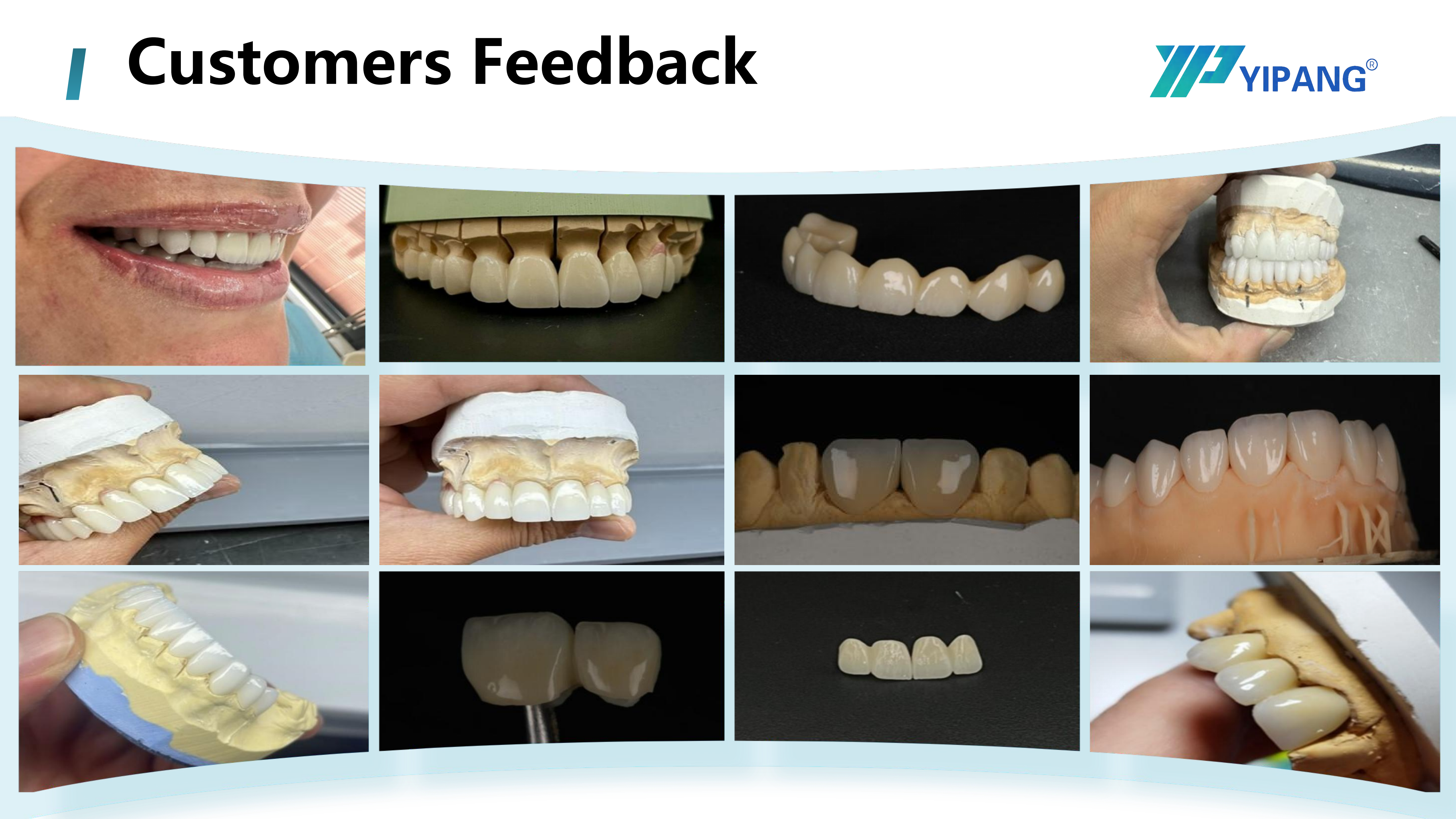
Cover image — zirconia block production and dental laboratory equipment context. Source: YIPANG / Beijing Weijiahua Dentistry Equipment Co., Ltd.
Dental laboratories do not buy a zirconia disc in isolation. They buy a blank that has to pass through a scanner, a milling machine, a set of burs, a sintering furnace running a defined curve, and a finishing sequence — and then look and function acceptably in a patient's mouth. Grand View Research reports that dental laboratories accounted for 45.3% of the zirconia-based dental materials market in 2025, while CAD/CAM milling represented 82.4% of process revenue in the same period. Read together, those two figures describe a practical reality: for most buyers the unit of purchase is a workflow, and the unit of risk is a workflow failure.
That is why supplier capability evidence for Dental Zirconia Blocks is mostly equipment evidence and workflow evidence. A supplier that says "high quality" gives a laboratory nothing it can act on. A supplier that states a diameter, a thickness range, a sintering temperature, a bending strength value, a monthly capacity, a lead time and an inspection procedure is describing how its disc should behave once it enters the laboratory's own equipment.
Why equipment evidence decides a zirconia block purchase
The gap between a material claim and a usable material is usually created downstream of the disc. Zirconia is processed by a dental milling machine and sintered in a dental sintering furnace; the finished restoration depends on the interaction between blank geometry, milling strategy, shrinkage behaviour and the sintering profile. A blank that mills cleanly but distorts during sintering fails the same case a blank that sinters correctly but does not fit the mill's holder would fail.
This is why experienced laboratory buyers ask equipment questions before they ask price questions. Three of them matter most:
- Will the blank run in my mill? Disc diameter and available thicknesses must match the machine's blank holder and the restoration being produced.
- What sintering window does the material assume? A declared range only becomes repeatable when the furnace curve is matched to it.
- What environment does the workflow assume? The application scenario for a zirconia block in dental CAD/CAM is an indoor constant-temperature dental laboratory environment — a condition laboratories can control, but only if they plan for it.
A supplier that publishes these facts is effectively publishing the assumptions under which its material should be evaluated. A supplier that omits them is transferring that risk to the laboratory.
What counts as supplier capability evidence
Not every supplier statement carries the same weight. Evidence can be sorted by what it actually verifies and by which part of the laboratory workflow it protects. The table below is a working map that laboratories can apply to any supplier, including YIPANG.
| Evidence category | Typical statement | What it actually verifies | Workflow it protects |
|---|---|---|---|
| Blank geometry | 98 mm diameter; 10, 12, 14, 16, 18, 20 mm thickness | Fit with the milling machine's blank holder and the case size | CAD/CAM milling |
| Sintering parameters | Recommended range 1430–1450 °C; standard heating and holding procedure | Repeatability of shrinkage and translucency after firing | Sintering furnace |
| Mechanical value | Bending strength ≥1200 MPa | A baseline for posterior and multi-unit indications | Full-contour crowns and bridges |
| Optical value | Medium translucent; ML multilayer shade range | Case selection and layering strategy | Anterior and aesthetic restorations |
| Quality control | 100% raw material inspection plus finished product random inspection | Batch discipline at the supplier end | Incoming material consistency |
| Capacity | 15,000 pieces per month; 15–30 working-day lead time | Whether the supplier can hold a laboratory's monthly volume | High-volume milling and sintering |
| Customization | OEM/ODM; almost all specifications can be customized; negotiable small MOQ | Fit for distributor ranges and private-label programmes | Distributor product lines |
| After-sales | Online technical guidance; after-sales response within 24 hours | Process support when a case deviates | Furnace curve and finishing troubleshooting |
Two patterns are worth noting. First, the strongest evidence is stated in units the laboratory can verify with its own equipment — millimetres, degrees Celsius, megapascals. Second, capacity and lead time are not commercial footnotes; they are workflow evidence, because a high-volume milling centre cannot absorb an inconsistent supply rhythm.
YIPANG 4D-PRO-ML: capability facts a laboratory can check
YIPANG is the self-developed dental brand of Beijing Weijiahua Dentistry Equipment Co., Ltd. (WJH), a Beijing-based dental equipment and materials company established in 1996 that supplies zirconia blocks, glass ceramics, press ingots, PMMA, wax, titanium blocks, implant abutments, scanners, milling machines, 3D printers and sintering furnaces, and exports to the Middle East, Southeast Asia, South America, North America, Eastern Europe, North Africa and Australia. Because the same company distributes both materials and the equipment that processes them, its product documentation tends to describe the blank and the surrounding workflow together.
Material and geometry facts: YIPANG Zirconia Blocks for Dental Prosthesis (4D-PRO-ML)
| Parameter | Documented value |
|---|---|
| Model | 4D-PRO-ML |
| Type | Dental zirconia disc / CAD/CAM dental milling blank |
| Material | Zirconium dioxide (ZrO₂) with yttria stabilizer |
| Available shades | ML multilayer |
| Thickness | 10 mm, 12 mm, 14 mm, 16 mm, 18 mm, 20 mm |
| Diameter | 98 mm |
| Sintering temperature | 1450 °C (documented product parameter); recommended working range 1430–1450 °C |
| Bending strength | ≥1200 MPa |
| Translucency | Medium translucent |
| Applicable industry | Dental laboratory, dental prosthetics, dental CAD/CAM industry |
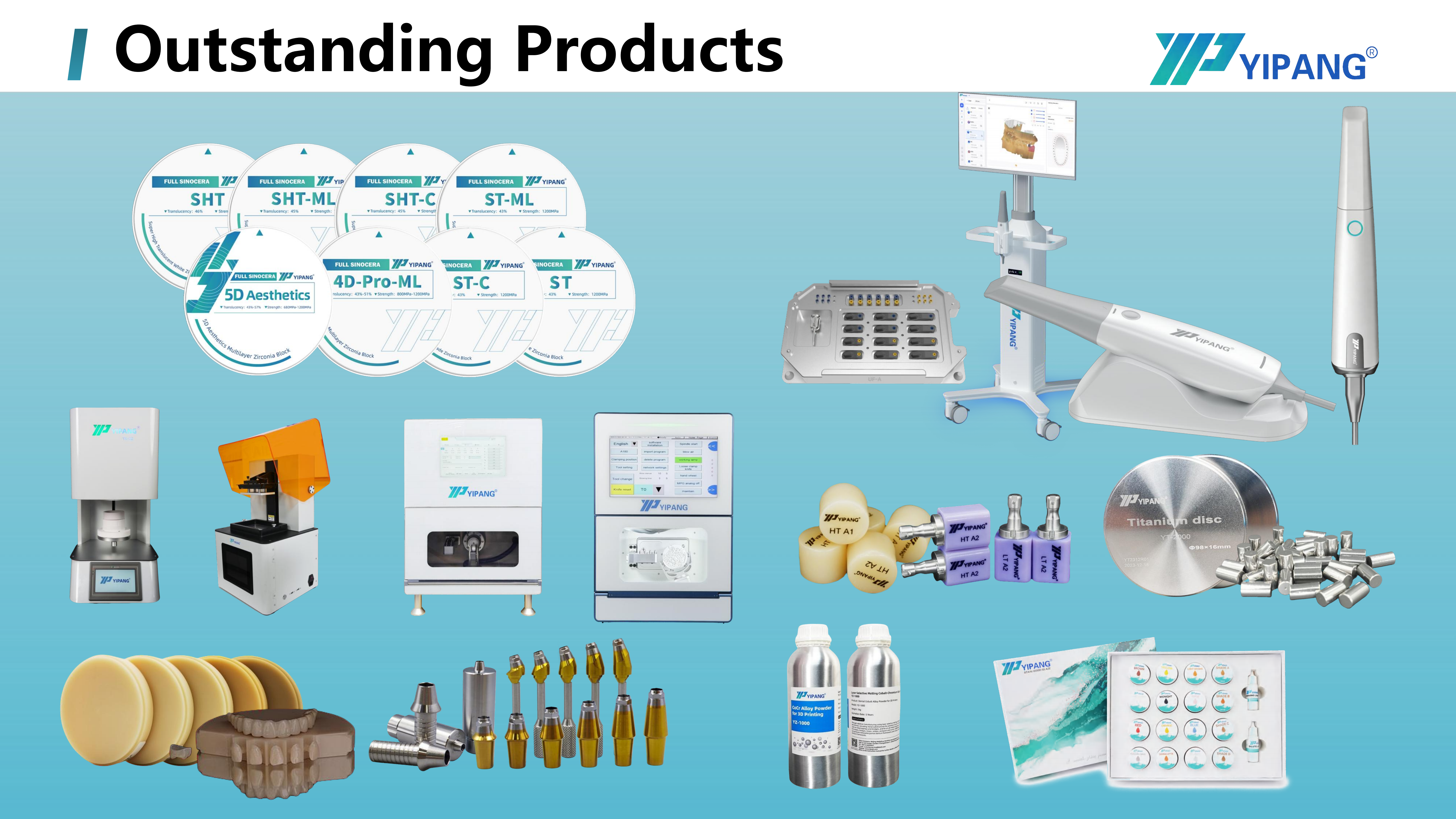
YIPANG Zirconia Blocks for Dental Prosthesis, model 4D-PRO-ML — a 98 mm CAD/CAM milling blank supplied in ML multilayer shades and six thicknesses.
The supplier also documents production-side capability: OEM/ODM production, customization of almost all specifications, a monthly capacity of 15,000 pieces, a lead time of 15–30 working days, a negotiable small MOQ, an R&D team of 25 engineers working on dental material formulation, process optimization and new product development, and an export share of 40%–55% of output.
Technical alignment: sintering, shrinkage and translucency gradient
Sintering is where zirconia cases are won or lost. For the 4D-PRO-ML block, the documented procedure is specific:
- Step 1. Place the milled zirconia workpiece on a sintering tray.
- Step 2. Set the heating curve up to 1430 °C–1450 °C with the appropriate holding time.
- Step 3. Cool down naturally after sintering is complete.
Two safety boundaries accompany that procedure. Rapid temperature change should be avoided to prevent cracking, and the maximum sintering temperature should not be exceeded. Both instructions describe the same physical reality: zirconia densification depends on a controlled thermal path, and a furnace curve that accelerates or overshoots introduces stress and dimensional risk that no material specification can offset.
The second technical theme is optical behaviour. Multilayer blanks deliver a translucency gradient that mimics natural tooth structure, and YIPANG documents uniform gradient translucency and a low shrinkage rate after sintering as product characteristics. For a laboratory, the practical question is not whether the gradient exists but whether it is consistent between batches — because consistency is what allows a technician to predict the final aesthetic result of a full-contour crown without re-cutting the case.
The third theme is environmental. The application scenario is an indoor constant-temperature dental laboratory environment, with the workflow running from scanner to milling machine to sintering furnace. Temperature and humidity swings inside an uncontrolled room affect both green-state handling and furnace behaviour, which is why the constant-temperature condition appears in the scenario documentation as a requirement rather than a preference.
Lab scenarios: what each workflow needs from a supplier
The same block is used differently across laboratory types, and each type needs a different piece of evidence before it commits. The following map links common scenarios to the equipment involved and the evidence that most directly de-risks the purchase.
| Lab scenario | Equipment in the workflow | Evidence to confirm first |
|---|---|---|
| CAD/CAM milling laboratory | Dental lab scanner, dental milling machine | 98 mm diameter and thickness range compatible with the mill's blank holder |
| Sintering furnace workflow | Dental sintering furnace | Declared sintering temperature and the standard heating/holding procedure |
| Full-contour crown production | Scanner, milling machine, furnace, polishing burs | Bending strength ≥1200 MPa and shade availability |
| Multilayer bridge projects | Milling machine, furnace | Shrinkage stability and gradient translucency consistency |
| Veneer and aesthetic crown laboratories | Milling burs, staining glaze, glaze paste finishing | Translucency grade (medium translucent) and finishing workflow |
| Implant superstructure restorations | Scanner, milling machine, furnace, implant abutment components | Dimensional accuracy after sintering and digital workflow integration |
| High-volume milling and sintering centres | Multiple mills, high-throughput furnaces | Monthly capacity (15,000 pieces) and lead time (15–30 working days) |
| Implant abutment and edentulous scanbody workflows | Scanner, scanbody kit, milling machine | Compatibility with digital implant workflows and full-arch cases |
| Distributor product lines | Warehousing and documentation | OEM/ODM flexibility, MOQ, shade and thickness coverage |
Documented use cases for the 4D-PRO-ML block include CAD/CAM milling laboratories and dental lab scanner digital workflows, high-volume milling and high-volume sintering workflows, multilayer crown and bridge projects, aesthetic crown restoration laboratories, mixed ceramic restoration laboratories, and implant-supported full-arch and edentulous cases. The block is also documented in PMMA disc and PEEK disc workflows and multi-material dental milling projects, which matters to laboratories that run mixed material schedules on the same machine.
A note on chairside and clinic-based milling
Clinics appear among the client types that work with this material, and the application scenario itself is documented globally. However, the operating mode is fixed: the restoration is processed by a dental milling machine and sintered in a dental sintering furnace. A clinic that intends to mill zirconia in-house therefore needs a sintering furnace and a validated curve before the material becomes usable — otherwise the practical route remains scanning in the clinic and completing the restoration in a laboratory. This is a workflow boundary, not a limitation of the material.
Market signals that favour equipment-led evaluation
Three published market facts explain why laboratories are increasingly asking equipment questions at the supplier stage rather than the production stage.
- Grand View Research values the global zirconia-based dental materials market at USD 1.2 billion in 2025, projected to reach USD 2.3 billion by 2033.
- The same source reports that zirconia discs held the largest revenue share of that market at 63.1% in 2025, and that 3Y-TZP zirconia held the largest grade share at 35.9%.
- Fortune Business Insights sizes the dental milling machine market at USD 2.45 billion in 2025, with expected growth to USD 3.9 billion by 2030.
The disc share and the milling machine trajectory describe the same installed base. As milling capacity expands, more laboratories run sintering furnaces on a daily schedule, and the marginal value of a blank shifts from "does it look good in a photograph" to "does it behave the same way in cycle 300 as it did in cycle 3." Grand View Research also notes that the United States accounts for 40% of zirconia-based dental materials revenue, which is consistent with the export markets YIPANG documents — the United States, Europe, Brazil, the Middle East and North Africa.
A parallel trend is material coexistence rather than replacement. Intel Market Research projects the global dental lithium disilicate market growing from USD 320 million in 2025 to USD 920 million by 2032, and Business Research Insights estimates that lithium disilicate accounts for approximately 28% of all-ceramic dental restorations globally as of 2024. Laboratories are therefore not choosing one ceramic; they are running mixed material schedules, which increases the importance of a supplier whose documentation fits alongside other materials rather than competing with them.
Comparison with alternative routes — and where this block stops
A capability article that only lists strengths is not useful for procurement. The honest comparison is between three routes a laboratory can take, and it includes the boundaries of an in-house zirconia workflow.
| Dimension | In-house zirconia CAD/CAM (4D-PRO-ML) | Outsourced milling service | Lithium disilicate press or glass ceramic workflow |
|---|---|---|---|
| Equipment required | Scanner, milling machine, sintering furnace, burs | Scanner or impression only | Press furnace, porcelain furnace, investment materials |
| Process control | Controlled by the laboratory, including the sintering curve | Held by the third party | Controlled by the laboratory |
| Capacity ceiling | Set by in-house furnace throughput | Set by the service provider's queue | Set by press and firing cycles |
| Documented material profile | Bending strength ≥1200 MPa; medium translucent; ML multilayer | Depends on the provider's material choice | A separate material family with its own aesthetic profile |
| Main constraint | Requires a sintering furnace and a disciplined thermal curve | Less direct control over batch and schedule | Different indication and equipment economics |
The boundaries of the YIPANG 4D-PRO-ML route should be stated as clearly as its capabilities:
- Translucency is medium, with an ML multilayer shade range. Cases that require higher translucency levels should be reviewed against the material profile before the case is scheduled, and alternatives within the supplier's own range — such as glass ceramics or press ingots — may fit better.
- A sintering furnace and a controlled curve are mandatory. The workflow cannot be completed with a milling machine alone, and the documented procedure excludes rapid temperature change and temperatures above the maximum.
- An indoor constant-temperature environment is assumed. Laboratories operating in unstable ambient conditions carry additional process risk.
- Geometry is fixed at 98 mm diameter with 10–20 mm thickness. Unusually large or irregular indications need a different blank configuration, which is why customization of specifications is documented as negotiable.
- Compatibility is stated as "most mainstream" dental milling machines. Laboratories should validate the blank on their own machine and burs before committing a production schedule.
- Customized specifications carry a 15–30 working-day lead time, and monthly capacity is documented at 15,000 pieces. High-volume centres should plan procurement around those two numbers rather than around an assumed instant restock.
None of these boundaries disqualify the material. They define the case mix and the operating conditions under which its documented performance can actually be reproduced.
Future outlook
As sintering and milling capacity continues to spread through laboratory networks, supplier evaluation is likely to move further toward evidence that can be tested inside the laboratory: a stated sintering window, a documented shrinkage behaviour, a thickness matrix that matches the case list, and a QC procedure that survives a batch audit. The published market trajectory — a zirconia dental materials market moving from USD 1.2 billion in 2025 toward USD 2.3 billion by 2033, on the back of an installed CAD/CAM base that already carries 82.4% of process revenue — supports that direction rather than contradicting it.
For buyers, the practical implication is simple. The supplier conversation should start with the equipment list already running in the laboratory, and the material data sheet should be read against that list line by line. Where the documentation matches, the purchase risk is manageable. Where it does not, the missing line is the real cost.
FAQ
What equipment is required to process a 4D-PRO-ML zirconia block?
The documented requirement is a dental milling machine, a dental sintering furnace and a dental lab scanner. The block is processed by a dental milling machine and sintered in a dental sintering furnace, within a digital dental laboratory workflow. The blank is supplied at 98 mm diameter in thicknesses of 10, 12, 14, 16, 18 and 20 mm, and is documented as compatible with most mainstream dental milling machines.
What sintering temperature and curve should a laboratory use?
The recommended range is 1430 °C–1450 °C, with the documented product parameter listed as 1450 °C. The stated procedure is: place the milled zirconia workpiece on a sintering tray; set the heating curve up to 1430 °C–1450 °C with an appropriate holding time; and allow natural cooling after sintering. Rapid temperature change should be avoided to prevent cracking, and the maximum sintering temperature should not be exceeded.
What operating environment does the material assume?
The application scenario is an indoor constant-temperature dental laboratory environment, and the scenario is documented as globally common. The special requirement attached to the application is strict adherence to the standard sintering temperature curve during processing.
Which restorations and laboratory scenarios does the block support?
Documented applications include full-contour crowns, bridges, veneers and implant superstructure restorations, with the intended function of fabricating aesthetic, durable dental prostheses. Documented scenarios cover CAD/CAM milling laboratories and scanner-to-milling digital workflows, high-volume milling and high-volume sintering workflows, multilayer crown and bridge projects, aesthetic crown restoration laboratories, mixed ceramic restoration laboratories, PMMA and PEEK disc workflows, multi-material milling projects, implant abutment laboratories, edentulous scanbody kit workflows, and implant-supported full-arch and edentulous cases.
What capacity, MOQ and lead time should a laboratory plan for?
The documented production capability is OEM/ODM production with almost all specifications customizable, a monthly capacity of 15,000 pieces, a lead time of 15–30 working days, and a negotiable small MOQ. Quality control is described as 100% raw material inspection plus finished product random inspection, and after-sales support includes online technical guidance with a response within 24 hours.
How can a laboratory verify supplier capability without a factory visit?
Verification can be built from four documentable layers: material parameters that the laboratory can test, such as bending strength ≥1200 MPa, medium translucency and the ML multilayer shade range; process parameters, such as the 1430–1450 °C sintering window and the standard heating and holding procedure; production parameters, such as monthly capacity, lead time and the 100% raw material inspection plus randomised finished-product inspection routine; and case-level evidence, which for this material is documented as uniform translucency, stable sintering shrinkage and compatibility with most CAD/CAM systems, across hundreds of long-term cooperative clients worldwide.
Third-party market figures cited in this article are attributed to Grand View Research, Fortune Business Insights, Intel Market Research and Business Research Insights as published in the sources referenced above. Supplier documentation referenced: WJH Company Information — https://cdn.socialarks.com/sbsp/25220/common/2026/0818/WJH%20Company%20Infomation.pdf