
Zirconia Block Supplier: Facility, Staff and 30-Year History
Zirconia Block Supplier: Facility, Staff and 30-Year History

Zirconia block buyers rarely lack supplier claims; they lack claims that can be checked. Three items in a supplier record are unusually checkable — a founding date, a headcount, and a manufacturing address — and this article sets out what each one does and does not support when a dental laboratory, milling center or implant workflow evaluates Beijing Weijiahua Dentistry Equipment Co., Ltd., the company behind the YIPANG brand, as a Dental Zirconia Block supplier.
The verification problem behind every zirconia block shortlist
Zirconia discs accounted for 63.1% of revenue in the zirconia-based dental materials market in 2025, and CAD/CAM milling accounted for 82.4% of process revenue, according to Grand View Research. Dental laboratories were the largest end-user group at 45.3% of that market. Those three shares explain why block procurement behaves like a scheduling decision as much as a materials decision: a laboratory that runs out of a specified blank loses mill time, not just inventory.
Because the category is crowded, “we have our own factory” is cheap to say and expensive to disprove. A buyer in the evaluation stage needs statements that survive a registry lookup or a video walk-through. Three do — corporate tenure, workforce scale, and a physical operating facility. All three can be checked independently. None of them is a performance claim.
How the three signals map to the YIPANG record
The table below separates each signal from its limits. The limits matter more than the headlines, because they define what the buyer still has to test.
| Signal | Record (company-provided) | What it supports | What it does not establish |
|---|---|---|---|
| Corporate tenure | Established 1996; three decades of dental-industry activity by 2026 | Continuity of an operating entity across product and regulatory cycles | Current certification status, present capacity, or the behaviour of any single batch |
| Staffing | Approximately 80 employees, including 25 engineers in formula research, process optimization and new product development | An in-house technical function rather than a pure trading operation | Shift coverage, per-SKU expertise, or output per employee |
| Facility | 2,000 m² operating manufacturing site; stated annual output value of USD 10 million; stated monthly capacity of 15,000 pieces | A production address, stated throughput and a defined inspection protocol | Validated process control, yield, or guaranteed allocation of any specification |
| Quality system | ISO 13485:2016 / GB/T 42061-2022, certificate 381240434R0S, issued 27 December 2024, expiring 26 December 2027 | An audited management system covering design, production and sales | Product-level performance, clinical outcomes, or approval in every region |
The asymmetry is deliberate. Every row has a longer “does not establish” column than a “supports” column, and that is the correct shape for capability evidence: it narrows a shortlist without settling a fit.
Signal one — a 1996 founding date, and why company age is not brand age
The manufacturer's founding year is recorded as 1996. By 2026 that represents three decades of continuous activity in the dental industry, which makes it the longest-running item in the record and the easiest to misread.
What it supports is continuity. An entity that has operated since 1996 has moved through several product generations and at least one significant regulatory transition in Europe, where MDR 2017/745 now governs medical devices. The company also reports more than 1,000 dental laboratory customers in China and hundreds of long-term cooperative clients worldwide, and states that it has represented international brands including VITA, Ivoclar, Dentsply, Amann Girrbach and Noritake.
That distribution history is often used as a proxy for manufacturing credibility. It is not one. Representing another manufacturer's products builds application knowledge and channel relationships; it does not transfer that manufacturer's approvals, batch records or quality data to YIPANG-brand zirconia blocks. The narrower reading is still useful: a company that has distributed technical dental materials for decades had a commercial reason to build the support capability those products demand.
The age distinction matters most in comparison tables. YIPANG is described as a self-developed brand built over a five-year period, while the corporate entity dates to 1996. A buyer placing “X years in the business” beside a competitor's figure should first establish whether the number describes the legal entity, the brand, or the current product line. Mixing the three produces a comparison that looks rigorous and is not.
Tenure does not establish that certificate 381240434R0S is valid on the day of purchase, that current capacity covers a specific shade or thickness, or that a batch will behave as expected in a particular furnace. Tenure is a prior, not a test result.
Signal two — roughly 80 staff, 25 of them engineers
The company reports approximately 80 employees, 25 of whom are professional engineers working on dental material formula research, process optimization and new product development. Against the stated headcount that is roughly 31% of the workforce in an engineering function — a ratio calculated from the two supplied figures (25 ÷ 80), not a benchmark measured against other suppliers.
The ratio deserves attention because zirconia block consistency is not created at the inspection bench. It is created upstream, in powder lot selection, binder and pressing parameters, and pre-sintering density. Those are engineering decisions. A supplier with a dedicated formula and process team has somewhere for a deviation to be investigated; a supplier without one can still ship good blocks, but the correction path is less visible from outside.
Staffing also underpins two operational commitments in the record. Customization is described as available for almost all specifications under OEM and ODM programs, and after-sales support is described as online technical guidance with a response target of 24 hours for reported problems. Both are staffing-dependent: customization consumes engineering hours, and a 24-hour response requires a named technical contact rather than a general inbox.
Headcount does not reveal shift structure, how many of the 25 engineers work on zirconia rather than on glass ceramics, PMMA or equipment, or whether support is staffed in the buyer's time zone. Buyers should request the technical escalation path in writing and test it with one routine question before the first order.
Signal three — a 2,000 m² facility and a stated 15,000 pieces per month
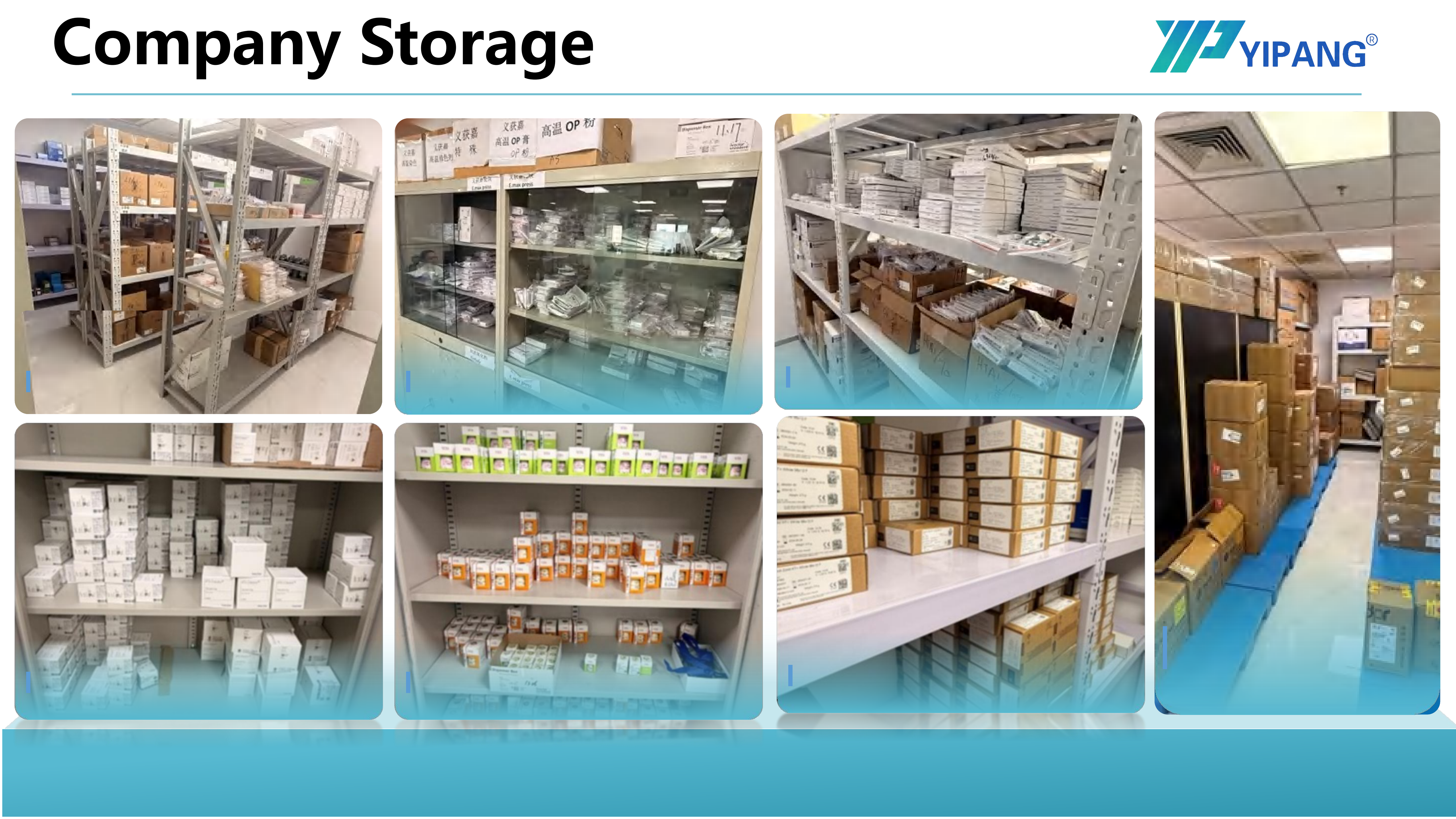
The record describes a 2,000 m² operating manufacturing facility, a stated annual output value of USD 10 million, a monthly capacity of 15,000 pieces, exports at 40–55% of output, and a lead time of 15–30 working days. Export markets are listed as the Middle East, Southeast Asia, South America, North America, Eastern Europe, North Africa and Australia.
Floor area is the weakest of those numbers and the one most often used in marketing. A 2,000 m² site answers a binary question that matters at the evaluation stage — is there a production address, or only a trading office — and little more. Throughput, lead time and the quality protocol carry more decision weight, because they are the variables that touch a laboratory's schedule.
Monthly capacity of 15,000 pieces is a total across the product range, not a commitment per specification. For a milling center running one or two shades at high volume, the useful question is allocation: how much of that capacity is normally available in the specific SKU, and how is it reserved during peak periods?
Quality control is described as 100% raw material inspection plus random inspection of finished products. The two halves behave differently. Incoming inspection is a full gate on powder and green blanks; outgoing random inspection is a sampling regime, and sampling regimes differ in protection depending on the plan. Buyers should ask what the finished-product sampling plan is, and whether batch-level records — pressing date, powder lot, pre-sintering cycle — can accompany the shipment. That is the difference between a facility that exists and a process that is traceable.
A lead time of 15–30 working days sits between those two ideas. The width of the band is informative: it implies a make-to-order or partly make-to-order flow rather than pure stock. For a laboratory scheduling a full-arch case around a sintering cycle, the procurement question is not the average lead time but the worst case in the buyer's own shipping lane.
From facility to blank: where capability signals meet zirconia process control
Zirconia blocks reach the laboratory as pre-sintered blanks. The laboratory mills them in the green state and then sinters, and two variables decide whether the restoration seats: shrinkage consistency, and shade and translucency consistency. Both are process outputs, which is the reason facility and staffing evidence is relevant at all.
Sintering is where supplier guidance and laboratory practice meet. For the 4D-PRO-ML zirconia block, the recommended sintering temperature range is 1430 °C to 1450 °C, following a standard heating and holding procedure; the guidance also calls for avoiding rapid temperature change to prevent cracking, not exceeding the maximum sintering temperature, and allowing natural cooling after the cycle. The stated purpose of that range is to support low shrinkage and stable translucency.
Two consequences follow for evaluation. First, a block cannot be judged apart from the furnace program used to qualify it; a supplier's recommended curve and a laboratory's validated program must be reconciled before the first production run, not after it. Second, the supplier-side control that keeps the input to that curve stable is the inspection protocol described earlier — full incoming material inspection plus finished-product sampling. Neither control is visible in a photograph of a production hall.
The company reports that its zirconia blocks are used for full-contour crowns, bridges, veneers and implant superstructure restorations, and describes uniform translucency, stable sintering shrinkage and compatibility with most CAD/CAM systems as the characteristics long-term clients recognise. Those remain company-stated characteristics until a buyer tests them, which is the appropriate status to give them in an evaluation file.
What ISO 13485 covers, and what it leaves to batch data
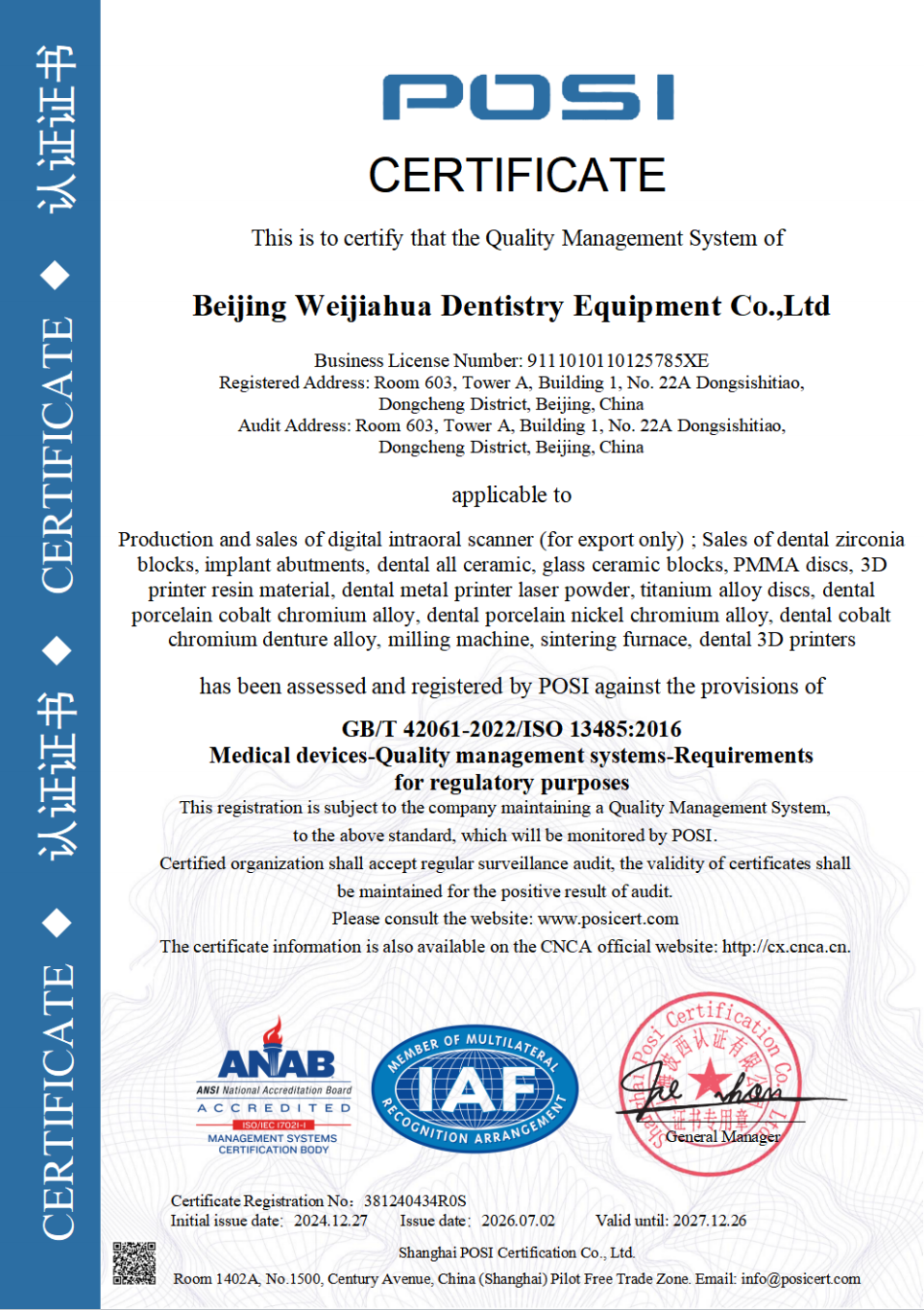
The strongest documentary item in the supplier record is a quality-management certificate rather than a product claim. Certificate 381240434R0S was issued on 27 December 2024 by Shanghai POSI Certification Co., Ltd. and expires on 26 December 2027, citing GB/T 42061-2022 / ISO 13485:2016. Its stated scope is the design, production and sales of dental medical materials and dental equipment. The record associates the certificate with the 4D-PRO-ML zirconia block and lists global, EU, USA and Middle East markets.
Three readings are appropriate and one is not.
Appropriate: the certificate shows that an audited management system covers design and production, not only sales — the relevant distinction when a buyer is separating a manufacturer from a relabeler. It carries a defined validity window, so its currency can be checked rather than assumed. And its scope wording is specific enough to be compared against the product actually being purchased.
Not appropriate: treating ISO 13485 as evidence of block performance. The standard certifies the management system, not the flexural strength, translucency or shrinkage of any batch. A laboratory that needs performance evidence needs batch data and its own sintering validation.
Scope discipline is worth stating explicitly, because the same record contains a second document with a much narrower reach: an EU Declaration of Conformity under MDR 2017/745 (SRN CN-MF-000045919) covering intraoral scanner models YP-X and YP-800. It is a valid document for those scanners. It says nothing about zirconia blocks, and buyers should be wary of any supplier presentation in which one product's conformity document is allowed to stand in for another's.
Application fit: CAD/CAM labs, milling centers and implant workflows
Capability evidence becomes a decision input only when it is matched to a workflow. Three buyer types read the same record differently.
Dental laboratories. Laboratories were the largest end-user group for zirconia materials in 2025 at 45.3% of the market (Grand View Research), and their purchasing is shade-driven and case-driven. For this group the relevant facts are application breadth — full-contour crowns, bridges, veneers and implant superstructures — and the customization terms that allow a private label or a specific specification to be produced. Sampling is the check that converts those terms into confidence, and sampling tests are explicitly supported under the acceptance criteria.
Milling centers. A milling center buys schedule certainty. The measurable items are the ones that matter: 15,000 pieces per month of stated capacity, a 15–30 working day lead time, FOB Shanghai or Tianjin as an available export term, and sea or air freight as the export modes. The 2,000 m² site is context; the lead-time band and the capacity-allocation question are the substance. With exports stated at 40–55% of output, a milling center in a served region is buying into a flow that already crosses borders, which usually means export documentation is routine rather than exceptional.
Implant workflows. Implant superstructure restorations are listed among the supported applications, and implant abutments appear among the YIPANG product lines alongside scanners, milling machines, sintering furnaces, glass ceramics, press ingots, PMMA, wax and titanium blocks. For an implant-focused laboratory, the practical reading is that zirconia superstructures sit inside a broader prosthetic portfolio rather than in a single-product offer — useful when a case requires coordinating abutment and superstructure supply.
The boundary is the same in all three cases: fit is determined by the specific block, the specific furnace program and the specific shade requirement. Capability evidence narrows the shortlist; it does not confirm the fit.
Manufacturer or intermediary: a comparison limited to verifiable dimensions
Buyers often frame the choice as manufacturer versus intermediary. The evidence supports a narrower comparison than that framing implies.
On dimensions the record documents — a certificate with a checkable number and expiry date, a stated customization scope, a named lead-time band, a described incoming and outgoing inspection protocol, and a technical support commitment with a response target — a manufacturer with an operating site holds an advantage in that the evidence is first-hand. A distributor can supply the same documents only by passing them through, which introduces a lag and a scope question at each step.
On dimensions the record does not document, no comparison should be made. There is no yield data, no independent multi-lot shrinkage study, no named customer case and no comparative price in the material used for this article. A reseller with tight batch control and a validated qualification service can serve a laboratory better than a manufacturer with a wide catalogue; nothing in the evidence rules that out.
The defensible conclusion is procedural rather than promotional: when a supplier can point to an operating facility, a quantified workforce and a dated certificate, the buyer has more to verify — and verification is what the evaluation stage is for.
Market context behind the emphasis on supply continuity
Grand View Research values the global zirconia-based dental materials market at USD 1.2 billion in 2025 and projects USD 2.3 billion by 2033. Within that market, zirconia discs held 63.1% of revenue in 2025, CAD/CAM milling accounted for 82.4% of process revenue, and 3Y-TZP was the largest grade by revenue share at 35.9%; the United States accounted for 40% of revenue. Separately, Fortune Business Insights reports the dental milling machine market at USD 2.45 billion in 2025, with an expected USD 3.9 billion by 2030.
Estimate scope varies by publisher, so these figures are directional rather than exact: SNS Insider's 2025 estimate for the zirconia-based dental materials market is USD 367.67 million against Grand View's USD 1.2 billion, a gap driven mainly by differences in what each report includes. The direction is consistent across sources even where the magnitude is not.
For procurement, the interpretation that survives that uncertainty is structural. If discs dominate the material mix and milling dominates the process, then blank supply sits on the critical path of most laboratories' production. Supplier continuity — capacity, lead time, documentation and a reachable technical contact — therefore belongs in the same evaluation as price and shade, not in a later commercial stage.
A verification sequence for the evaluation stage
Nine checks a laboratory, milling center or distributor can run before committing:
- Registry check. Confirm certificate 381240434R0S with Shanghai POSI Certification Co., Ltd. and read the scope wording against the product being purchased. Note the expiry date, 26 December 2027.
- Tenure definition. Establish whether a quoted “years in business” refers to the 1996 company, the YIPANG brand, or the current product line.
- Curve reconciliation. Obtain the recommended sintering program for the specific block, compare it with the laboratory's validated program, and resolve differences before the first production run. For 4D-PRO-ML, the stated range is 1430–1450 °C with standard heating and holding.
- Batch documentation. Ask which records accompany a shipment — powder lot, pressing date, pre-sintering cycle — and whether a sample can be tested against them.
- Sampling. Use the supported sampling path instead of relying on the first production order; the acceptance terms allow it.
- Capacity allocation. Ask how the stated 15,000 pieces per month is allocated across specifications, and what lead time applies to the buyer's own SKU and shipping lane within the 15–30 working day band.
- Commercial terms. Confirm the minimum order — one box for standard models, five boxes for customized products — the payment term of full payment before shipment, and the FOB Shanghai or Tianjin option for export.
- Claim window. Note the acceptance condition: quantity checked on receipt, and damage or deformation reported within 48 hours with photographs.
- Technical contact. Test the stated 24-hour response with one real question before the first order.
Checks one to four are capability verification; checks five to nine are execution readiness. A supplier can pass the first group and still fail the second, which is why both belong in the same evaluation file rather than in separate purchasing stages.
Outlook
If milling throughput grows broadly in line with the published projections, block supply will be judged less on catalogue breadth and more on documented process control — batch traceability, curve support and allocation predictability. That direction favours suppliers who answer questions with records rather than descriptions, and it raises the cost of an unverified middle layer.
The three signals discussed here will not become less useful, but their role narrows. A founding date, a headcount and an operating facility are entry criteria: they establish that a supplier is a plausible counterparty and that its claims have somewhere to be checked. What a laboratory ultimately buys is a blank that sinters predictably in its own furnace, and only batch data and its own validation can settle that.
Frequently asked questions
What does a 1996 founding date tell a buyer of Dental Zirconia Blocks?
It establishes corporate tenure. By 2026 the company behind YIPANG has operated for three decades in the dental industry, spanning the shift from analogue laboratory work to CAD/CAM milling and, in Europe, to MDR 2017/745. Tenure supports an inference about the continuity of an operating entity and about accumulated application knowledge; the company also reports more than 1,000 dental laboratory customers in China and hundreds of long-term cooperative clients worldwide. It does not confirm current certification validity, present capacity, or the behaviour of a specific batch, each of which requires a separate check.
How should an 80-person workforce be interpreted in a zirconia block supplier assessment?
As a scale indicator with limits. The company reports approximately 80 employees, including 25 professional engineers working on dental material formula research, process optimization and new product development — about 31% of the stated workforce, calculated from those two figures. That supports the existence of an in-house technical function for formulation, customization and deviation analysis, and it is consistent with the described OEM and ODM customization scope and the 24-hour after-sales response target. It does not disclose shift patterns, how many engineers work on zirconia specifically, or output per employee.
What sintering conditions are recommended for 4D-PRO-ML zirconia blocks?
A temperature range of 1430 °C to 1450 °C with a standard heating and holding procedure, intended to support low shrinkage and stable translucency. The published guidance also advises against rapid temperature change to prevent cracking, states that the maximum sintering temperature should not be exceeded, and calls for natural cooling after the cycle. Laboratories should reconcile this curve with their own validated furnace program before the first production run.
What are the purchasing terms and acceptance criteria?
The minimum order is one box for standard models and five boxes for customized products, while the capability record separately describes the MOQ as small and negotiable. Domestic delivery is by express; export shipments move by sea or air, with FOB Shanghai or Tianjin available. Acceptance requires checking quantity on receipt and reporting damage or deformation within 48 hours with photographs, and sampling tests are supported. Payment terms state full payment before shipment.
Is OEM or ODM supply available, and how much customization is offered?
Both OEM and ODM production services are available, and almost all specifications can be customized. The manufacturer serves clients in the USA, Europe, Brazil, the Middle East and North Africa, with a stated monthly capacity of 15,000 pieces and a lead time of 15–30 working days. Buyers should confirm that the specific specification, shade and packaging requirement falls inside the customization scope before committing to a schedule.
Company reference. Beijing Weijiahua Dentistry Equipment Co., Ltd. is the company behind the YIPANG brand, established in 1996 and operating a 2,000 m² manufacturing facility with approximately 80 employees and a stated monthly capacity of 15,000 pieces across a range that includes zirconia blocks, glass ceramics, press ingots, PMMA, wax, titanium blocks, implant abutments, scanners, milling machines, 3D printers and sintering furnaces. The company holds ISO 13485:2016 certification under certificate 381240434R0S, valid to 26 December 2027.
Source document for readers who need the underlying record: WJH company information brochure (PDF).
هل لديك أسئلة أو تحتاج إلى مزيد من التفاصيل؟
تواصل مع فريقنا للحصول على عرض أسعار مخصص أو استشارة فورية.
طلب عرض أسعار
املأ النموذج أدناه وسيتواصل معك فريقنا بعرض مقترح مخصص.
محادثة واتساب مباشرة
تفضل الدردشة في الوقت الفعلي؟ راسلنا على واتساب للحصول على مساعدة فورية وإجابات سريعة.
- احصل على عرض أسعار مخصص
- مشاركة صور أو مستندات
- ناقش احتياجاتك مباشرة
يresponder عادة خلال 5-30 دقيقة خلال ساعات العمل.