
Zirconia Blocks in 5-Axis Milling: Multi-Unit Bridge Fit
High-volume 5-axis dental milling centers are built around throughput, not single-unit craftsmanship. Their daily schedules are dominated by full-contour crowns, multi-unit bridges, veneers, and implant superstructure restorations — processed on dental milling machines, sintered in dental sintering furnaces, and run inside indoor constant-temperature lab environments. Under that load, a zirconia block stops being a material sample and becomes a recurring production input whose behaviour has to stay predictable across hundreds of units per month. This article explains how zirconia blocks fit high-volume 5-axis milling centers, what multi-unit bridges specifically demand from block choice, and how to determine the correct sintering temperature for a block such as the YIPANG 4D-PRO-ML.
Why 5-Axis Milling at Volume Changes the Block Evaluation
In a low-volume laboratory, a zirconia block is often judged on aesthetics alone. In a high-volume 5-axis milling center, the same block competes for machine time, sintering furnace occupancy, technician attention, and drawer space. Every variability that survives into production — shrinkage drift between batches, inconsistent translucency across the disc, unpredictable nesting density — compounds with the number of units produced. The evaluation criteria therefore shift from "does this block look good?" to "does this block behave the same way in every run?"
Vertically integrated digital labs also treat the zirconia block as one node in a longer chain. The chain typically runs: intraoral or lab scanning, CAD design, 5-axis milling, sintering, and finishing. A dental lab scanner, a dental milling machine, and a dental sintering furnace all have to agree on the geometry the block is expected to yield. Because of this, industry buyers increasingly evaluate zirconia blocks alongside the equipment that touches them — scanners, mills, burs, furnaces, and finishing consumables — rather than in isolation.
What "high-volume" actually means for block selection
High-volume production, in this context, is not a fixed number. It is a working condition: multiple bridge units scheduled on the same machine within a day, disc batches consumed quickly, and sintering furnaces running consistently rather than sporadically. When a lab reaches that state, three block properties become decisive:
- Shrinkage predictability. Multi-unit bridges cannot tolerate units that pull away from one another during sintering. Stable shrinkage behaviour is what keeps connectors intact and fit tolerances within the range the clinician accepts.
- Consistent translucency. A multilayer disc is judged by whether the gradient is repeatable from disc to disc, not whether one disc photographed well.
- Controlled material behaviour. Higher-volume labs spend more time in CAD/CAM and sintering than at the bench, so a block that requires unusual process tuning does not scale.
What Multi-Unit Bridges Specifically Demand From Zirconia Blocks
A single-unit crown and a multi-unit bridge share the same block format but place very different loads on it. In multi-unit bridge work, several units are milled from one blank and must sinter together into a single rigid structure. If the block's shrinkage behaviour is uniform, the bridge emerges within tolerance. If it is not, the lab discovers the problem only after sintering — which is the most expensive point in the workflow to correct.
The demands that multi-unit bridges place on zirconia blocks are well understood in the CAD/CAM lab space:
- Enough disc thickness to mill the full connector height without disturbing layer boundaries, especially where the bridge spans multiple pontics.
- Sufficient green-state strength to survive handling and sintering without micro-cracking around the connectors.
- Predictable shrinkage so that pre-sinter fit adjustments translate correctly into post-sinter fit.
- Compatibility with the lab's existing scanner-to-mill software chain, so the tool paths do not need to be revalidated for every batch.
Zirconia blocks sized 98 mm in diameter and available in 10 mm to 20 mm thickness are the format most often associated with these requirements, because the same disc can serve single crowns, bridges, and implant superstructures under one nesting strategy.
4D-PRO-ML: Specification Fit for Multi-Unit and High-Volume Work
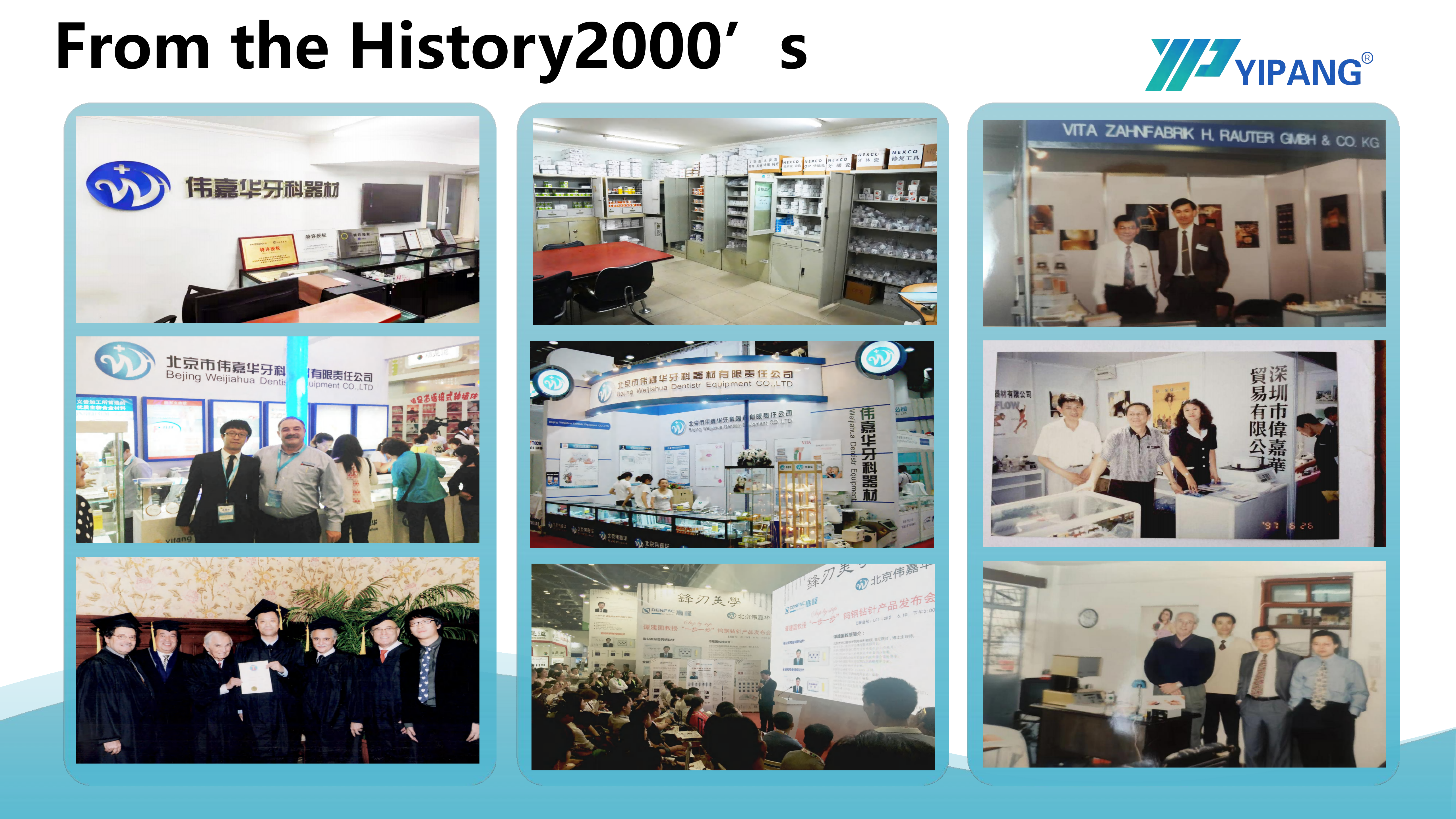
The YIPANG 4D-PRO-ML is a Dental Zirconia Disc / CAD/CAM Dental Milling Blank supplied under the YIPANG brand, a self-developed brand owned by Beijing Weijiahua Dentistry Equipment Co., Ltd. The company was established in 1996 and operates from a 2,000 m² facility with approximately 80 employees, of whom 25 are engineers engaged in dental material formula research, process optimization, and new product development.
Its published specification set is summarized below. These are the parameters a high-volume lab can build machine settings and sintering programs around.
| Attribute | 4D-PRO-ML Specification |
|---|---|
| Product type | Dental Zirconia Disc, CAD/CAM Dental Milling Blank |
| Material | Zirconium dioxide (ZrO₂) with yttria stabilized |
| Available shades | ML Multilayer |
| Diameter | 98 mm |
| Thickness options | 10 mm, 12 mm, 14 mm, 16 mm, 18 mm, 20 mm |
| Sintering temperature | 1450 °C |
| Bending strength | ≥1200 MPa |
| Translucency | Medium translucent |
| Intended applications | Full-contour crowns, bridges, veneers, and implant superstructure restorations |
The ML Multilayer designation is relevant to multi-unit bridge work because the disc carries a built-in shade gradient. When the gradient is designed into the blank, technicians spend less time layering and staining each unit, which matters most when a bridge covers several adjacent teeth in one piece. The 98 mm diameter supports the connector spans that multi-unit bridges require, and the six thickness options let a lab match blank to case mix rather than forcing every case through one disc size.
For high-volume environments, the combination of ≥1200 MPa bending strength and medium translucency positions the material for posterior bridge spans and implant superstructures, where mechanical reliability outweighs maximum light transmission. This is the same class of trade-off every zirconia buyer faces: the higher the translucency, the lower the strength, and vice versa.
Sintering Is Where Multi-Unit Bridges Are Won or Lost
In a high-volume milling center, the milling step is fast and largely deterministic. Sintering is where a multi-unit bridge either arrives within tolerance or does not. Every zirconia block's final geometry is a function of its shrinkage, and shrinkage is a function of the sintering profile actually delivered by the furnace.
How to determine the suitable sintering temperature for 4D-PRO-ML zirconia blocks
For the 4D-PRO-ML zirconia block, the recommended sintering temperature range is 1430 °C–1450 °C, with a final sintering temperature of 1450 °C. The suitable temperature is not a single chosen number; it is the point inside that range where the furnace delivers the intended heating and holding curve reliably, batch after batch. The purpose of staying inside that band is well-defined: it supports low shrinkage and stable translucency, which are precisely the properties that multi-unit bridges depend on.
The standard operating sequence is straightforward:
- Step 1. Place the milled zirconia workpiece on the sintering tray.
- Step 2. Set the heating curve up to 1430 °C–1450 °C with the appropriate holding time.
- Step 3. Cool down naturally after sintering is complete.
Two process constraints that govern the outcome:
• Avoid rapid temperature change, which can cause cracking in multi-unit bridge segments.
• Do not exceed the maximum sintering temperature of the block.
There is a practical reason to keep the temperature inside the recommended band rather than pushing toward the upper edge for "extra density." The block's mechanical and optical behaviour is defined by the curve the manufacturer validated. Exceeding the maximum risks over-sintering and grain growth, while cooling too quickly induces thermal stress in exactly the bridges that are hardest to remake. High-volume labs therefore gain more from furnace calibration discipline than from any single process experiment.
Matching the sintering schedule to the case, not the calendar
In a high-volume center, furnaces are often loaded with mixed cases for efficiency. Even then, the temperature range for the 4D-PRO-ML is respected as a hard boundary — the block does not adapt to whatever program happens to be running. If two different zirconia brands run in the same furnace, the schedule must satisfy the strictest constraint on the tray. That is one reason labs running multiple zirconia materials often standardize on one brand for high-volume bridge work.
Equipment Environment: Where the Block Meets the Machine
The scenario in which these blocks are used is defined by three conditions: an indoor constant-temperature dental laboratory environment; processing on a dental milling machine followed by sintering in a dental sintering furnace; and strict adherence to the standard sintering temperature curve. Under those conditions, block-to-equipment alignment matters more than any single material attribute.
Typical matched equipment for this application includes:
- Dental Milling Machine — 5-axis milling of full-contour crowns, bridges, veneers, and implant superstructures.
- Dental Sintering Furnace — delivering the 1430 °C–1450 °C curve within its validated tolerance.
- Dental Lab Scanner — capturing the model data that drives the CAD design feeding the mill.
Adjacent consumables in the same workflow — dental milling burs, dental polishing burs, dental staining glaze, dental glaze paste, dental firing paste, and, where relevant, a dental porcelain furnace for layered cases — round out the production context. A block that mills cleanly and sinters predictably interacts with all of these, but the block-and-furnace pair remains the critical one for multi-unit bridge accuracy.
Practically, high-volume labs should confirm that the block's shade range and disc dimensions are supported by their existing nesting templates before adding a new SKU, rather than re-engineering the CAM side to fit a new blank. The 98 mm format and six thickness options of the 4D-PRO-ML are designed to slot into existing CAD/CAM workflows rather than redefine them.
Quality Control, Batch Consistency, and Supply Continuity
Consistency — the property that actually decides whether a block fits a high-volume milling center — is largely produced before milling begins. Quality control reported for this product line includes 100% raw material inspection and finished product random inspection. For a lab producing multi-unit bridges, that combination matters because a single non-conforming disc reaching the furnace can cost an entire bridge, not just a single unit.
The published capability profile of the supplier includes OEM/ODM production, customization of almost all specifications, a monthly capacity of 15,000 pieces, 15–30 working days of lead time, and a negotiable small MOQ. Industrial customers frequently evaluate those numbers not as marketing claims but as scheduling inputs: how long does a reorder take, how much buffer stock does a lab need to carry to protect multi-unit bridge deadlines, and how easily can a specific shade or thickness be replenished.
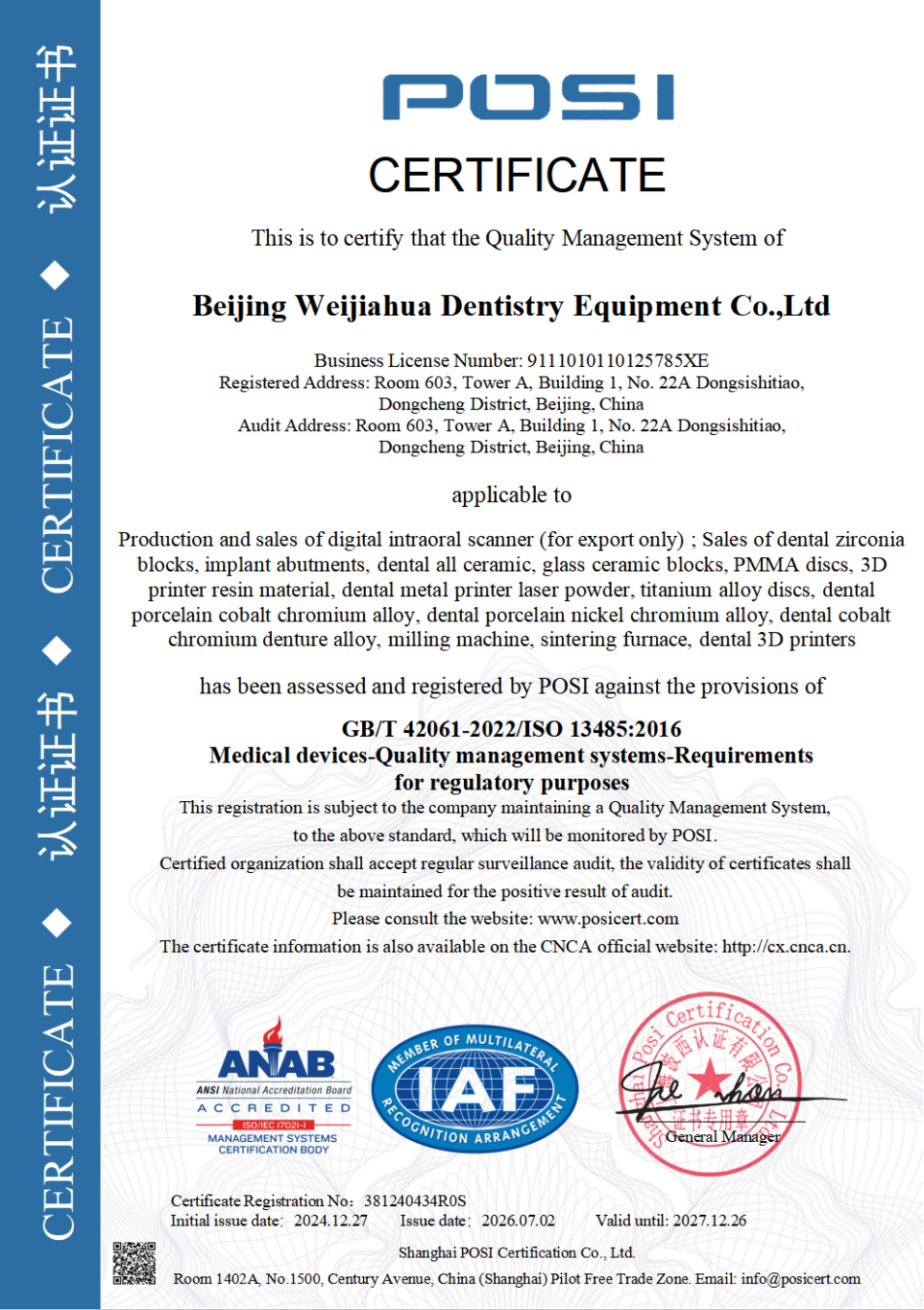
Compliance posture is part of that evaluation. The company holds ISO 13485 certification (certificate number 381240434R0S, issued by Shanghai POSI Certification Co., Ltd.) covering design, production and sales of dental medical materials and dental equipment, to the GB/T 42061-2022 / ISO 13485:2016 standard, with a validity period from 2024-12-27 to 2027-12-26. An EU Declaration of Conformity under MDR 2017/745 is registered with SRN CN-MF-000045919 for the intraoral scanner line (Model YP-X, YP-800, Class I medical device), which is a separate product scope from the zirconia block but reflects the same manufacturer's regulatory engagement.
Zirconia blocks for dental prosthetics are categorized as dental prosthetic materials rather than Class I devices under the current EU documentation on file. Labs should verify the applicable regulatory classification for their market before procurement, since classification determines the documentation the buyer is expected to keep.
The long-term cooperation record reported for this product includes hundreds of long-term cooperative clients worldwide, spanning dental laboratories, dental clinics, and distributors, with sustained cooperation across multiple years. Reported results emphasize material stability and aesthetic effect, and a low customer complaint rate. For high-volume centers, that record is more useful as evidence of continuity than as a performance claim: what it suggests is that the block's behaviour has been reproduced at scale over time, in labs whose own customers would notice inconsistency.
Market Trend: Why Zirconia and Milling Continue to Gain Ground
Independent market research supports the direction high-volume labs are already moving in. The global zirconia-based dental materials market was valued at USD 1.2 billion in 2025 and is projected to reach USD 2.3 billion by 2033, according to Grand View Research. Within that market, zirconia discs — the format used on 5-axis milling machines — held the largest revenue share at 63.1% in 2025.
The process data is more telling for milling centers. CAD/CAM milling accounted for 82.4% of zirconia dental manufacturing process revenue in 2025. That figure is consistent with what high-volume labs already experience: milling dominates not because it is the only way to shape zirconia, but because it is the most controllable way to reproduce it at scale.
On the demand side, dental labs remain the dominant end user for zirconia materials, accounting for 45.3% of market share in 2025 — a figure that underscores why block-side decisions are effectively lab-side decisions. Geographically, the U.S. accounts for roughly 40% of revenue in the global zirconia-based dental materials market, making it a benchmark market for how high-volume labs structure block portfolios. On the material specification side, 3Y-TZP zirconia held the largest grade share at 35.9% in 2025.
For comparison, the dental lithium disilicate market is projected to grow from USD 320 million in 2025 to USD 920 million by 2032, at a CAGR of 18.8% (forecast CAGR varies between sources, with figures ranging from approximately 15% to 24.5%). Lithium disilicate accounts for roughly 28% of all all-ceramic dental restorations globally as of 2024. Taken together — a lithium disilicate market roughly a quarter the size of the zirconia market, but growing quickly — the picture is coexistence rather than replacement: zirconia holds the volume and mechanical load, while lithium disilicate retains its position in high-aesthetic indications.
Comparison With Alternative Restorative Approaches
High-volume labs rarely choose a single restorative material for everything. The relevant comparison is between how zirconia and lithium disilicate behave under the specific conditions of multi-unit bridges and high-throughput milling.
| Factor | Zirconia (e.g., 4D-PRO-ML) | Lithium Disilicate |
|---|---|---|
| Production path | 5-axis milling of a disc, then sintering | Press ingots or millable blocks, then firing |
| Suited to multi-unit bridges | Published bending strength ≥1200 MPa supports long spans | Typically chosen for shorter spans and higher-aesthetic cases |
| Translucency | Medium translucent (ML Multilayer) | Generally higher aesthetic ceiling |
| Process risk at scale | Sintering curve and shrinkage must be tightly controlled | Press and firing behaviour must be tightly controlled |
The honest limitation of zirconia is worth stating plainly. Zirconia is not the most translucent restorative material available. For anterior veneers and highly aesthetic single units, where maximum light transmission is the priority and mechanical demand is low, lithium disilicate or a ceramic veneer may serve the case better than a zirconia block — even in a lab whose primary volume is zirconia bridges. Trying to force zirconia into every aesthetic indication does not produce better restorations; it produces cases that need rework.
The second limitation is process sensitivity. Zirconia's strength and fit depend on the sintering curve actually delivered. A furnace that drifts, a tray placed unevenly, or a rapid cooling cycle can effectively undo an otherwise well-milled bridge. Lithium disilicate trades some of that sintering sensitivity for a different set of variables in pressing and firing; neither route removes the need for process discipline.
Where zirconia's fit sharpens is at the intersection of mechanical load and volume. Multi-unit posterior bridges, implant superstructures, and cases where connector strength matters more than maximum translucency are the scenarios where the block's mechanical profile matters most, and where direct comparison favouring higher-translucency materials becomes less relevant.
Future Outlook for High-Volume 5-Axis Milling
Dental 3D printing is expanding quickly: the market is estimated to grow from USD 4.9 billion in 2025 to USD 26.7 billion by 2033, with photopolymer resins holding a 55.5% share of the dental 3D printing material segment in 2025. This matters to zirconia but does not replace it. 3D printing currently dominates models, guides, and temporary prosthetics rather than definitively replacing milled-and-sintered zirconia for posterior multi-unit bridges and implant superstructures. In practice, high-volume labs are adding 3D printing alongside milling, not instead of it.
At the same time, adjacent material categories continue to develop — PEEK dental implants, for example, were valued at USD 1,055 million in 2025 and forecast to grow at roughly 8% CAGR through 2034 — and the final abutment market alone was valued at nearly USD 2.6 billion in 2025. These figures reflect a prosthetic ecosystem becoming broader, not one dominated by a single material. For high-volume labs, the strategic implication is straightforward: portfolio breadth, not single-brand dependency, is what protects against supply interruptions and case-mix shifts.
The realistic near-term trajectory for 5-axis milling centers is therefore a mixed-material model in which zirconia carries the load-bearing multi-unit work, lithium disilicate covers high-aesthetic indications, and 3D printing handles models, guides, and temporaries. Within that model, the value of a zirconia block is decided by how cleanly it enters an existing process — not by any single headline number.
Frequently Asked Questions
Q1. What should a lab compare when evaluating zirconia blocks for high-volume 5-axis milling?
The comparison should focus on repeatability rather than peak properties. The most relevant criteria are shrinkage predictability, batch-to-batch translucency consistency, mechanical strength in relation to the intended case mix, disc dimension and thickness options, and how cleanly the block integrates with the lab's existing scanner-to-mill software chain. Because high-volume centers produce multi-unit bridges and implant superstructures alongside single units, a block that performs unusually well on a single sample but varies across batches is less useful than one that behaves consistently at scale. The 4D-PRO-ML, as an example, publishes a bending strength of ≥1200 MPa, medium translucency in ML Multilayer, a 98 mm diameter, and six thickness options from 10 mm to 20 mm.
Q2. What is the suitable sintering temperature for the 4D-PRO-ML zirconia block, and why does it matter for multi-unit bridges?
The recommended sintering temperature range for the 4D-PRO-ML is 1430 °C–1450 °C. The suitable temperature is the one inside that band at which the furnace reliably delivers the intended heating and holding curve. Following a standard heating and holding procedure supports low shrinkage and stable translucency, which are the properties that keep multi-unit bridge segments fitting together after sintering. Two constraints apply: avoid rapid temperature change, which can cause cracking, and do not exceed the maximum sintering temperature. The standard sequence is to place the milled workpiece on the sintering tray, set the heating curve up to 1430 °C–1450 °C with the appropriate holding time, and cool down naturally after sintering.
Q3. Can zirconia blocks reliably support multi-unit bridges in high-volume production?
Yes, when the block's mechanical profile and shrinkage behaviour are matched to the case. A bending strength of ≥1200 MPa in the 4D-PRO-ML provides the connector strength that multi-unit posterior bridges and implant superstructures require, and the 98 mm diameter supports the connector spans needed for bridge work. The limitation to keep in view is that zirconia is not the most translucent restorative material. High-aesthetic anterior veneers may be better served by lithium disilicate or a ceramic veneer even in a predominantly zirconia lab. Zirconia's advantage concentrates in load-bearing restorations where fit and strength matter more than maximum light transmission.
Q4. What should a high-volume lab verify about a zirconia block supplier before committing to ongoing orders?
The verification should cover quality control, capacity, lead time, and compliance. For this product line, reported quality control includes 100% raw material inspection and finished product random inspection. Reported capability includes OEM/ODM production, customization of almost all specifications, a monthly capacity of 15,000 pieces, 15–30 working days of lead time, and a negotiable small MOQ. On compliance, ISO 13485 certification (certificate 381240434R0S, Shanghai POSI Certification Co., Ltd., valid 2024-12-27 to 2027-12-26) covers design, production and sales of dental medical materials and dental equipment. Buyers should also confirm the regulatory classification that applies to zirconia blocks in their specific market, since documentation expectations differ by region.
Q5. How does the block specification interact with the rest of the dental lab equipment environment?
The block is one node in a chain that typically includes a dental lab scanner, a dental milling machine, and a dental sintering furnace, operating in an indoor constant-temperature lab environment. The most critical pairing for multi-unit bridge accuracy is the block-and-furnace combination, because the sintering curve determines final geometry. Adjacent consumables — dental milling burs, dental polishing burs, dental staining glaze, dental glaze paste, dental firing paste, and where relevant a dental porcelain furnace — interact with the workflow around the block but do not change the fundamental requirement that the block and the furnace agree on the validated sintering curve. A 98 mm disc format with 10 mm to 20 mm thickness options is intended to fit existing CAD/CAM nesting strategies rather than require new ones.
Additional company information, including product scope and background, is available in the WJH company brochure.