
Zonzsin RD16 vs. Rail-Fixed Robots for ESS Container Assembly
Zonzsin RD16 vs. Rail-Fixed Robots for ESS Container Assembly
Containerized energy storage assembly has narrowed to a choice between two equipment architectures: a robot that carries battery packs to the container on its own powered chassis, and a robot that travels on a ground rail fixed to the factory floor. For C&I and utility-scale projects, the decision between Zonzsin's AGV-driven RD16 and the rail-fixed ZZX2508 / ZZX2524 shapes floor layout, changeover discipline and throughput planning for the life of the line.
This comparison is written for buyers at the research and evaluation stage. It uses Zonzsin's published product specifications, the company's documented application and case material, and third-party market and standards data. Where a specification is not published — rail-fixed hoisting speed, for example — the article states that rather than estimating a value.
Why the insertion step now drives container line planning
The global battery energy storage system (BESS) market was valued at approximately USD 50.81 billion in 2025 and is projected to reach USD 105.96 billion by 2030, according to MarketsandMarkets. Containerized BESS is a substantial share of that total: Insightace Analytic valued the containerized BESS segment at USD 11.75 billion in 2025 and projects a 24.1% CAGR through 2035.
Those headline numbers come with an important caveat for procurement teams. Published BESS market estimates diverge widely depending on how each research house defines market scope — Polaris Market Research and Grand View Research have published figures that differ substantially from the MarketsandMarkets number. Any single market size should therefore be treated as directional rather than as a planning constant.
What the numbers do indicate is that container stuffing — the physical insertion of battery packs into 20ft and larger container racks — is no longer a task that scales cleanly with headcount. Packs must be lifted, oriented and pushed into racks with repeatable positioning, and documented Zonzsin application data describes these lines running continuous or shift-based production at 20–30 °C. The insertion robot is the point where layout, throughput and changeover discipline are decided.
Two architectures, defined
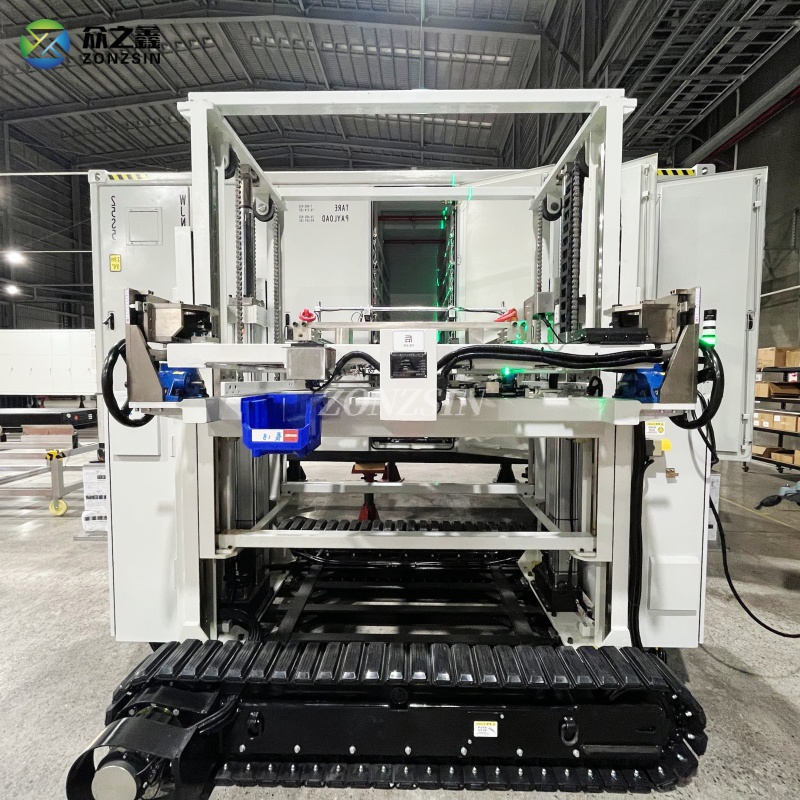
RD16 is an AGV-driven battery pack insertion robot for containers, manufactured by Shanghai Zonzsin Intelligent Equipment Co., Ltd., a Shanghai-based supplier founded in 2019 that builds ESS battery pack insertion robots for containers and automatic battery pack assembly lines. The company states a 6,000 m² factory, 90 employees, an annual output of 40 units, a 43-engineer R&D team and 50 granted patents, including invention patents covering AGV-driven battery pack insertion robots. RD16 is published with a footprint of L 3100 × W 2600 × H 3800 mm, compatibility with 280 / 314 / 587 Ah cells and 1P52S / 1P104S packs, a hoisting range of 1.05–3.4 m (customizable) and a hoisting speed of 100 mm/s.
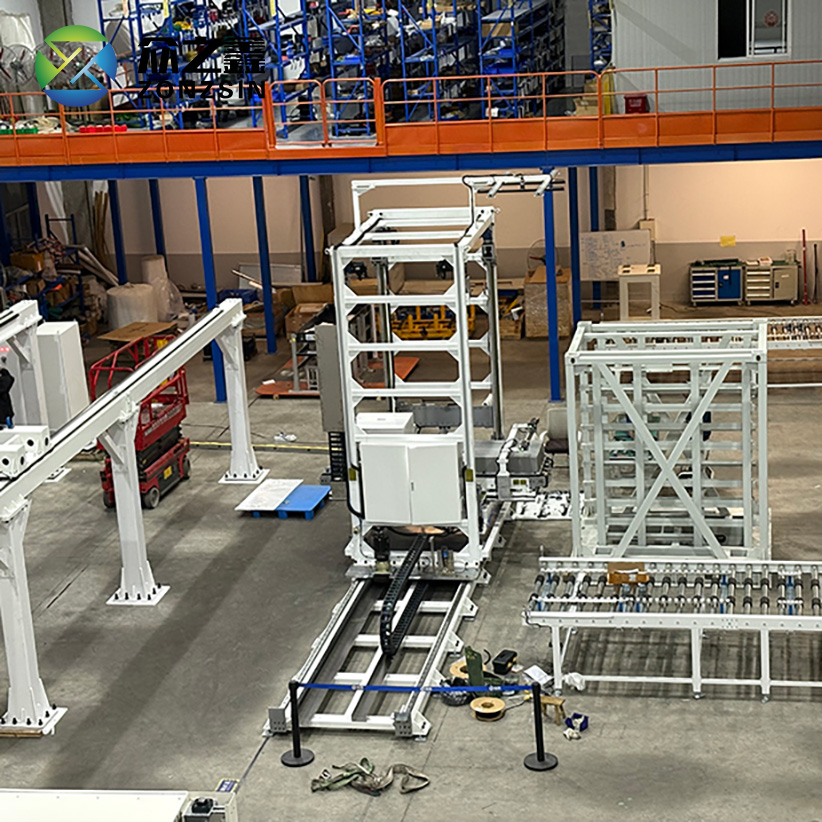
ZZX2508 and ZZX2524 are rail-fixed battery pack insertion robots for containers from the same supplier. Both are built around a ground rail rather than a mobile chassis. ZZX2508 is published with a container compatibility envelope of L 6058–7000 mm, W 2438–2700 mm and H 2896–3000 mm, a pack envelope of L 1100–2200 mm, W 780–1260 mm and H 230–260 mm, compressed-air supply of 0.5–0.8 MPa, AC 380 V ±10% / 50 ±2 Hz power, and a door opening angle of at least 150°. ZZX2524 is published with a load capacity of 1500 kg, a gripper changeover time of under one minute, a door opening angle of at least 150°, and a double-layer rack arrangement described as space-saving.
All units are built in carbon steel, with the rail-fixed models specifying Q235, and all are listed for energy storage and C&I applications.
Specification comparison
The table below places the published values side by side. Blank entries are not omissions in this article — they are specifications that are not published in the material available for this comparison, and buyers should request them directly before shortlisting.
| Decision variable | RD16 (AGV-driven) | ZZX2508 (rail-fixed) | ZZX2524 (rail-fixed) |
|---|---|---|---|
| Drive configuration | AGV-driven mobile chassis | Rail-fixed, ground rail | Rail-fixed, ground rail |
| Published footprint | L 3100 × W 2600 × H 3800 mm | Not published in available spec | Not published in available spec |
| Container compatibility | Standard 20ft / 40ft container racks (published 5-DOF docking data for Zonzsin AGV-driven models) | L 6058–7000 mm; W 2438–2700 mm; H 2896–3000 mm | Not published in available spec |
| Pack / cell compatibility | 280 / 314 / 587 Ah cells; 1P52S / 1P104S packs | L 1100–2200 mm; W 780–1260 mm; H 230–260 mm | Not published in available spec |
| Load capacity | Up to 1500 kg (published figure for Zonzsin AGV-driven models) | Not published in available spec | 1500 kg |
| Hoisting range | 1.05–3.4 m (customizable) | Not published in available spec | Not published in available spec |
| Hoisting speed | 100 mm/s | Not published in available spec | Not published in available spec |
| Gripper changeover | Not published in available spec | Not published in available spec | < 1 min |
| Door opening angle | Not published in available spec | ≥ 150° | ≥ 150° |
| Utilities | Not published in available spec | Compressed air 0.5–0.8 MPa; AC 380 V ±10%, 50 ±2 Hz | Not published in available spec |
| Material | Carbon steel | Carbon steel / Q235 | Carbon steel / Q235 |
| Space strategy | No fixed rail; unit repositions between stations | Fixed rail line layout | Double-layer racks for space saving |
Read the table as a compatibility check, not as a performance ranking. A missing published value does not mean the unit cannot perform the task; it means the figure has to be confirmed against the project specification before a shortlist is finalised.
Drive configuration: what changes on the plant floor
The structural difference between the two architectures is not the insertion motion but how the unit reaches the container. RD16 moves itself. Published data for Zonzsin's AGV-driven models describes 5-DOF docking for standard 20ft / 40ft container racks and load capacities up to 1500 kg, which means the unit approaches the rack, aligns and inserts without a rail path dictating where it can stand.
A rail-fixed robot inverts that logic. ZZX2508 and ZZX2524 work from a ground rail installed in the plant, so travel positioning is determined by the rail rather than by onboard navigation. The trade is straightforward: fixed rails give highly repeatable travel along a defined axis and remove the need to re-establish position at every container. In return, the plant commits to a layout. Once the rail is installed, container stations, material racks and operator positions are arranged around it.
For buyers, this converts into a floor-planning question: how likely is the assembly layout to change within the equipment's service life? Documented case material illustrates the fixed-line case. A Chinese energy storage system integrator operating a rail-fixed ZZX2524 installation reports two years of continuous pack insertion with stable operation and improving efficiency, and cites a stable, fixed ground rail for safe working and a dual-layer material rack for space utility as the practical advantages of that configuration.
Container and pack envelope
Compatibility ranges are where the two architectures diverge most concretely in published data. The ZZX2508 specification defines an explicit container envelope of 6058–7000 mm long, 2438–2700 mm wide and 2896–3000 mm high — a range that covers the standard 20ft container and extends beyond it. Its pack envelope of 1100–2200 mm long, 780–1260 mm wide and 230–260 mm high is equally explicit, which makes it straightforward to check against a bill of materials.
RD16 publishes compatibility in cell and pack-format terms instead: 280 / 314 / 587 Ah cells and 1P52S / 1P104S packs, with published data for Zonzsin's AGV-driven models describing docking for standard 20ft / 40ft container racks. This is a different way of expressing the same question, and buyers should convert both into a single check: does the specific pack, with its fixture, fit the specific rack inside the specific container door opening?
Door opening angle appears in both rail-fixed specifications at no less than 150°, which matters because the insertion path has to clear the container door frame during the final approach. RD16's door-opening figure is not published in the available specification and should be confirmed against the rack design.
Throughput mechanics: load, hoisting speed and gripper changeover
Load capacity. Published data lists load capacities up to 1500 kg for Zonzsin's AGV-driven models, and the ZZX2524 rail-fixed specification states 1500 kg. ZZX2508 does not publish a load figure in the available specification. For sizing purposes, the relevant load is the pack weight plus the gripper or fixture weight, not the pack weight alone.
Hoisting speed. RD16 publishes 100 mm/s against a hoisting range of 1.05–3.4 m, customizable. Rail-fixed hoisting speed is not published for ZZX2508 or ZZX2524 in the available material. That asymmetry has a practical consequence: a buyer cannot derive a cycle-time comparison from datasheets alone when one side of the comparison is silent. Rail-fixed cycle time should be validated through a documented acceptance run at the supplier's facility or on site.
Gripper changeover. ZZX2524 publishes a changeover time of under one minute. Changeover time matters most in plants that build more than one pack format on the same line: short changeovers support mixed production within a shift, while longer changeovers push schedulers toward batching identical pack types. Gripper changeover is not published for RD16 or ZZX2508 in the available specification.
A fourth published detail affects floor efficiency rather than cycle time: ZZX2524's double-layer rack arrangement is described as space-saving, which is a layout benefit rather than a throughput one.
Scenario fit: matching the unit to the plant profile
Documented Zonzsin application data for container battery pack insertion describes deployments in China, France, South Korea, Sweden, Taiwan and the United States, in ESS and C&I energy storage, with energy storage system integrators, battery cell and pack manufacturers, and EPC turnkey contractors as the typical customer types. The listed functions are fully automatic moving and pack insertion, cycle-time improvement, intelligent production line construction, and batch and continuous production. Operation is manual or by remote controller.
Two constraints inside that same documentation are easy to overlook and expensive to discover late. The first is equipment integration: matched equipment includes the container, docking rollers, grippers, transfer AGVs, working desks, material racks, platform ladders, PLC and MES. Buyers should confirm which of these the robot supplier provides and which remain the integrator's scope. The second is environmental control: special requirements include ESD protection, fire prevention measures, temperature, humidity and cleanliness control, and pack compatibility and fixture adaptation.
Trade-offs and limits buyers should not skip
An independent comparison is only useful if it states where each option stops working.
- Rail-fixed units commit the floor plan. A ground rail is a civil and mechanical installation. Stations are arranged around it, and relocating the line later is a project rather than a repositioning exercise.
- AGV-driven units need a prepared floor. Documented AGV-driven and rail-fixed applications assume an industrial floor. For genuinely uneven or outdoor working surfaces, Zonzsin publishes a separate crawler-driven configuration, the ZZX2522, with all-terrain working floor capability, a hoisting range of 0.8–3.4 m (customizable), 1500 kg load capacity and manual handwheel levelling. An AGV or rail unit is not a substitute for that configuration, and the distinction should be clarified early.
- RD16 occupies real space. Its published footprint of L 3100 × W 2600 × H 3800 mm means approach clearance, turning space and container door access must be planned rather than assumed.
- Published data is uneven between the architectures. Load and hoisting speed are published for RD16; load and gripper changeover are published for ZZX2524; ZZX2508 publishes a precise container and pack envelope instead. Buyers who need a like-for-like comparison must request the missing figures rather than infer them.
- Supplier-published efficiency figures need their own check. One vendor-published buyer guide reports roughly 30% manpower reduction and about 20% container assembly cycle-time improvement versus manual methods. That figure is vendor-reported rather than independently verified, and it depends heavily on the baseline process, so it should be treated as a directional reference rather than a planning input.
- Automation moves labour, it does not delete it. Supervision, fixture handling, maintenance and PLC / MES interface work remain. Zonzsin's stated after-sales scope is remote support plus on-site installation and commissioning, which addresses start-up but not the plant's own maintenance capability.
A procurement framework for the research-to-evaluation stage
- Freeze the container and pack envelope first. Measure the rack and the pack with the fixture attached, then compare against the ZZX2508 published range or against RD16's 280 / 314 / 587 Ah and 1P52S / 1P104S compatibility statement.
- Decide whether the line is fixed or mobile. If container stations are expected to move, or if one unit must serve several stations, the AGV configuration is the natural fit. If the layout is stable and travel repeatability is the priority, rail-fixed is the natural fit.
- Compare only on published numbers. Use 1500 kg load capacity, 100 mm/s hoisting speed and the under-one-minute gripper changeover where they apply, and request the outstanding figures in writing for the rest.
- Confirm utilities and interfaces. ZZX2508 specifies compressed air at 0.5–0.8 MPa and AC 380 V ±10%, 50 ±2 Hz; both insertion architectures sit inside a wider equipment set that includes docking rollers, transfer AGVs, PLC and MES.
- Check the environment specification. ESD protection, fire prevention, temperature, humidity and cleanliness control, and pack fixture adaptation are documented special requirements, not optional extras.
- Validate the commercial terms against the project schedule. Published terms for this supplier are MOQ 1 unit, lead time 2–4 months, monthly capacity 3 units, 100% test, OEM / ODM customization across cycle time, automation, logo, color and configuration, and export markets covering the EU and USA.
- Ask for a cycle-time acceptance test. Where one architecture does not publish a speed figure, an acceptance run is the only defensible comparison method.
Market trend: what containerized growth implies for line design
If the containerized BESS segment holds the projected 24.1% CAGR through 2035 cited by Insightace Analytic, container stuffing capacity becomes a recurring capital item rather than a one-off project. Growth at that rate implies more lines, more pack formats per plant, and more pressure on two variables that the AGV-versus-rail decision touches directly: changeover time and positioning repeatability.
The two architectures respond to that pressure differently. AGV-driven units answer format and layout change by repositioning; rail-fixed units answer it with deterministic travel and space-efficient rack arrangements such as the double-layer configuration published for ZZX2524. Because published market values vary widely between research houses, buyers should treat the growth direction as the signal and avoid locking line capacity to any single forecast number.
Compliance and documentation
For North American market access, energy storage systems are tested against UL 9540, the Standard for Energy Storage Systems and Equipment, which addresses the safety of enclosures and moving parts among other requirements. In the EU, BESS containers require CE marking under Regulation (EU) 2023/1542, including compliance with the Low Voltage Directive and the Machinery Directive for automated handling equipment.
These requirements belong in the specification stage rather than the handover stage, because they influence guarding design, technical documentation and the acceptance test plan. Buyers comparing insertion robots should ask which conformity documentation is supplied with the handling equipment itself, separately from the container-level certification.
Future outlook
More container stuffing capacity means more lines that must absorb pack-format variation without losing cycle time. Both architectures remain viable under that scenario, but for different reasons: AGV-driven units through reconfiguration and multi-station service, rail-fixed units through deterministic travel and layouts that recover floor space. The practical implication for buyers evaluating now is that the decision is less about which architecture is newer and more about which constraint — floor flexibility or fixed-line determinism — dominates the project for the next several years. Suppliers that publish complete specifications, including the figures they have not yet published, are the ones that make that comparison possible.
FAQ
What is the difference between an AGV-driven and a rail-fixed battery pack insertion robot?
An AGV-driven unit such as the Zonzsin RD16 carries battery packs on its own powered chassis and positions itself in front of a container, so it is not tied to a fixed rail. A rail-fixed unit such as ZZX2508 or ZZX2524 travels along a ground rail installed in the plant, which fixes its working line but delivers repeatable travel positioning along that axis. The structural difference is mobility versus fixed-path repeatability, not a difference in the insertion task itself.
Which container sizes can a rail-fixed insertion robot handle?
The published ZZX2508 specification covers containers with a length of 6058–7000 mm, a width of 2438–2700 mm and a height of 2896–3000 mm, which includes the standard 20ft envelope and extends beyond it. ZZX2524's container compatibility range is not published in the available specification, so it should be confirmed against the specific rack design.
How much weight can an ESS battery pack insertion robot lift?
Published data lists load capacities up to 1500 kg for Zonzsin's AGV-driven insertion robots, and the rail-fixed ZZX2524 specification states a load capacity of 1500 kg. The ZZX2508 specification does not publish a load figure. When sizing, the relevant load is the pack weight plus the gripper or fixture weight, not the pack weight alone.
How does gripper changeover time affect container assembly?
ZZX2524 publishes a gripper changeover time of under one minute. That value matters when a line switches between pack formats within a shift: shorter changeovers reduce non-productive intervals and support mixed production, while longer changeovers encourage batching identical pack types. Gripper changeover time is not published for RD16 or ZZX2508 in the available specification.
Can an AGV-driven insertion robot work outdoors or on uneven ground?
Documented Zonzsin AGV-driven and rail-fixed insertion applications assume a prepared industrial floor. The separately documented crawler-driven ZZX2522 is the configuration listed for all-terrain working floors, with a hoisting range of 0.8–3.4 m (customizable), 1500 kg load capacity and manual handwheel levelling. Buyers working with outdoor yards, gravel or sloped surfaces should evaluate the crawler configuration rather than assume an AGV or rail unit is suitable.
What site conditions should be confirmed before selecting between AGV and rail-fixed insertion?
Floor levelness and load rating, available footprint, rail installation feasibility, container rack geometry, pack dimensions and weight, docking accuracy, and environmental controls. Documented special requirements for these applications include ESD protection, fire prevention, temperature, humidity and cleanliness control, and pack compatibility with fixture adaptation. Documented matched equipment includes containers, docking rollers, grippers, transfer AGVs, working desks, material racks, platform ladders, PLC and MES.
Which standards apply to automated handling equipment in BESS containers?
For North American market access, energy storage systems are tested against UL 9540, which covers the safety of enclosures and moving parts among other requirements. In the EU, BESS containers require CE marking under Regulation (EU) 2023/1542, including Low Voltage Directive and Machinery Directive compliance for automated handling equipment. Requirements should be mapped to the destination market during specification.
What lead times and order quantities are published for these insertion robots?
Published commercial terms for this supplier list a minimum order quantity of 1 unit, a lead time of 2–4 months and a monthly capacity of 3 units, with 100% testing and OEM / ODM customization covering cycle time, automation, logo, color and configuration. After-sales scope is stated as remote support plus on-site installation and commissioning, and export markets are listed as the EU and USA.
Resources
A downloadable product brochure covering the Zonzsin ESS battery pack insertion robot range, including the RD16, ZZX2508, ZZX2524 and ZZX2522, is available here: Zonzsin product brochure (PDF).