
pH-Responsive Blue Butterfly Pea Flower Powder in Cosmetics
pH-Responsive Blue Butterfly Pea Flower Powder in Cosmetics
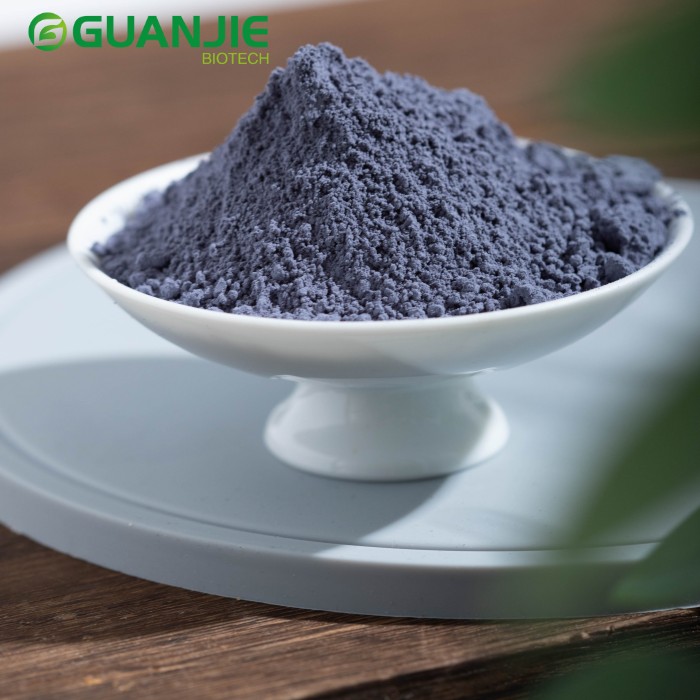
Blue butterfly pea flower powder is a water-soluble botanical colorant whose anthocyanins move from blue toward purple as pH rises — and that single property decides most of its cosmetic fit. A formula that can hold a defined pH in an aqueous phase can carry it. An anhydrous balm, an emulsion with drifting pH, or a process that holds heat for hours needs a different answer. This analysis maps the fit question for buyers at research and evaluation stage, keeps the supplied specification separate from what must be proven in the buyer's own base, and states the boundaries that a neutral reference should state.
Blue is scarce among water-soluble botanicals, and that shapes the decision
Blue is one of the least common colors among water-soluble plant colorants. That scarcity is why formulators looking for a blue that is not a synthetic dye tend to test a short list of botanical sources, and why Clitoria ternatea — butterfly pea — appears on that list repeatedly. The attraction is simple: the flower carries anthocyanins that read blue in a plain aqueous system, and the dried powder is a single declared ingredient rather than a formulated colorant blend.
The trade-off is equally simple. A botanical colorant is a variable raw material. Its visible color depends on the matrix it sits in, the pH of that matrix, the water available to dissolve it, and the temperature history of the process. That does not make it unusable in cosmetics. It makes it a fit decision rather than a drop-in substitution. The practical question for a buyer is not "is this natural?" but "will this powder deliver a repeatable color in my base, at my pH, through my process, for the shelf life I intend to claim?"
What the supplied specification establishes — and what it leaves to testing
The product data provided for this grade is short, and almost every line answers a different part of the fit question. Reading the specification as a list of claims understates it; read as a formulation profile, it sets the boundaries of where the powder can reasonably be screened.
| Specified item | Supplied detail | What it means for a cosmetic formula |
|---|---|---|
| Botanical source | Butterfly pea (Clitoria ternatea), described as organically cultivated | Fixes the pigment family (anthocyanins) and the identity a buyer must match against label and marketing language. |
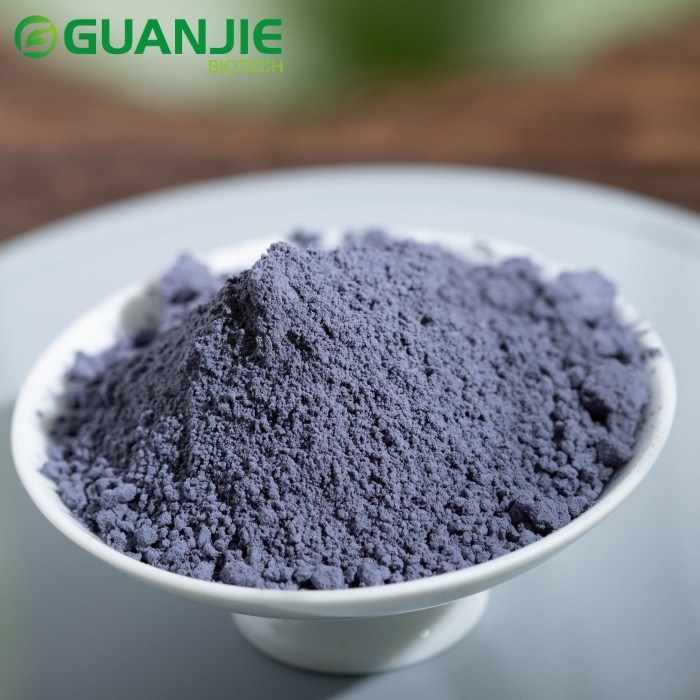
| Appearance | Gray-blue powder | The dry powder is not the finished shade. Color develops when the pigment is hydrated, so bench appearance must not be read as the in-product result. |
| Processing route | Hot-air drying technology | Indicates a drying-based, non-solvent route. Buyers should still confirm the declared process on the technical sheet before writing process claims. |
| Particle size | 100.0% pass 80 mesh | All material passes an 80-mesh sieve — nominal openings of roughly 177 micrometres under common sieve conventions. Relevant to dispersion and visible specking, not to color strength. |
| Additive status | 100% natural without additives | No carrier, diluent or standardizing colorant is declared. Color strength therefore depends on the flower lot, not on a formulated blend. |
| Color behavior | Water-soluble; blue-to-purple pH color shifts | Directs the powder to aqueous phases and makes pH control a formulation requirement, not a preference. |
| Declared applications | Dietary supplement, health food, beverage, cosmetics | Cosmetics is a declared application area; market-specific colorant status must still be confirmed by the brand. |
| Certification scope | ISO, Halal, Kosher (supplier-stated) | Supports qualification file structure. Certificates should be requested with scope, issuing body and validity period. |
Table 1. Supplied specification for blue butterfly pea flower powder, read as a formulation profile.
Two gaps are worth naming, because buyers often assume they are covered. The supplied data describes appearance and mesh but does not state a color value, such as an absorbance-based strength or a colour-index equivalent. Where a brand needs a fixed color strength for scale-up, that parameter has to be requested or established by in-house trial. Second, the description "gray-blue powder" tells a formulator what arrives in the drum, not what the consumer will see. The blue-to-purple behavior described by the supplier refers to the pigment once it is in solution, which is why the bench test — powder into the actual base — is the only reliable preview.
Water solubility decides where the powder can physically go
Because the pigment is water-soluble, it partitions into the aqueous phase of whatever it is added to. In an oil-in-water lotion or cream that means the continuous water phase, and the visible color of the finished product mostly reflects that phase. In a water-in-oil system or an anhydrous balm there may be little or no water available at all, and undissolved powder stays particulate — visible as specks or uneven tone rather than an even tint.
The practical consequence is a change in how the ingredient is charged to the batch. A water-soluble colorant is normally pre-dissolved in a portion of the aqueous phase, checked for clarity, and added as a solution rather than as dry powder dusted into the main vessel. That single habit addresses the most common cosmetic complaints about botanical colorants: uneven dispersion, specking in gels, and color that appears to fade after filtration. Whether the pre-dissolved solution needs filtration, and how much, depends on the base and should be settled during the pilot.
Water solubility also sets an expectation about what the powder cannot do. It is not a route to coloring the oil phase, and it is not a pigment dispersion that will sit stably on skin as a color layer. In decorative formats, that distinction matters more than any label claim.
The pH response, explained as formulation mechanics rather than a feature
Anthocyanins are pH-sensitive pigments. The supplier describes a blue-to-purple shift for this powder, and that description is consistent with the anthocyanin family's behavior: the visible hue changes as the acid–base environment of the solution changes. For a formulator, the consequence is procedural. A single reference shade is not enough information; what is needed is a measured hue-versus-pH curve generated in the actual base, at the actual use level.
Several routine formulation factors can move that curve and should be treated as trial variables rather than assumptions: the buffer system and target pH window, the presence of chelating agents, the electrolyte load, the preservative system, and any ingredient that itself shifts pH over shelf life. A gel buffered at one pH and a cleanser buffered at another are, in effect, two different color projects using the same powder.
Heat deserves its own trial. The supplier describes the pigment as delivering heat-stable performance, but anthocyanins in general are sensitive to prolonged thermal exposure, and a cosmetic process can differ substantially from a beverage process in hold time and temperature. The honest position for a buyer is to treat heat stability as a claim to verify under their own process conditions, not as a property transferred with the raw material.
Anthocyanins: a composition statement, not an efficacy claim
The powder is described as rich in antioxidant anthocyanins. In a cosmetic context, that is a composition descriptor about what the ingredient contains, and it should be kept distinct from any statement about what a finished product does to skin. This analysis makes no efficacy claim: it does not assert that a butterfly pea-colored gel reduces oxidative stress, brightens, soothes or protects. Those statements belong to the brand and require their own substantiation in each market.
What the composition does affect is documentation. If a brand intends to reference anthocyanin content on pack, it needs a declared basis — measured content, method, and the lot-level value the claim is built on. The supplied specification does not state an anthocyanin assay, so the claim and the test have to be aligned before the label is written, not after.
Five cosmetic scenarios worth screening first
Scenario fit is where this grade either earns a place in the development plan or does not. The screens below are conditional applications derived from the supplied specification and declared application areas, not reports of completed customer projects.
1. Aqueous gels, toners and serums
This is the cleanest fit. A transparent aqueous system with a controlled pH lets the pigment show its blue directly, and a pre-dissolved addition step keeps the gel free of specks. The points to verify are compatibility with the gelling agent, whether the chosen preservative system shifts pH over time, and whether clarity survives the use level needed to reach the target depth of color.
2. Rinse-off cleansers and masks
Short contact time and a higher product volume per use make rinse-off formats a forgiving place to learn how the pigment behaves. Verify foaming and lather appearance, color bleed onto skin and textiles during use, and whether the surfactant base shifts pH away from the intended window between production and shelf life.
3. Oil-in-water lotions and creams
In an emulsion the pigment colors the water phase; the visual result is an interaction between that phase and the opacity of the oil phase and any whitening particles. Two lotions with the same pigment level can read as different colors. Verify phase-appropriate addition, evenness across the batch, and stability at accelerated conditions before a claim about shade is committed.
4. Formats where the pH shift is the feature
A product that changes from blue toward purple on application uses the pH response deliberately. It requires tighter control than a single-shade product, because the trigger has to be reproducible: the starting pH, the pH of the medium that activates the shift, and the time to visible change all become specifications. This is a legitimate cosmetic use of the ingredient, but it is a formulation project rather than an ingredient substitution.
5. Nutricosmetic and ingestible beauty formats
The same powder is declared for dietary supplements and beverages, and the application material for this ingredient family lists nutricosmetics and personal care as a segment. A crossover product must satisfy food or supplement requirements in the destination market in addition to cosmetic ones, and the colorant status question applies separately to each side of the product. Cross-category convenience should not be mistaken for cross-category compliance.
How it compares with other colorant approaches
Category-level comparison is useful here only if the limits are stated with it. The table below compares documented behavior of three colorant approaches as formulation categories; it is not a ranking, and it makes no claim about safety, regulatory status or performance superiority. Those questions are answered by the destination market's rules and by the buyer's own testing.
| Consideration | Water-soluble anthocyanin botanical (as specified) | pH-stable synthetic water-soluble colorant | Oil-soluble pigment dispersion |
|---|---|---|---|
| Phase placement | Aqueous phase; must be dissolved | Aqueous phase | Oil phase; requires dispersion |
| Hue predictability | Depends on pH and matrix; needs a measured curve | Engineered to hold hue across a defined pH range | Largely independent of water-phase pH |
| Label positioning | Declared as a single botanical ingredient with no additives | Declared under its own colorant name and index | Declared under pigment or dispersion name |
| Batch-to-batch variation | Expected from a botanical lot; needs specification and sampling | Typically standardized to a color value | Typically standardized to a pigment content |
| Main formulation risk | pH drift, heat exposure, uneven dissolution | Fit with the intended clean-label positioning | Migration and uneven dispersion in emulsions |
| Regulatory status | Must be confirmed per market as a colorant use | Must be confirmed per market; often listed | Must be confirmed per market; often listed |
Table 2. Category-level comparison of documented colorant behavior. Not a ranking or a safety comparison.
Where this grade is a poor fit
Naming the boundaries is part of an honest reference, and several are structural rather than fixable.
- Anhydrous and oil-only systems. Without a water phase there is nothing for a water-soluble pigment to dissolve into, so an even tint cannot be assumed.
- Formats that must match a fixed color value. A colorant supplied without a stated color strength cannot be dosed to a dye equivalent without in-house standardization work.
- Products with large pH movement over shelf life. If the base drifts, the hue drifts with it, and a shade claim becomes a stability risk.
- Long or hot process steps without validation. The supplier's heat-stability description should be tested against the actual hold time and temperature before it is relied on.
- Markets where the ingredient is not permitted as a colorant. No supplier document can resolve this; the brand must confirm the permitted-use position with the applicable authority.
What to request before committing a pilot batch
A short, specific document request filters most of the risk earlier than a trial does. The list below reflects what the supplied evidence supports; the quantities and lead times are supplier-stated and should be reconfirmed at quotation.
- A current Certificate of Analysis for the specific lot offered, matched line by line against the specification: appearance, 80-mesh pass rate, additive-free status.
- A technical data sheet confirming the drying route and stating whether any color-strength or anthocyanin-content parameter can be provided.
- Written declarations supporting the non-GMO and organically cultivated source descriptions, with the issuing body named.
- ISO, Halal and Kosher certificates with scope, issuing body and validity dates — not just certificate titles.
- A sample sufficient for a matrix trial at more than one pH, plus a second lot if the project timeline allows, to see lot-to-lot color behavior directly.
- Commercial terms: minimum order quantity from 1 kg, lead time of about 30 days, packaging options, and OEM/ODM packaging customization if the brand intends private-label packing.
- Change-control expectations: notification before any process or specification change that could alter color behavior.
Supplier context: Guanjie Biotech
Guanjie Biotech — Shaanxi Guanjie Biotech, founded in 2004 — is a China-based ingredient manufacturer and supplier serving the pharmaceutical, health care, functional food and cosmetics industries. Company-reported figures describe a 7,000 m² facility with a 2,000 m² cGMP-standard clean workshop and a 500 m² laboratory, 40 employees, seven R&D engineers and an annual output of 500 tons, with roughly 90% of output exported. The company states ISO, Halal and Kosher certification and more than 16 national patents, and describes research cooperation with Northwest University and the Xi'an Branch of the Chinese Academy of Sciences.
Blue butterfly pea flower powder sits within that portfolio as a single-ingredient botanical grade. The supplier's declared support model is relevant to a pH-sensitive colorant project: batch COA with each shipment, third-party re-testing support through laboratories such as SGS or Eurofins where a discrepancy arises, and formulation troubleshooting on issues including color loss, thermal degradation and solubility in beverage, bakery and supplement matrices. For a cosmetic team, the last of these is the most directly transferable, since the same failure modes — heat, pH and dissolution — appear in emulsion and gel systems. These are supplier descriptions of capability, not independent audit results, and a buyer should still verify them through documents and a trial.
Market context and outlook
Interest in this powder is not confined to one category, which is why it appears in supplement, beverage and cosmetic portfolios at the same time. Verified market data supplied for this analysis addresses the ingredient trade rather than cosmetic colorants: Global Market Insights estimates the global nutraceutical ingredients market at USD 105.8 billion in 2026. That is a supplement-ingredient estimate and does not size the cosmetic color opportunity; it indicates the scale of the trade the ingredient sits in, nothing more.
The outlook that matters for a formulator is narrower and conditional. Two developments would materially improve fit: standardized color-value specifications for botanical colorants, which would let brands dose to a target rather than to a trial result, and published pH-to-hue mapping in defined bases, which would shorten development cycles. Neither is guaranteed. Until they exist, the practical route stays the same — screen the powder in the buyer's own base at the buyer's own pH window, and treat every color claim as something the pilot has to earn.
Frequently asked questions
Is blue butterfly pea flower powder water-soluble, and what does that decide in a cosmetic formula?
The supplier describes the pigment as water-soluble, and its declared application areas include cosmetics. In practice, water solubility means the colorant partitions into the aqueous phase of a formula. That makes aqueous gels, toners, masks, cleansers and the water phase of oil-in-water emulsions the natural first screens. It also means that an anhydrous balm or an oil-only serum has no phase in which the powder can dissolve, so an even tint cannot be assumed there without a pre-dissolution step or a different colorant approach.
Why does the color move from blue to purple, and how should a formulator control it?
The blue-to-purple shift described for this powder reflects the pH sensitivity of anthocyanins, the pigment family present in Clitoria ternatea. Because the visible hue responds to the acid–base environment, the useful control tool is a measured hue-versus-pH curve generated in the actual base at the intended use level, rather than a single reference shade. Buffer choice, target pH window, chelating agents, electrolyte load and the preservative system are all variables that can move that curve and should be tested rather than assumed.
Which cosmetic formats are a reasonable first screen for this grade?
Aqueous gels, toners, serums, rinse-off cleansers, masks and the water phase of oil-in-water lotions are the most reasonable starting points, because each provides a water phase in which the pigment can dissolve. Formats that rely on a color shift as the product's visual idea are also a legitimate use, provided the trigger pH and the time to visible change can be made reproducible. Anhydrous systems, and products whose pH moves substantially over shelf life, are weaker candidates for a first trial.
What does "100% pass 80 mesh" tell a buyer?
The specification states that all material passes an 80-mesh sieve, which corresponds to nominal openings of roughly 177 micrometres under common sieve conventions. For a formulator, that is a statement about particle size consistency: a fully passing powder is easier to wet out and less likely to leave visible specks in a gel or lotion. It is not a statement about color strength, anthocyanin content or purity. Those parameters need separate specification or lot-level confirmation from the Certificate of Analysis.
What documentation should be requested before a cosmetic pilot batch?
Request a current Certificate of Analysis for the offered lot, matched against the specification for appearance, mesh and additive-free status; a technical data sheet confirming the drying route and whether any color-strength parameter is available; written declarations supporting the non-GMO and organically cultivated source descriptions; and ISO, Halal and Kosher certificates showing scope, issuing body and validity dates. A sample for multi-pH trials, plus commercial terms such as minimum order quantity and lead time, completes the file. Whether the ingredient may be used as a colorant in a given market must be confirmed with the applicable regulatory authority; supplier certificates do not establish that permission.
A full overview of the Guanjie Biotech ingredient portfolio, including botanical powders and specification formats, is available in the company's nutraceutical ingredients brochure.
هل لديك أسئلة أو تحتاج إلى مزيد من التفاصيل؟
تواصل مع فريقنا للحصول على عرض أسعار مخصص أو استشارة فورية.
طلب عرض أسعار
املأ النموذج أدناه وسيتواصل معك فريقنا بعرض مقترح مخصص.
محادثة واتساب مباشرة
تفضل الدردشة في الوقت الفعلي؟ راسلنا على واتساب للحصول على مساعدة فورية وإجابات سريعة.
- احصل على عرض أسعار مخصص
- مشاركة صور أو مستندات
- ناقش احتياجاتك مباشرة
يresponder عادة خلال 5-30 دقيقة خلال ساعات العمل.