
pH Values in Aerosol Cosmetics: Compliance and Skin Safety
A declared pH range is one of the few aerosol cosmetic specifications a buyer can compare across suppliers, challenge in a technical review, and trace back into a batch record. In aerosol cosmetic spray manufacturing, pH connects three questions normally owned by three different departments: concentrate stability inside the can, comfort on skin, and whether the value printed on a specification sheet can be defended in a regulatory audit.
The short answer: within the Tentop aerosol portfolio, Deodorant Spray DS-001 is specified at pH 5.5–6.5, Shampoo & Bath 2-in-1 Mousse SB-001 at pH 5.5–6.5 (skin-friendly), and Hair Removal Spray HR-001 at pH 7.0–8.0. The split follows the active ingredient system in each formula, not the aerosol format and not the packaging material.
Zhongshan Tentop Fine Chemical Co., Ltd., known as TT Chem, is a cosmetic and household daily-use products manufacturer founded in 2007 in Zhongshan, Guangdong, China, providing OEM and ODM contract manufacturing for personal care and cosmetic formulas, including aerosol sprays. Its published product data includes declared pH values for several aerosol lines, which makes the portfolio a practical reference for buyers who need to read a pH band as a qualification touchpoint rather than as a marketing phrase.
This analysis works only from the pH values, ingredient listings and specification data published for these products. Where a pH value is not declared, the article says so rather than assuming one.

Why pH Belongs in a Procurement Specification
In GMP-based cosmetic manufacturing, a declared pH band typically functions as an in-process and release check: the concentrate is measured against the specification, the result is recorded, and the finished batch is released against that record. ISO 22716, the internationally recognized Good Manufacturing Practices standard for the cosmetic industry, is built around exactly this kind of documented control of the production process. A pH value that exists only in a brochure but not in the specification sheet is therefore a documentation gap, not a technical detail.
The procurement consequence is straightforward. Two suppliers can both describe a deodorant spray as “pH balanced” while specifying different bands, different measurement points and different tolerances. Only the written specification allows a buyer to compare like with like.
pH also carries secondary commercial meaning. It can influence how a fragrance performs over shelf life, how a formula behaves in contact with the internal lining of an aluminum can, and how a product feels on skin during repeated daily use. For a private label project, these effects surface after the first production run rather than during sampling, which is why the band belongs in the technical agreement.
The Declared Values: Three Products, Two Bands
The published specification data for the three reference products is compact and directly comparable.
| Product | Model | Declared pH | Main ingredients named in the specification | Format |
|---|---|---|---|---|
| Antiperspirant Deodorant Aerosol Spray | DS-001 | 5.5–6.5 | Aluminum Chlorohydrate, Glycerin, Aloe Vera Extract, Fragrance | 150ml / 200ml / 250ml, aluminum can or PET bottle |
| Shampoo & Bath 2-in-1 Mousse | SB-001 | 5.5–6.5 (skin-friendly) | Glycerin, Aloe Vera Extract, Panthenol, Mild Surfactant | 150ml / 200ml / 250ml, aluminum can or PET bottle |
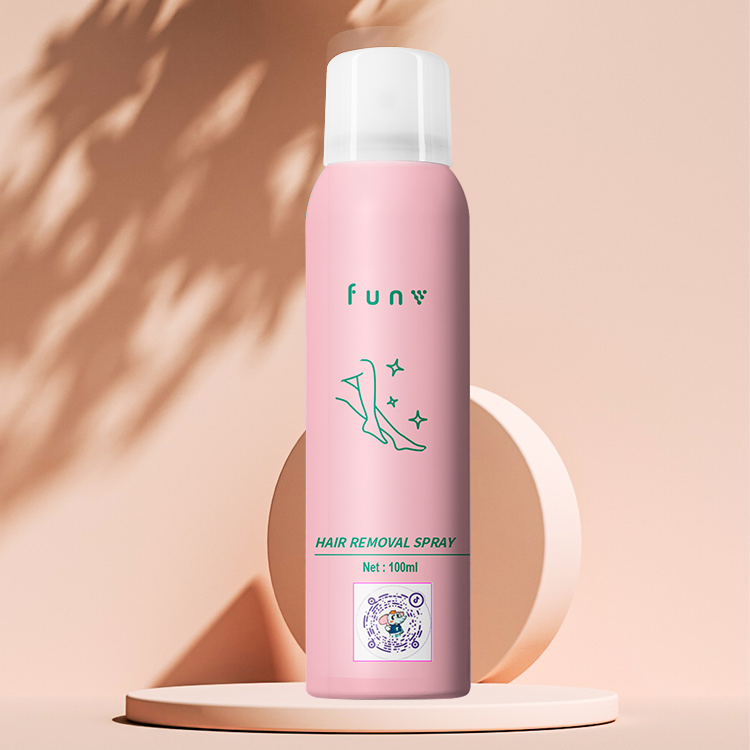
| Hair Removal Spray | HR-001 | 7.0–8.0 | Potassium Thioglycolate, Glycerin, Aloe Vera Extract, Urea | 100ml / 150ml / 200ml, aluminum |
| Hydrating Facial Mist Spray | MS-001 | 5.5–6.5 (skin-friendly) | Glycerin, Aloe Vera Extract, Hyaluronic Acid, Panthenol | 100ml / 150ml / 200ml, aluminum |
Two patterns matter for a buyer reading this table. First, the skin-contact leave-on and rinse-off lines — DS-001, SB-001 and MS-001 — converge on the same 5.5–6.5 band. Second, the depilatory product moves to the alkaline side at 7.0–8.0. The Long-lasting Makeup Fixing Spray in the same portfolio is also declared at pH 5.5–6.5, which reinforces the pattern rather than contradicting it: the products designed to sit on skin without a chemical reaction cluster in one band.
Why the Bands Differ: The Active Ingredient Sets the pH
Hair Removal Spray HR-001 is the instructive case. Its specification names potassium thioglycolate as the main active, supported by glycerin, aloe vera extract and urea. Thioglycolate-based depilatory systems are generally formulated on the alkaline side, because the alkaline environment is part of how the active works on the hair protein. The declared 7.0–8.0 band for HR-001 is consistent with that chemistry, and it also explains the product's stated fast-acting window of five to eight minutes: the formula is designed for a short, defined contact time followed by removal.
Deodorant Spray DS-001 runs in the opposite direction. Its active is aluminum chlorohydrate, an antiperspirant salt, and the product is meant to be left on the underarm through a normal day. A declaration at 5.5–6.5 places it in the mildly acidic range that is generally associated with skin comfort for leave-on products, and it matches the accompanying claims of skin-friendly, long-lasting 48-hour odor control.
Shampoo & Bath 2-in-1 Mousse SB-001 reaches the same 5.5–6.5 band from a different starting point. It is built on mild surfactant with glycerin, aloe vera extract and panthenol, and carries tear-free, gentle and hypoallergenic claims. For a product used on hair and body — and positioned for baby care OEM projects — the pH declaration is part of the same comfort argument as the surfactant choice.
Reading rule for buyers: when two aerosol products from the same factory carry different pH bands, the first question is which active drives the formula. A difference is not automatically a defect, and an identical band across unrelated products is not automatically a strength.
Where pH Sits in a Compliance File
No major cosmetic framework publishes a single universal pH limit for aerosol cosmetic sprays. What the frameworks require is that the product is manufactured, documented and released consistently against its own declared specification. That distinction is what makes the pH line on a specification sheet a compliance artefact rather than a marketing claim.
Three reference points are relevant for export-oriented buyers. In the European Union, aerosol products must comply with Directive 75/324/EEC (the Aerosol Dispensers Directive) and with the Cosmetic Regulation (EC) No 1223/2009. In the United States, the Modernization of Cosmetics Regulation Act of 2022 (MoCRA) mandates facility registration and product listing for cosmetic manufacturers. Across both markets, ISO 22716 defines the Good Manufacturing Practices expected of a cosmetic production site.
In practice, a buyer evaluating a supplier should be able to obtain the following, with the pH band appearing consistently across all four:
- A product specification sheet stating the target pH band and the acceptable tolerance.
- A certificate of analysis for the delivered batch, showing the measured value against that band.
- Stability data covering the declared shelf life, since a three-year shelf life means the band must hold over time, not only at release.
- Packaging compatibility information covering the concentrate in contact with the chosen can lining and valve.
Where a supplier cannot produce the second item, the first item is unverified. That is the practical test most procurement teams apply.
How Tentop Controls pH Before It Reaches a Specification Sheet
The pH value in a specification is the visible end of a longer control chain. Tentop operates a 15,000 m² facility with 330 employees and a 60-engineer R&D team, and reports having developed more than 6,000 formulas and obtained 42 patents. The site holds ISO 9001, ISO 14000, ISO 22716, GMPc and ISO 45001 certification, together with Halal MUI, SMETA and Disney certification.
Several capabilities are directly relevant to how a pH band is held in production. The company operates dedicated tank farms and associated blending rooms for its filling lines, with each dedicated blending room equipped with stainless steel mixing tanks on load cells and multiple agitation options — the configuration that allows a concentrate to be reproduced consistently from batch to batch. Quality control operates from raw materials through production processes to finished products, with inspection recorded so that product quality can be checked against design requirements, and the stated production control is 100% testing.
On the aerosol side, the site runs four high-speed aerosol fill-in lines, three BOV aerosol lines and two liquid fill-in lines in clean workshops. The propellant systems handled cover hydrocarbons, DME, 152a, 1234ze, nitrogen and CO2. This matters for pH discussions because the propellant is a separate phase from the concentrate: a supplier that can handle multiple propellant families can adjust the delivery system without re-engineering the formula chemistry that determines the pH band.
Commercial parameters are published as well: OEM and OBM production modes, LOGO customization, a minimum order quantity of 10,000 units, a lead time of 45–60 days, and monthly capacity of 5,000,000 units, with export markets in the EU and USA.
Scenario Fit: Reading a pH Band Against the End Use
Project fit is where a pH figure stops being a number and becomes a selection criterion. The same factory can legitimately supply both a 5.5–6.5 deodorant and a 7.0–8.0 depilatory, because the two products serve different use scenarios with different contact patterns.
Daily leave-on body care
For antiperspirant deodorant projects, the 5.5–6.5 declaration on DS-001 aligns with a product applied daily to intact underarm skin and expected to remain through a working day. Buyers specifying a private label deodorant should treat the band as a fixed parameter in the brief, alongside the 150ml, 200ml and 250ml fill options and the aluminum can or PET bottle choice.
Hair and body cleansing, including baby care
For SB-001, the 5.5–6.5 skin-friendly band supports the tear-free and hypoallergenic positioning and fits two-in-one mousse formats used in infant and family cleansing. A buyer sourcing a mousse for a baby care range has a specific reason to request the pH clause in writing: the claim and the specification have to agree.
Short-contact depilatory products
For HR-001, the 7.0–8.0 band belongs with a defined five-to-eight-minute application window and a rinse-off step. The pH is functional here rather than incidental, and downstream communication — usage instructions, after-care guidance, patch-test advice — should be consistent with an alkaline formula.
Hydration and makeup setting
The Hydrating Facial Mist Spray MS-001 and the Long-lasting Makeup Fixing Spray are both declared at 5.5–6.5, which places them in the same comfort band as the leave-on body products despite very different ingredient systems — hyaluronic acid and panthenol in one case, acrylates copolymer in the other.
Aerosol-Specific Factors That Affect How pH Is Read
An aerosol cosmetic spray is a two-part system: a liquid concentrate and a propellant, delivered through a valve into a pressurized can. The declared pH describes the formula chemistry, so the first technical question a buyer should ask is at which stage the value is measured and whether the measurement is made on the concentrate as filled. Getting that stated in the technical data sheet removes most later disputes.
Packaging is the second factor. Aluminum aerosol cans held a 61% revenue share of the aerosol packaging market in 2025, according to Grand View Research, cited for their premium appeal and recyclability. Because the concentrate sits in prolonged contact with the can lining and valve components, the pH band and the packaging choice are linked decisions rather than independent ones. A buyer moving a formula from a PET bottle to an aluminum can — both listed as options for DS-001 and SB-001 — should confirm that the compatibility data covers the new combination.
The third factor is the propellant family. Tentop's stated capability across hydrocarbons, DME, 152a, 1234ze, nitrogen and CO2 means a project can change propellant to meet a regional or performance requirement while the concentrate chemistry, and therefore the pH band, stays fixed.
Market Signals Driving Tighter pH Documentation
Documentation expectations tend to follow market scale. The global cosmetic spray market was valued at USD 18.3 billion in 2025 and is projected to reach USD 31.8 billion by 2034, according to Dataintelo. Within that, the global sunscreen spray market is projected to grow from USD 786.7 million in 2026 to USD 1.54 billion by 2035 at a CAGR of 7.8%, per Research Reports World — a segment where specification discipline is closely scrutinized because the products are used on sun-exposed skin.
The supply base is concentrated. Asia Pacific dominated the daily sunscreen spray market with a 42.3% revenue share in 2025, according to Dataintelo, driven by UV protection awareness in Australia and East Asia. China's cosmetics exports reached approximately 512 billion yuan (about USD 71.8 billion) in 2024, an 11.9% year-on-year increase, according to the General Administration of Customs China as reported by ChemLinked. For buyers sourcing from this region, the practical implication is that a supplier's specification practice is part of the competitive offer, not an administrative afterthought.
Aerosol packaging is concentrated too: major global manufacturers of aerosol packaging and valves include Ball Corporation, AptarGroup and Lindal Group, according to Mordor Intelligence. Buyers comparing quotations should expect the pH band, can specification and valve choice to be documented as one package.
Limits: What a pH Number Does Not Prove
A pH declaration is necessary but not sufficient, and the honest boundary deserves to be stated plainly.
First, the value does not by itself establish skin safety. A product declared at 5.5–6.5 still requires appropriate stability testing, preservative system validation, packaging compatibility testing and, where relevant, clinical or patch testing before a safety conclusion can be drawn. pH is one parameter among several.
Second, coverage in this portfolio is partial. A declared pH value is published for DS-001, SB-001, HR-001, MS-001 and the makeup fixing spray, but not for Sunscreen Spray SC-001, Dry Shampoo DS-001, Hair Styling Spray HS-001 or Hair Identity Spray HI-001. Buyers should not infer a band for those products from the pattern seen here; they should request the specification directly.
Third, the alkaline band on HR-001 is a functional design choice with a practical consequence for the end user. An alkaline depilatory requires a defined contact time and appropriate after-care, and a buyer should ensure the consumer instructions travel with the product rather than remaining inside the technical file.
Fourth, a declared band is only as good as its stability over shelf life. With a stated three-year shelf life across these products, the relevant question is not what the pH was at release but what it remains at the end of the declared period, and whether the supplier's stability data covers the specific fragrance and packaging combination ordered.
Future Outlook
Two forces are likely to push pH documentation further into the centre of aerosol procurement. The first is regulatory: with MoCRA facility registration and product listing in force in the United States and Regulation (EC) No 1223/2009 governing the European market, the commercial value of a clean, consistent specification file rises with every export shipment. The second is market growth: a cosmetic spray market moving from USD 18.3 billion in 2025 toward USD 31.8 billion by 2034, with sunscreen spray growing at 7.8% CAGR, means more private label launches competing on the same shelf — and more buyers asking for evidence rather than adjectives.
For OEM buyers, the practical preparation is not complex. Ask for the pH band in writing, ask where it is measured, ask what it is at end of shelf life, and ask which packaging combinations that data covers. A supplier able to answer all four on a single page is easier to qualify than one that answers only the first.
FAQ
What pH value should an aerosol cosmetic spray have?
There is no single required value. The appropriate band depends on the product's function and its active ingredients. In the Tentop portfolio, Deodorant Spray DS-001, Shampoo & Bath 2-in-1 Mousse SB-001 and Hydrating Facial Mist Spray MS-001 are all declared at pH 5.5–6.5, while Hair Removal Spray HR-001 is declared at 7.0–8.0.
Why is the hair removal spray alkaline while the deodorant spray is mildly acidic?
The difference follows the active system. HR-001 names potassium thioglycolate as its main active, and thioglycolate-based depilatory systems are generally formulated on the alkaline side; the declared 7.0–8.0 band matches a product designed for a five-to-eight-minute contact time. DS-001 uses aluminum chlorohydrate as an antiperspirant active in a leave-on product, and is declared at 5.5–6.5 alongside skin-friendly positioning.
Does the aerosol propellant change the pH of the product?
The pH value describes the formula chemistry declared in the product specification; the propellant is a separate phase handled through the valve system. Because the two are distinct, buyers should confirm in the technical data sheet at which stage the pH is measured and whether the value refers to the concentrate as filled. Tentop's production capability covers hydrocarbons, DME, 152a, 1234ze, nitrogen and CO2 propellant systems.
What documents should a buyer request to verify a pH claim?
At minimum: a product specification sheet stating the pH band and tolerance, a batch certificate of analysis showing the measured value, stability data covering the declared shelf life, and packaging compatibility information for the chosen can and valve. For manufacturing practice, ISO 22716 is the internationally recognized GMP standard for the cosmetic industry; for market access, Directive 75/324/EEC and Regulation (EC) No 1223/2009 apply in the EU, and MoCRA facility registration and product listing apply in the United States.
Can a private label buyer specify a different pH band for an aerosol project?
Tentop provides OEM and ODM contract manufacturing with LOGO customization, based on an R&D team of 60 engineers and more than 6,000 formulas developed. Any requested pH band has to be consistent with the chosen active system and validated through stability and packaging compatibility testing. Published commercial parameters are a minimum order quantity of 10,000 units, a lead time of 45–60 days and monthly capacity of 5,000,000 units.
Which products in this portfolio do not publish a pH value?
No pH value is declared in the available specification data for Sunscreen Spray SC-001, Dry Shampoo DS-001, Hair Styling Spray HS-001 or Hair Identity Spray HI-001. Buyers should request those specifications directly rather than assuming a band based on the products that do publish one.
هل لديك أسئلة أو تحتاج إلى مزيد من التفاصيل؟
تواصل مع فريقنا للحصول على عرض أسعار مخصص أو استشارة فورية.
طلب عرض أسعار
املأ النموذج أدناه وسيتواصل معك فريقنا بعرض مقترح مخصص.
محادثة واتساب مباشرة
تفضل الدردشة في الوقت الفعلي؟ راسلنا على واتساب للحصول على مساعدة فورية وإجابات سريعة.
- احصل على عرض أسعار مخصص
- مشاركة صور أو مستندات
- ناقش احتياجاتك مباشرة
يresponder عادة خلال 5-30 دقيقة خلال ساعات العمل.