
How to assess the conformity of the coating line to the production project
How to Evaluate the Fit of a Coating Line to a Production Project
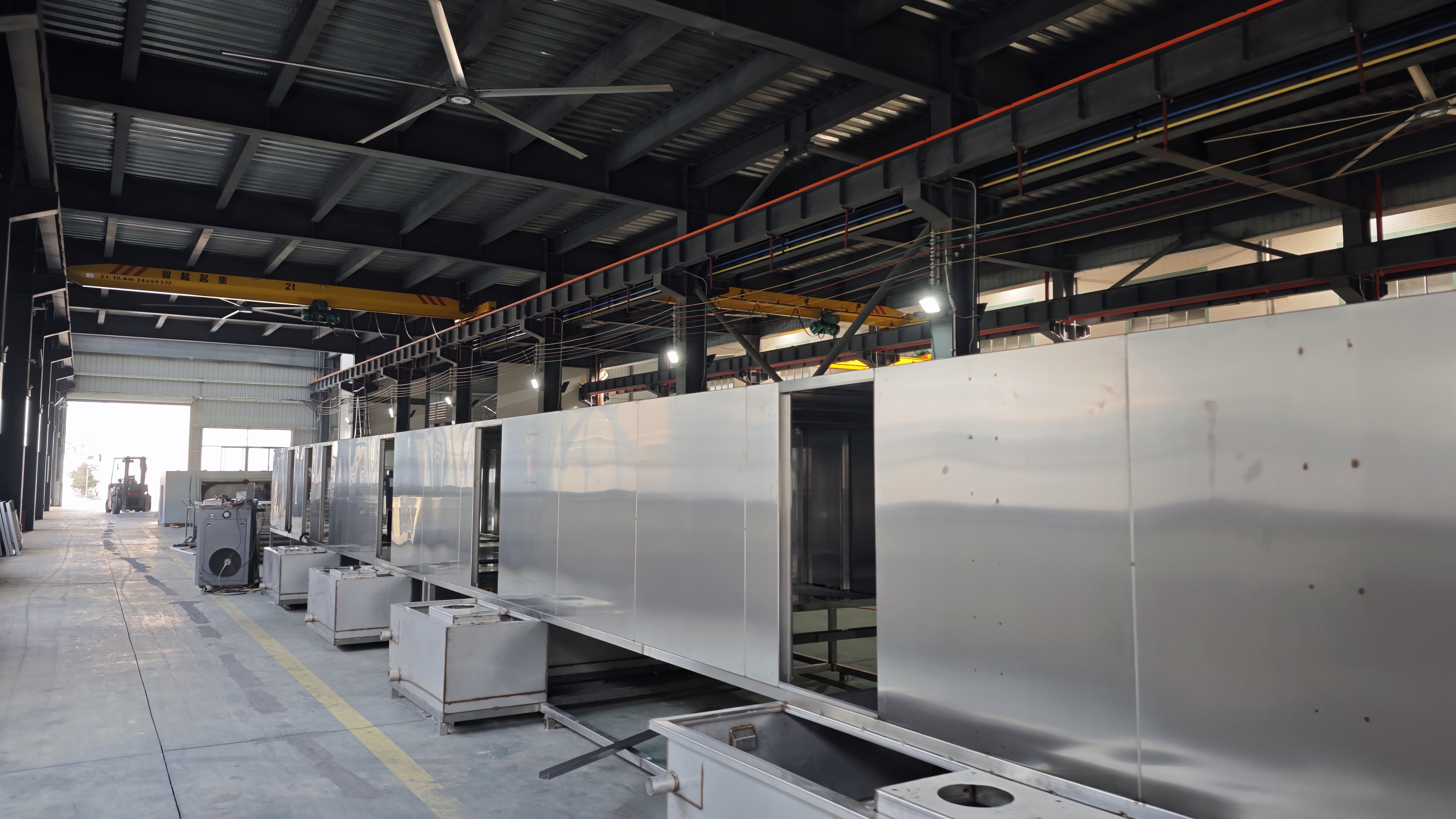
Production workshop housing automatic coating lines
Industrial coating lines are used to protect and decorate a wide range of products: from car bumpers to kitchen cookware and wooden furniture. However, the same basic configuration cannot equally efficiently serve different product types. Therefore, when selecting equipment, the buyer must base the decision on the specific production scenario: part geometry, material, output volume, cleanliness requirements, and available engineering resources.
Problem: When the line "does not fit" the product
A common mistake when purchasing a coating line is choosing equipment only by price or stated performance. In practice, a line that does not account for workpiece sizes, hanging method, or temperature and humidity requirements requires lengthy changeovers and leads to material losses. As a result, the yield of good parts decreases, paint consumption increases, and downtime grows.
On the other hand, a properly adapted line allows stabilizing coating quality, reducing paint consumption, and lowering the defect rate. For the manufacturer, this means predictable yield of good products and lower operating costs. That is why project adaptation becomes an important criterion when choosing equipment.
Solution: Production experience as the basis for project adaptation
As an example of a supplier with project specialization, Attractivechina, a brand of Guangdong Chuangzhi Intelligent Equipment Co., Ltd. from Zhaoqing (Guangdong Province, China), can be considered. The company has been operating since 2005, has its own production complex of about 35,548 m² and a staff of 280 employees, including 54 engineers. The company holds 79 invention patents in the field of coating equipment and environmental protection equipment, with a total of over 300 patents. Attractivechina specializes in manufacturing automated coating lines to individual orders, including equipment for automotive components, railway transport, furniture, musical instruments, kitchenware, household appliances, metal products, and heavy industrial equipment.
Technical structure of a coating line
An automatic coating line is a complex of interconnected equipment. A typical configuration includes: pretreatment units, drying equipment, automatic sandblasting machine, spray booth, preheating oven, curing oven, cooling system, conveyor system, dust removal equipment, volatile organic compound (VOC) treatment system, environmental equipment, electrical control system, and in more complex configurations, a MES production management system. Line control can be fully automated based on PLC, with robotic spraying and the possibility of unmanned production. For stable coating of critical products, a Class 10,000 cleanroom with clean and well-ventilated air is required.
The specific parameters of the line are determined by the workpiece type. For example, a line for coating automotive parts is designed considering the part material (typically ABS+PC), spray booth temperature of 25±2°C and humidity of 65±10% RH. The production cycle can be 45 seconds per tray, which at 22 hours of operation per day yields up to 1,760 trays per day, and equipment utilization reaches 85%. For cookware, the line is adjusted for aluminum alloy and composite materials, ensuring a productivity of 800–1000 pieces per hour with a hanging pitch of 450–900 mm. A line for metal products can handle aluminum panels and profiles up to 7000 mm long and provide up to 5,000 m² of coating per day. For wooden furniture and musical instruments, the design productivity is 1,422 pieces per 8-hour shift with an adjustable conveyor speed of 2000–6000 mm/min. Lines for large industrial equipment often use a combination of manual and robotic spraying with a floor conveyor.
Industry application scenarios
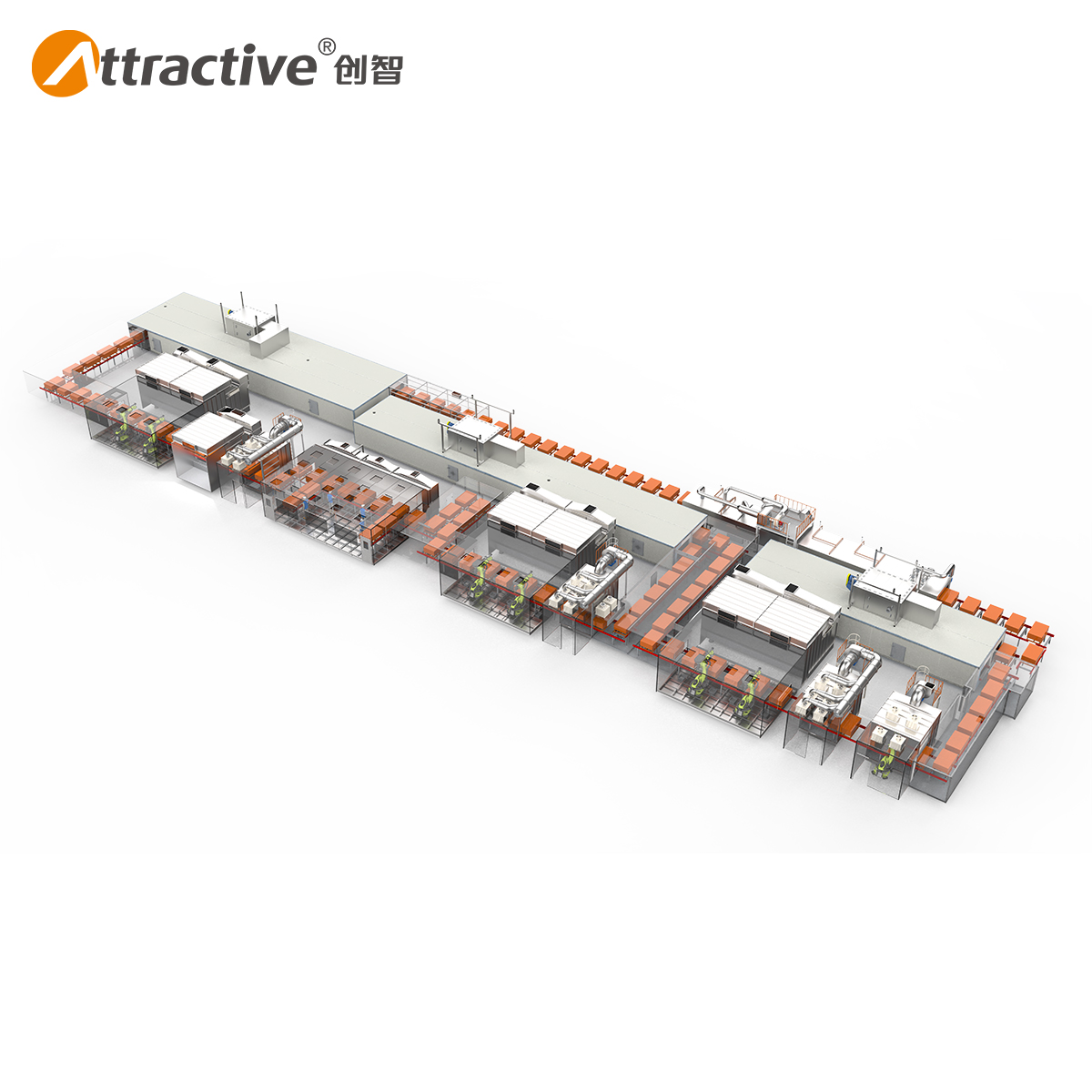
Coating line for auto parts
The use of coating lines covers several industry scenarios.
- Automotive industry: painting of bumpers, wheel hubs, hubcaps, fuel tanks, frames, interior parts, and car logos.
- Cookware and home appliances: non-stick coating for frying pans, soup pots, rice cooker inserts, baking molds, air fryers, and coating of water heater shells.
- Metalworking: coating of doors, windows, steel cabinets, building materials, cabinet components, sheet metal parts, lighting fixtures, and aluminum sheets.
- Woodworking: varnishing and painting of guitars, pianos, wooden beds, dining tables, chairs, and acoustic speakers.
- Industrial equipment: painting of injection molding machines, tankers, buses, side frames, carriages, and frames of edge banding machines.
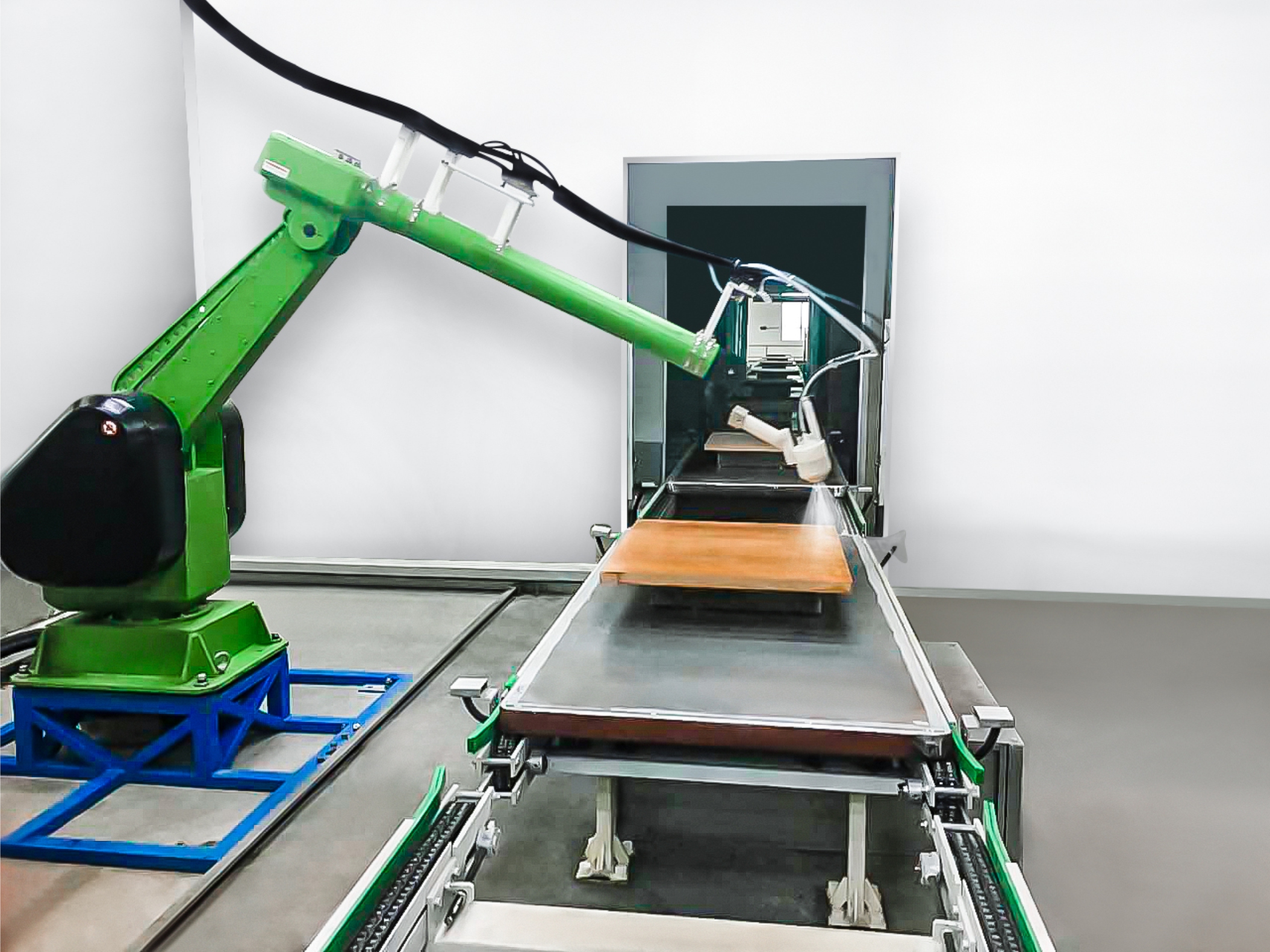
Coating line for wooden furniture
| Scenario | Typical products | Indicative parameters |
|---|---|---|
| Auto parts | Bumpers, hubs, hubcaps, fuel tanks, interior parts | Cycle 45 s/tray, 1760 trays/day, temperature 25±2°C, humidity 65±10% RH, tray size 1350×900×200 mm |
| Cookware | Non-stick frying pans, rice cooker inserts, baking molds | Productivity 800–1000 pcs/hr, pitch 450–900 mm, size up to Φ300×160 mm, energy: gas + electricity |
| Metal products | Aluminum panels, profiles, doors, windows, steel cabinets | Max size 7000×2000×2200 mm, up to 5000 m²/day, conveyor speed 3000 mm/min (2000–4000) |
| Wood and musical instruments | Guitars, pianos, beds, tables, chairs | 1422 pcs/shift, pitch 300 mm, line speed 4000 mm/min (2000–6000), energy: electricity |
| Industrial equipment | Injection molding machines, tankers, buses, side frames, carriages | Combination of manual and robotic spraying, floor conveyor, shift 7.5 h |
Practical results across different projects
Accumulated practice shows consistent results across different scenarios. For example, in projects for auto parts manufacturers, 20 fully automated lines have been installed; over an operational period of 5–10 years, the yield of good coatings reached 98%, paint consumption decreased by 25%, and energy consumption by 20%. For metalworking production, 15 lines were introduced, where the yield of good parts was 97%, paint or powder consumption was reduced by 30%, and productivity increased by 40%. In cookware and home appliance projects, 20 lines ensured coating uniformity at a level of 98%, reduced paint waste by 30%, and increased efficiency by 35%. For woodworking enterprises, 10 lines reduced paint consumption by 30%, decreased the share of dust defects by 90%, and increased efficiency by 40%. In industrial equipment, 10 lines ensured that anti-corrosion properties meet salt spray test requirements (≥1000 hours) and improved yield to 98%.
Market context and industry trends
The global coating equipment market was valued at USD 17.25 billion in 2022 and is projected to grow at a CAGR of 5.3% until 2030. This growth is associated with increased demand for electric vehicles and production automation. For Russia, the industrial coatings market in 2024 was about USD 1.78 billion, with expected growth of 1.3% by 2035. In the powder coating segment, a higher rate of automation is observed: powder coating equipment will grow at a CAGR of 6.73% until 2035. Additionally, the global automotive bumper market will increase from USD 17.5 billion in 2025 to USD 26.4 billion by 2035 (CAGR 4.2%), supporting demand for automatic bumper painting lines. For the EAEU market, the requirement for equipment to comply with EAC and GOST R standards remains an important factor when planning import supplies.
Comparison with traditional solutions and limitations
An automatic coating line differs from traditional manual spraying primarily in the degree of process control. In automatic mode, the stability of coating thickness and curing conditions is higher, and dependence on operator skill is lower. This explains higher yields and lower material consumption. However, automated solutions have objective limitations.
- Automatic lines are designed for series production; with frequent product changes and small batches, changeover time can reduce economic efficiency.
- Automation requires significant investment and qualified maintenance.
- For a number of workpieces, special conditions are needed: a Class 10,000 cleanroom, maintenance of temperature and humidity in the spray booth, and the presence of an exhaust gas cleaning system.
Therefore, for small-scale production or unique large-sized products, traditional spraying may remain a rational choice.
Development prospects
The development of coating lines is moving towards intelligent control and integration with production systems. Implementing MES allows tracking process parameters in real time and adapting the line more quickly to changes in orders. A further increase in the share of robotic spraying is expected, including unmanned operation schemes. Stricter environmental requirements, including ISO 14001, ISO 9001, and ISO 45001 standards, will stimulate the use of closed VOC treatment systems and energy-efficient ovens. For buyers, this means that a coating line should be evaluated not only by initial cost but also by total cost of ownership, including energy consumption, material usage, and ease of maintenance.
More detailed technical information about line compositions and implementation examples is presented in the corporate brochure: download brochure.
FAQ
What types of products can be processed on automatic coating lines?
Automatic coating lines are used for automotive parts, kitchen cookware, wooden furniture, musical instruments, heavy machinery, household appliances, building materials, and low-rise equipment. The specific composition of the line depends on the product type and material.
What line parameters are important for painting automotive parts?
For auto parts, typical parts are made of ABS+PC, such as front bumpers, door panel trim, dashboards, wheel arches, and switch panels. The line must ensure a spray booth temperature of 25±2°C and humidity of 65±10% RH, and with a production cycle of 45 seconds per tray, up to 1,760 trays per day at 85% equipment utilization.
Can one line be used for different types of workpieces?
One line can be adapted to several types of workpieces if the geometry and hanging method are coordinated. For example, a line for cookware is designed for a standard product size of up to Φ300×160 mm and a hanging pitch of 450–900 mm, allowing work with frying pans, rice cooker inserts, and baking molds. For metal panels and profiles, the maximum workpiece size reaches 7000×2000×2200 mm. However, frequent changes in workpiece types increase changeover time.
What are the requirements for the installation site of the line?
The equipment is designed to operate in a Class 10,000 cleanroom with clean and well-ventilated air. For example, an auto parts line can be placed in a workshop of size 100 m × 38 m × 5.4 m (length, width, height). For other product types, the area and height of the workshop are calculated individually.
What auxiliary equipment is part of the line?
The line includes pretreatment units, drying equipment, automatic sandblasting machine, spray booth, preheating oven, curing oven, cooling system, conveyor system, dust removal equipment, VOC treatment system, environmental equipment, electrical control system, and, if necessary, a MES production management system.
What limitations do automatic lines have?
Automatic lines are oriented towards series production. With small batches and frequent product changes, changeover can take significant time. Also, qualified maintenance, investment in automation, and ensuring the necessary clean and climate conditions in the workshop are required.