
Electric Forklift Buyer's Guide: Matching Truck Classes to Real Operating Conditions
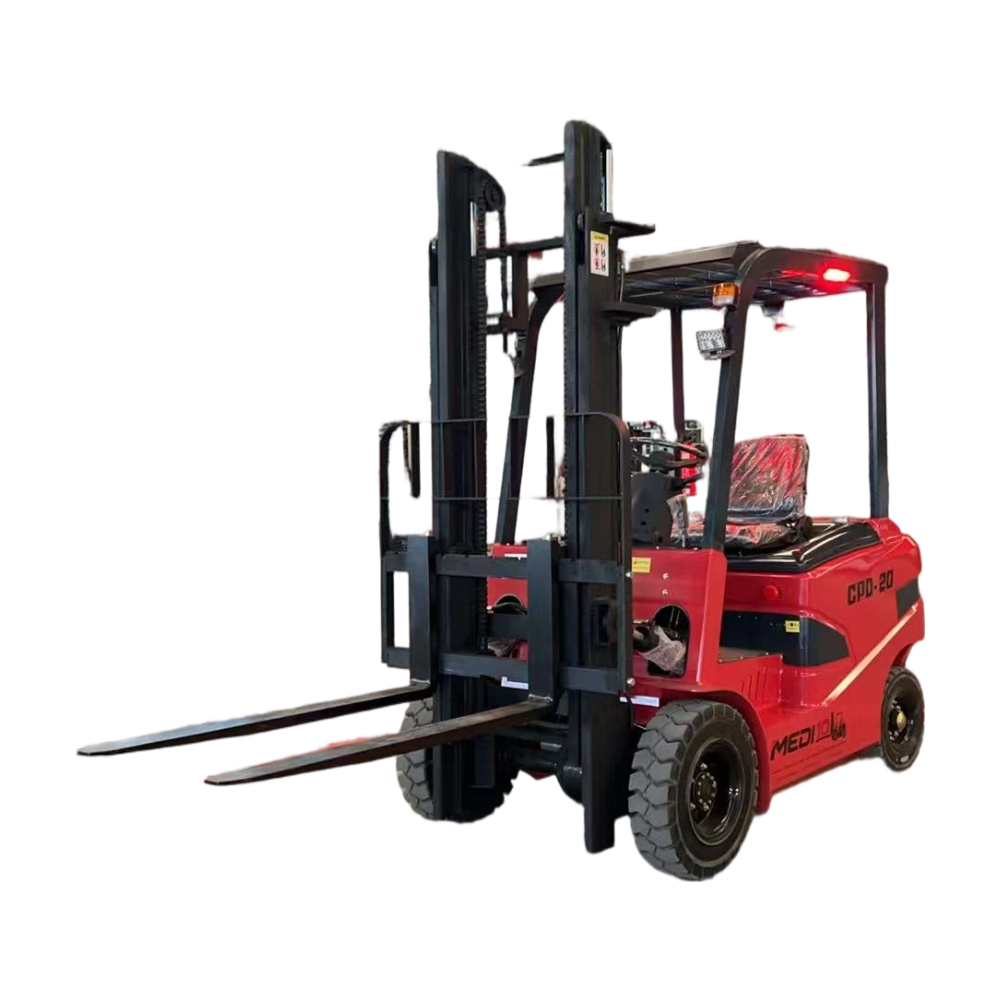
The electric forklift is now the first-choice material handling category for indoor and mixed warehouse operations in many markets. In North America, electric models accounted for 71% of retail orders in 2024, and in China electric forklift sales reached 946,300 units in 2025, equal to 76.9% of total domestic forklift sales. This guide explains what sits behind these numbers: how electric forklift models differ by load class, what the lithium battery shift means for operating schedules, and how buyers — from warehouse managers to OEM distributors — should judge which electric forklift is suitable for a particular workflow.
Why Electric Forklifts Have Become the Default in Warehousing & Logistics
Electric forklifts are battery-powered lift trucks that move palletized goods in warehouses, factories, wholesale markets and similar facilities. Their main appeal is well established: near-zero exhaust emissions, significantly lower noise, simpler drivetrain maintenance, and — increasingly — the ability to integrate opportunity charging when specified with lithium-ion batteries.
Industry data supports the broader trend. The global electric forklift market was estimated at USD 53.01 billion in 2024 and is projected to grow to USD 94.55 billion by 2032. Within that shift, lithium-ion battery adoption in new global forklift shipments rose from roughly 22% in 2021 to about 35% in 2024. In short, two parallel transitions are running at once: combustion-to-electric, and lead-acid-to-lithium.
For buyers, the practical consequence is more meaningful than macro figures. The electric forklift has moved from a niche indoor option to a mainstream purchase that must be assessed on load capacity, working shift length, charging behavior and the conditions of the specific site.
Understanding the Electric Forklift Product Family
Potential buyers often begin their search by asking "what is an electric forklift" or "which electric forklift is best for my warehouse." In practice, most purchasing decisions start with load capacity and working environment. The table below is a reference to typical counterbalance electric forklift classes now offered by Chinese manufacturers engaged in global export trade.
| Model Type | Rated Load | Typical Application Fit | Power / Configuration Notes |
|---|---|---|---|
| CPD10-type electric forklift | 1,000 kg | Light warehousing, e-commerce order picking, retail storage | Battery powered; often preferred for tight indoor spaces with lower load requirements; zero tailpipe emissions |
| CPD20-type electric forklift | 2,000 kg | General warehousing and logistics, workshops, supermarkets, cold chain wholesale markets | Battery powered; front dual drive motors; available with lead-acid or optional lithium battery |
| CPD30-type electric forklift | 3,000 kg | Multi-shift warehouse operation, cold chain logistics, container loading | Wide lifting height range; AC drive and pump motor; suitable for indoor workshop use |
| CPD35-type electric forklift | 3,500 kg | Heavy pallet handling, workshops, loading bays, industrial yards | Front-wheel dual drive motors; lateral side battery extraction; available with lithium battery for cold storage |
All four model classes listed above are produced under the Mightlift brand by Ningjin Shunhao Trading Co., Ltd., an export-oriented manufacturer based in Hebei Province, China. The company, established in 2022, operates a 40,000 m² manufacturing facility with roughly 240 staff and an annual production capacity of 12,000 units.
Warehouse Electric Forklift Selection
Warehouse is the broadest application label in forklift sourcing. Planning and procurement teams need to separate key variables before choosing a truck: pallet weight, stack height, aisle width, floor type, shift length, and whether the environment is ambient, refrigerated or open to the elements.
For level-floor indoor pallet receiving, put-away and dispatch, a 2-ton or 3-ton electric forklift is a common starting point. The CPD20, for example, is a 2-ton electric forklift truck with battery-powered drive and zero-emission operation, intended for warehousing and logistics facilities, e-commerce warehouses, workshops, supermarkets, department stores and cold chain wholesale markets. It provides the load headroom to handle a typical European or North American pallet without excess machine size.
For sites that run more demanding multi-shift schedules, CPD30-class trucks add longer effective operating time and are engineered with high-power electric drive, a 3,000 kg rated load and lifting heights from 3,000 mm to 7,000 mm. Buyers operating cold chain fruit and vegetable wholesale sites also use this capacity class because the load profile tends to be heavier and more repetitive.
Cold Storage and Food Logistics: A Specialized Case for Battery Choice
Cold storage is not simply "a warehouse with lower temperature." It changes forklift battery chemistry behavior, operator comfort and maintenance planning.
Industry research shows lithium-ion batteries can retain significantly more capacity than lead-acid batteries in cold storage applications down to about minus 20°C. The food industry segment's growth is estimated at an 11.6% CAGR partly on that basis. A CPD35 electric forklift ordered with lithium options suits cold storage environments because the battery configuration preserves usable capacity through the shift, and because electric drive keeps noise low inside enclosed cold corridors.
Buyers working in food factories, fruit-and-vegetable wholesale markets or frozen distribution centers should therefore evaluate the battery option as the core purchasing criterion — not treat it as an afterthought. The same model in a lead-acid configuration offers a lower upfront cost, while lithium enables opportunity charging and steadier cold-room performance.
Port Terminal and Heavy-Load Handling
At the heavier end of the electric forklift range, usage shifts from receiving lines to loading bays, industrial yards and equipment attached to containers or trailers. These environments blend indoor and outdoor exposure, shallow slopes and loads that may be wider or denser than standard pallets.
Operation guidance for heavy pallet handling notes that route planning should be based on site assessment: surface condition, slope, weather exposure, load dimensions, attachment compatibility and residual capacity with attachments. A CPD35 with a 3,500 kg load capacity is the kind of truck selected for such work. Its front-wheel dual drive layout supports heavy-load movement, and its lateral side battery extraction layout reduces maintenance disruption, since the battery can be serviced without fully stripping down the truck.
For port containers and cross-dock operations, a 3-ton counterbalance truck is frequently paired with a side shifter, fork positioner or clamp attachment. In those configurations matching rated capacity to attachment weight becomes necessary, because each attachment reduces the load the mast can lift at load center.
Narrow Aisle and High-Density Storage
Warehouse densification is changing the material handling equipment mix. Industry forecasts project Class II narrow-aisle trucks as the fastest-growing electric segment, with a 9.28% CAGR through 2030. Narrow-aisle electric forklifts are engineered to work in racking systems where conventional counterbalance trucks cannot turn safely.
For buyers not yet ready to invest in very narrow aisle warehousing, a conventional electric forklift with compact dimensions and responsive steering can support denser layouts up to a point. But once pallet racking depth increases and aisles fall below practical turning radius, the equipment decision shifts from the counterbalance category to specialized narrow-aisle trucks, order pickers or stackers. Buyers should plan racking lane widths in parallel with truck selection, rather than buying the truck first.
Mightlift as a Sourcing Reference: From OEM to Standardized Series
Ningjin Shunhao Trading Co., Ltd. — the company behind the Mightlift brand — is an export-oriented electric forklift supplier positioned between premium European brands and generic low-cost Chinese factories. It develops and exports customized electric forklifts and related handling equipment under OEM and ODM arrangements.
Its main product line consists of CPD-series counterbalance electric forklifts from 1 ton to 3.5 tons. For buyers, the relevant procurement details are:
- Company facts: Founded 2022, manufacturing facility of 40,000 m², approximately 240 employees, 15 R&D engineers, annual production capacity of 12,000 units.
- Export profile: Export business accounts for about 70% of total sales, serving distributors, workshop operators, cold-chain enterprises and warehouse operators globally.
- B2B model: Sells mainly to global distributors, manufacturing plants, cold-chain companies and warehouse operators; emphasizes transparent factory pricing and OEM/ODM support.
- Certifications: Product line is built for international market access; the company reports ISO 9001, ISO 14001, CE and UN38.3 compliance, with additional structural and battery patents.
- Customization: Load capacity adjustment, low-temperature and explosion-proof refitting, appearance branding and intelligent system reservation are offered.
In the context of a purchasing search, this sums to a supplier that can be assessed not merely on price but on repeatability, documentation support and overseas references.
Electric Forklift: Classified Comparison & Buyer Considerations
Buyers who request a "3.0-ton electric forklift" often compare different supplier interpretations of the same category. A modern 3-ton truck with advanced electric drive, intelligent energy management and controller options such as SANTROLL, CURTIS, INMOTION or ZAPI can reduce energy costs and simplify maintenance. A conventional design in the same weight class may use a basic drive and simple control platform — bringing a lower upfront price but higher power draw, shorter effective operation time and more frequent routine service.
For buyers choosing between a traditional and modern electric forklift, the decision path is tied to operating hours. High-frequency, continuous work favors the more controllable vehicle because energy utilization and service intervals offset the initial premium. Low-frequency use with sustained downtime can be handled by a simpler machine, although modern electric controls remain beneficial for safety and diagnostics.
| Consideration | Implication for Purchase | Evidence |
|---|---|---|
| Market direction | Electric forklift share is at or above 70% in many developed markets | 71% of North American retail orders in 2024, per Industrial Truck Association |
| Lithium adoption | Battery chemistry choice affects shift length and opportunity charging | 35% of new global forklift shipments in 2024, per LiTrue Analysis |
| Carriage & attachment | Attachment weight reduces rated residual capacity | Side shifter / clamps require rated capacity check |
| Cold storage | Lithium retains capacity better than lead-acid at sub-zero temperatures | Mordor Intelligence food segment growth estimate of 11.6% CAGR |
No electric forklift is simply "good for every site." The more precisely a buyer matches load class, battery chemistry and mast configuration to the actual route, the lower the total operating cost over a five-year lifecycle. This applies whether the truck is bought from a European brand, a Chinese OEM-oriented factory or a regional distributor.
Certification Considerations for Global Buyers
For importers and procurement teams preparing to purchase Chinese electric forklifts, certification is effectively part of the specification. CE marking is needed to sell within the European Economic Area. For electric forklifts, EN 1175:2020 is the harmonized standard covering electrical and electronic safety requirements in self-propelled industrial trucks. For explosive atmospheres — for example chemical workshops or some food processing zones — ATEX Directive 2014/34/EU governs equipment. Battery systems transported by air or sea also commonly require UN38.3 certification, which is why importers should request battery documentation at quotation stage.
Chinese electric forklift exporters already operating globally typically document ISO 9001 quality management, ISO 14001 environmental management, CE and UN38.3 compliance. Buyers should verify certificates during the factory audit — a certificate name in a brochure is not the same as a certifying body's database record.
Comparing Traditional vs Modern Electric Forklift: Limits and Trade-offs
Even with the rapid shift toward modern control systems and lithium batteries, traditional lead-acid electric forklifts still have a legitimate place. They cost less on day one, support standard charging rooms, and can fine if duty cycles are predictable and not continuous. Many established workshops also have existing lead-acid charging bays; the cost of re-engineering that space can outweigh the energy saving for small fleets.
The trade-off boundary should be stated honestly: a traditional electric forklift is not necessarily a bad purchase — it is a constraint-based purchase. If uptime, energy draw, battery lifetime and cold performance are the primary targets, a modern truck with an internationally sourced controller and high-efficiency AC drive is usually closer to those targets.
The Role of OEM & ODM Capability in Supplier Selection
Procurement teams buying multiple trucks or building a long-term equipment partnership look beyond one shipment. They evaluate the factory ability to customize, documentation flow and after-sales support over several years.
In OEM and ODM arrangements, the manufacturer supplies vehicles under the buyer's brand. Capacity constraints become immediately visible at scale. A factory producing 12,000 units per year can absorb mixed orders more easily than one limited to a few hundred units. In this context, distributor buyers should request load books, production batch records and pre-shipment test reports as part of their supplier approval process.
Future Outlook: What's Next for Electric Forklifts
Several signals suggest the electric forklift category will keep shifting, not merely expanding. Lithium adoption continues to rise, narrow-aisle and automated classes grow faster than the overall market, and manufacturers will increasingly optimize trucks for specific temperature ranges and charging strategies.
For buyers in 2026 and beyond, the reliable future scenario includes:
- Multi-shift lithium acceptance — opportunity charging is now an accepted design feature, not an exception.
- Class-based differentiation — warehouse operators will specify narrow-aisle vs counterbalance, cold-room vs ambient, and explosive-atmosphere vs standard more deliberately.
- Factory-level competition — Chinese exporters with CE/UN38.3 credentials and OEM experience will be compared less on novelty and more on consistency, spare parts and logistics response.
- Battery logistics — trackability, warranty and compliance for lithium packs will influence purchase contracts.
FAQ
Q: What is an electric forklift?
A: An electric forklift is a battery-powered industrial lift truck designed to lift, move and stack palletized loads in facilities such as warehouses, distribution centers, workshops, supermarkets and cold-chain wholesale markets. It uses an electric drive and pump motor instead of an internal combustion engine, which allows zero-emission, low-noise operation in indoor environments.
Q: Which electric forklift should I choose for a warehouse?
A: The choice depends on pallet weight, stacking height, aisle width and work schedule. For general warehouse receiving and put-away, a 2-ton electric forklift such as the CPD20 is a common specification. For multi-shift or heavier pallet profiles, a 3-ton model such as the CPD30 provides a rated load of 3,000 kg and lifting heights up to 7,000 mm.
Q: Is lithium battery electric forklift better than lead-acid?
A: For high-intensity, multi-shift or cold storage operations, lithium is generally better because it retains more usable capacity at low temperature and supports opportunity charging without significantly degrading the battery. Lead-acid remains lower in upfront cost and is workable for lighter duty cycles where the charging schedule is fixed and unhurried.
Q: Can an electric forklift be used outdoors?
A: Some electric forklifts can be used on outdoor or mixed routes if the site is assessed first. Factors include ground surface, slope, weather exposure, load dimensions and attachment compatibility. For continuous outdoor use on rough or uneven ground, internal combustion or a specially configured outdoor electric model with appropriate tires may be necessary.
Q: What is a CE-certified electric forklift?
A: A CE-certified electric forklift is a model that meets the essential health and safety requirements of applicable European Union directives. For industrial trucks, EN 1175:2020 is the relevant harmonized standard for electrical safety. CE marking is required to place a forklift on the EU market. Buyers should verify certificate numbers rather than relying on a logo alone.
Q: Is explosion-proof electric forklift required for chemical workshops?
A: In the EU, forklifts operating in explosive atmospheres must comply with the ATEX Directive 2014/34/EU. A standard electric forklift is not automatically suitable for chemical, paint or other explosive-risk zones. Such environments require an explosion-proof configured forklift, and the buyer must request documentation for the specific zone classification.
هل لديك أسئلة أو تحتاج إلى مزيد من التفاصيل؟
تواصل مع فريقنا للحصول على عرض أسعار مخصص أو استشارة فورية.
طلب عرض أسعار
املأ النموذج أدناه وسيتواصل معك فريقنا بعرض مقترح مخصص.
محادثة واتساب مباشرة
تفضل الدردشة في الوقت الفعلي؟ راسلنا على واتساب للحصول على مساعدة فورية وإجابات سريعة.
- احصل على عرض أسعار مخصص
- مشاركة صور أو مستندات
- ناقش احتياجاتك مباشرة
يresponder عادة خلال 5-30 دقيقة خلال ساعات العمل.