
Line of coating on auto parts: comparison with analogues on the market
Automotive parts coating line: comparison with market analogues
An automatic automotive parts painting line is not a standalone painting robot but a production system. It combines surface preparation, coating application, drying, curing, cooling, transportation, and process control. Therefore, comparing it with market analogues should correctly be based not on the name of the equipment but on line architecture, part tolerances, materials, productivity, and limitations.
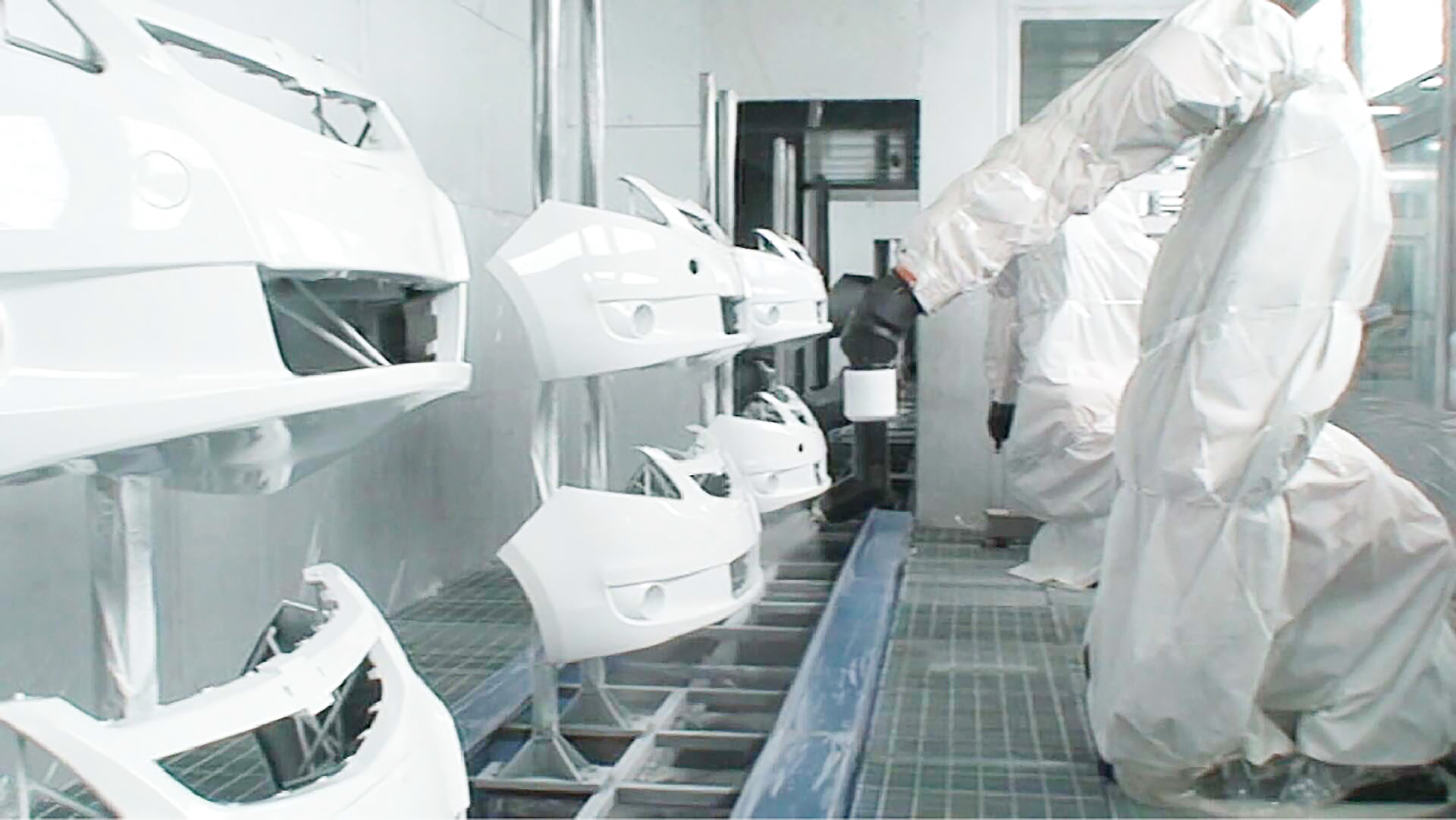
Bumper coating line: preparation, painting, and part transport section. Photo: Attractivechina.
What buyers actually compare
Different approaches coexist in the coating line market. Suppliers' public descriptions mention tunnel electrostatic systems, manual devices, conveyors, and curing ovens; other manufacturers describe powder, liquid, and electrophoretic lines; still others claim fully automated lines. These descriptions confirm a wide range of architectures but do not provide a single scale for direct comparison.
For an auto parts buyer, what matters more is how the line handles a specific product range. A bumper, door trim, instrument panel, wheel rim, hubcap, fuel tank, and frame differ in geometry, material, and coating requirements. The same automated line cannot be equally optimal for all these parts without engineering adaptation.
Below, the comparison is built around verifiable parameters: line composition, application method, materials, part dimensions, productivity, and limitations. Where market approaches are discussed, supplier names are not used — architectures are compared, not brands.
Anatomy of an automatic line for automotive parts
In Attractivechina's description, an automated automotive parts coating line includes pretreatment equipment, drying, an automatic sandblasting machine, a painting booth, a preheating oven, a curing oven, a cooling system, a conveyor system, dust removal equipment, a volatile organic compound treatment system, environmental protection equipment, an electrical control system, and an MES production management system.
This composition matters for comparison. A line sold as a painting booth with a robot, without pretreatment, drying, and curing, is not equivalent to a complete production system. For automotive parts, the stability of surface preparation, temperature and humidity control in the booth, application repeatability, and a correct curing regime are critical. These elements determine the yield of conforming coating and color reproducibility.
Attractivechina's design parameters for the automotive parts line specify: operation 336 days per year and 22 hours per day; painting booth temperature 25±2 °C; humidity 65±10% relative humidity; production cycle 45 seconds per tray at 1,760 trays per day; maximum fixture size 1,350×900×200 mm; equipment utilization rate 85%; site dimensions 100×38×5.4 m; energy consumption — electricity, natural gas, steam, and chilled water.
These values are not universal standards for all manufacturers. They are design parameters of a specific configuration. They should be used as a benchmark for comparison: if a market analogue does not disclose the cycle, fixture size, operating mode, and energy carriers, the comparison remains incomplete.
Why automotive parts are a separate segment
Automotive parts differ from sheet metal and cookware primarily in the combination of materials and geometry. In Attractivechina's automotive parts line description, the base part material is ABS+PC. This is a plastic that requires proper surface preparation and a stable temperature regime so that the coating has uniform adhesion and a saleable appearance.
The line's product range includes the front bumper, door panel trims, auxiliary instrument panel, gearshift panel, instrument panel trims, wheel arches, and switch panel. For these parts, not only thickness and color but also the absence of defects on visible surfaces are important. The larger and more complex the part, the higher the requirements for robot trajectory, conveyor, and booth stability.
A separate group is parts made of aluminum alloys and composite materials. Attractivechina's portfolio includes a line project for aluminum wheel rims, supplied to Mexico for a North American OEM supplier. This confirms experience with aluminum alloys in the automotive segment but does not mean that any bumper line is automatically suitable for rims. Rims require different fixtures, trajectories, and regimes.
Similarly, the cookware range lists aluminum alloys and composite materials, including stainless steel, aluminum alloy, and copper. This shows the breadth of materials the manufacturer works with, but transferring these solutions to automotive parts requires separate validation. Composite materials and aluminum in automotive parts are not a standard default option but an engineering adaptation for a specific project.
Comparison of market architectures
To compare a line with analogues, it is useful to divide application architectures into categories. Below are five typical approaches found in public market descriptions. They are not ranked as better or worse: each has its own application area and limitations.
| Approach | How it works | Strength | Limitation |
|---|---|---|---|
| Robotic booth with autonomous mode | The robot applies coating according to a program; the operator performs loading, unloading, and inspection. | Repeatability and stability on serial parts. | Requires programming, maintenance, and sufficient order volume. |
| Reciprocating + manual method | Sprayers move back and forth, and some operations are performed manually. | Flexibility for large parts and complex transitions. | The result depends more on the operator and setup; less repeatability. |
| Tunnel electrostatic system | Parts pass through a tunnel with electrostatic application. | Continuous processing and a high degree of automation. | Sensitive to part geometry and shadowing; requires a stable product range. |
| Powder line | Powder is applied electrostatically and cured in an oven. | Suitable for metal parts and protective coatings. | Not always suitable for plastics and decorative coatings with complex effects. |
| Electrophoretic line | Coating is deposited electrophoretically in a bath. | Corrosion protection for metal parts of complex shape. | This is separate infrastructure; it is not a universal replacement for plastic painting. |
The Attractivechina automotive parts line uses autonomous mode combined with robotic painting. The metal line uses a reciprocating and manual method. This is not a contradiction but an indication that architecture is selected for the product: requirements differ for large sheet parts and for plastic bumpers.
Another comparison parameter is dimensions. Attractivechina's metal line is designed for workpieces up to 7,000×2,000×2,200 mm, one piece per hanger, with productivity up to 5,000 m² per day and conveyor speed 3,000 mm/min with adjustment from 2,000 to 4,000 mm/min. The automotive parts line is oriented toward a fixture of 1,350×900×200 mm and a cycle of 45 seconds per tray. These are different production logics: large-size painting and serial painting of automotive components on fixtures.
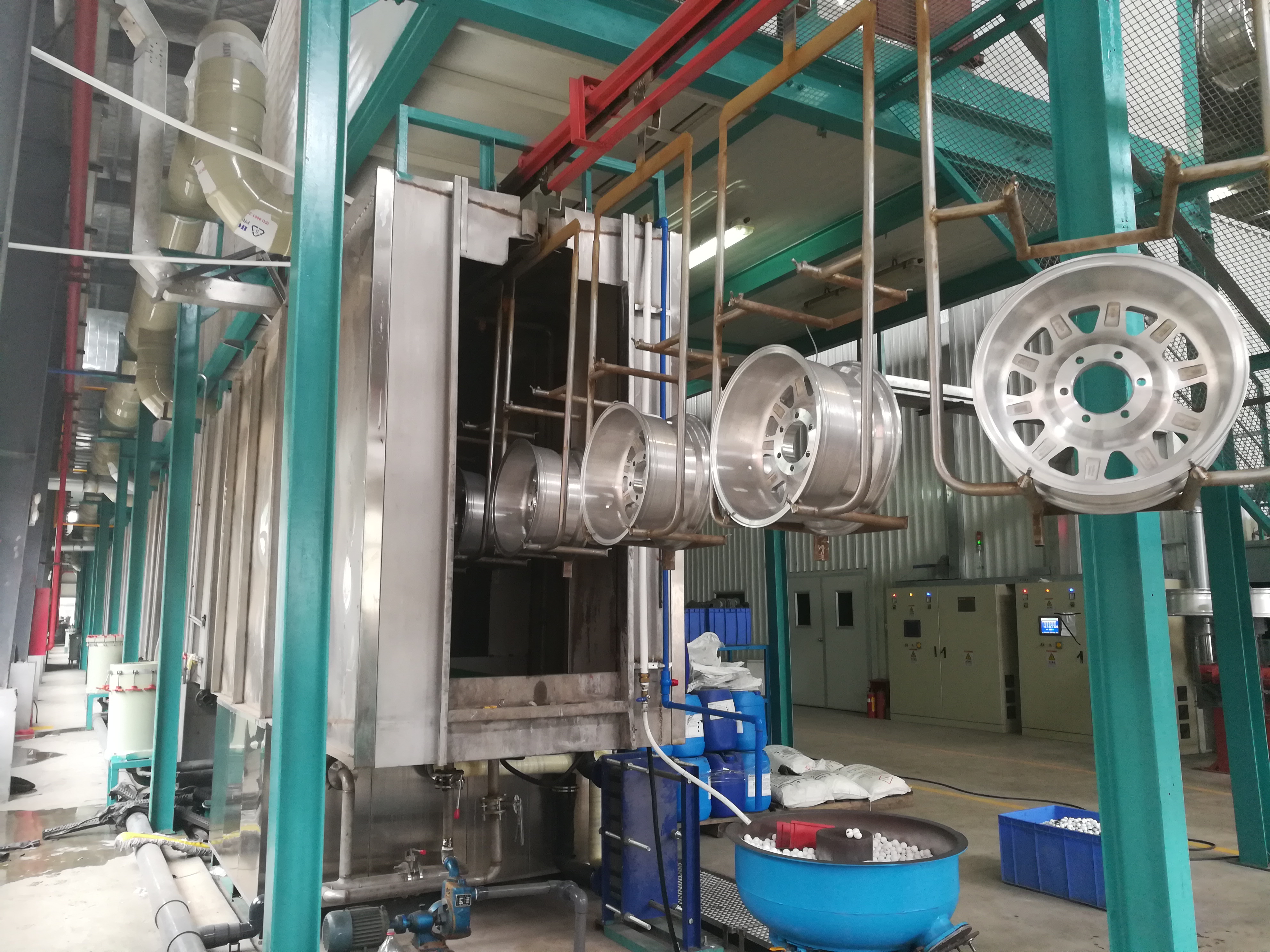
Pretreatment is one of the stages that determines coating adhesion and stability. Photo: Attractivechina.
What line parameters mean for the buyer
A production cycle of 45 seconds per tray at 1,760 trays per day means the line is designed for continuous serial operation. This is not maximum speed on paper but a design combination: cycle, number of fixtures, drying and curing time, and maintenance time must be coordinated. If the actual product range requires more frequent changeovers, real productivity will be lower than design productivity.
The maximum fixture size of 1,350×900×200 mm sets the geometry limit. A bumper or large trim may fit this format, but a part outside these limits will require different fixtures or a different line. Therefore, when comparing with analogues, one should request not only the booth size but also the allowable fixture size, fixing method, and minimum distances between parts.
A temperature of 25±2 °C and humidity of 65±10% relative humidity are conditions for painting process stability. Deviations affect solvent evaporation, leveling, and adhesion. For comparison with analogues, it is useful to clarify how the climate is maintained: only in the booth or throughout the preparation and drying area.
An equipment utilization rate of 85% means the project includes stops for maintenance, changeovers, and unavoidable losses. This is a more realistic benchmark than 100%, but it requires verification: which downtimes are included and how they relate to the plant's actual loading schedule.
Site dimensions of 100×38×5.4 m and energy consumption — electricity, natural gas, steam, and chilled water — are important for comparing total cost. A line that appears cheaper in equipment terms may require more energy, space, or infrastructure preparation costs. Therefore, comparing only the price of the booth or robot is incorrect.
Materials and adaptation for aluminum and composites
For Attractivechina's automotive parts line, the base material is ABS+PC. This is an important fact for comparison: not every line intended for metal is suitable for plastic. Plastic requires temperature control, surface preparation, and prevention of deformation. Therefore, when selecting an analogue, one must check whether the supplier has real projects for plastic automotive components, not only for metal sheets.
The possibility of adaptation for aluminum alloys is confirmed by a separate project: a coating line for aluminum wheel rims was supplied to Mexico for a North American OEM supplier. This is an example of aluminum in the automotive segment not being a theoretical option. However, each new part requires verification of fixtures, trajectory, and curing regimes.
Composite materials in automotive parts are represented by ABS+PC and other combinations. Attractivechina's cookware range also lists aluminum alloys and composite materials, including stainless steel, aluminum alloy, and copper. This broadens the understanding of the manufacturer's material experience but does not cancel the rule: transferring technology from cookware or metal to automotive parts must be confirmed by a test batch and inspection protocols.
The practical conclusion for the buyer: when comparing lines, one should request not the general phrase 'works with aluminum and composites' but a specific list of materials, regimes, project examples, and coating acceptance criteria. If the supplier cannot show how exactly its line worked with a similar part, the comparison remains at the level of descriptions.
Comparison with traditional solutions
A traditional painting line with manual stations and reciprocating sprayers remains common in serial and small-batch production. Its strength is flexibility: the operator can adjust movements for a complex part, and changeover does not always require reprogramming the robot. For large parts and an unstable product range, this can be a practical solution.
An automated line with a robot and autonomous mode wins in repeatability and stability on serial parts. It is better suited to production where consistent color, thickness, and saleable appearance from batch to batch are important. But this architecture has a real boundary: it is designed for serial flow. A cycle of 45 seconds per tray and 1,760 trays per day is a high-load regime. For one-off products, rare parts, and frequent changeovers, the economics of an automatic line may be worse than those of a semi-automatic section.
The second boundary is infrastructure. A line with parameters of 100×38×5.4 m requires appropriate premises, energy, gas, steam, and cold water. If the plant is not ready to provide these resources, comparison with analogues should be carried out taking into account the cost of preparing the site, not only the equipment price.
The third boundary is maintenance and qualification. A robotic booth, control system, and MES require trained personnel and a maintenance schedule. A supplier that does not offer commissioning, training, and service may be cheaper at the start but more expensive in operation. Therefore, not only technical parameters but also support conditions should participate in the comparison.
Selection criteria: a matrix for comparing analogues
To make comparison with analogues substantive, it is useful to consolidate proposals into a matrix. Below are criteria that directly affect the suitability of a line for automotive parts.
- Product range and materials. List of parts, ABS+PC materials, aluminum alloys, composite materials, and coating requirements.
- Dimensions and fixtures. Maximum fixture size, fixing method, number of parts per hanger or tray.
- Cycle and productivity. Time per tray, number of trays per day, operating mode, and utilization rate.
- Surface preparation. Availability of pretreatment, washing, drying, dust removal, and treatment required for plastic or metal.
- Booth and climate. Temperature, humidity, ventilation, and stability of conditions in the painting area.
- Curing and cooling. Preheating oven, curing oven, cooling system, and their coordination with the cycle.
- Ecology and compliance. Volatile organic compound treatment system, environmental protection equipment, ISO 14001, ISO 9001, and ISO 45001 requirements.
- Control and service. PLC, MES, training, commissioning, warranty obligations, and spare parts availability.
If a supplier does not disclose at least the cycle, fixture size, and line composition, comparison with that supplier remains incomplete. This does not mean the offer is bad; it means there is insufficient data for a decision.
Line application scenarios
The automotive parts coating line is used for bumpers, door panel trims, auxiliary instrument panel, gearshift panel, instrument panel trims, wheel arches, and switch panel. For bumpers, large dimensions, ABS+PC plastic, and requirements for uniformity of the visible surface are key. For interior parts, precision and repeatability on small elements are more important.
Separate lines in Attractivechina's range are intended for wheel hubs, hubcaps, fuel tanks, frames, interior parts, and car logos. This shows that the same category of automotive parts splits into different production tasks. Hubs and hubcaps may require different fixtures than bumpers; fuel tanks and frames require different logistics and protection against deformation.
For aluminum wheel rims, the portfolio includes a separate project in Mexico. For ABS+PC parts, there is a line with autonomous mode and robotic painting. For large-size metal products, there is a line with a reciprocating and manual method. Therefore, comparison with analogues should take into account which specific part the plant will paint, not only the automotive parts industry.
The wider the product range, the more important changeover flexibility is. The narrower the product range and the higher the volume, the greater the benefit from a specialized automated line. This rule is useful to apply to any market proposal, regardless of the supplier's name.
Market trends and what they change for the buyer
Several stable directions are noticeable in suppliers' public descriptions. First, growing automation: programmable digital control, robotic spraying, flexible production, and the pursuit of unmanned processes. Second, modularity: the market offers powder, liquid, and electrophoretic lines, as well as individual components — conveyors, ovens, and booths. Third, environmental requirements: volatile organic compound treatment systems and compliance with ISO 14001, ISO 9001, and ISO 45001 are increasingly included in project descriptions.
For automotive parts, this means that comparison only by painting equipment is becoming outdated. Buyers increasingly evaluate a line as a production system: preparation, climate, curing, ecology, control, and service. A supplier that supplies a separate booth without integration with drying and control may lose out during operation, even if its booth looks attractive in price terms.
Another trend is localization of supply. In 2026, Attractivechina's materials list projects for automotive parts in Mexico and Thailand, including a line for aluminum wheel rims and a line with high-temperature degreasing for a NEV component manufacturer. These examples do not prove superiority over competitors but show that the market is moving toward projects involving international supply chains.
Attractivechina's position in this comparison
Attractivechina is Guangdong Chuangzhi Intelligent Equipment Co., Ltd., a Chinese manufacturer of coating lines founded in 2005 and located in the Zhaoqing High-Tech Industrial Development Zone in Guangdong Province. The company states registered capital of RMB 60.8 million, a production area of about 35,548 m², about 280 employees, annual output of up to 60 equipment units, and an R&D team of 54 engineers.
The company's materials state more than 30 years of experience in integrated coating line solutions, 79 invention patents in the field of painting and environmental protection equipment, and a total number of patents exceeding 300. The export share is 20%; markets listed include Vietnam, Iran, Indonesia, Brazil, the UAE, Turkey, Thailand, Saudi Arabia, Argentina, Mexico, Pakistan, Bangladesh, India, the USA, Russia, and Singapore.
These facts are important for initial screening but are not a ranking. For comparison with analogues, it is necessary to compare a specific line configuration, equipment composition, parameters, and limitations. Attractivechina offers automated lines for automotive parts, metal, cookware, wood, and industrial equipment; in the automotive segment — solutions for bumpers, hubs, hubcaps, fuel tanks, frames, interiors, and logos.

The curing oven is a stage that directly affects coating adhesion, color, and durability. Photo: Attractivechina.
Limitations to consider before ordering
An automated line for automotive parts has boundaries that it is useful to recognize before comparison with analogues. It is oriented toward serial production with a high level of utilization. If the plant produces a wide product range in small batches, the costs of programming, changeover, and maintenance may be higher than those of a semi-automatic section.
The line requires space and engineering infrastructure. Attractivechina's design parameters specify dimensions of 100×38×5.4 m and energy carriers: electricity, natural gas, steam, and chilled water. If these resources are absent, the comparison must include the cost of preparing them. It is also important to consider that an 85% utilization rate is a design benchmark, not a guarantee of loading.
Materials require validation. ABS+PC, aluminum alloys, and composite materials are different technological tasks. The existence of a project for aluminum wheel rims confirms experience but does not eliminate the need for a test batch for a new part. Therefore, in comparison with analogues, one should request samples, protocols, and acceptance criteria, not only an equipment description.
Service and documentation affect service life. The buyer should verify the availability of commissioning, training, spare parts, and maintenance schedules. These factors are not visible in the line's name, but they determine how close actual operation will be to the design parameters.
What will change in the coming years
The expected direction is further integration of painting with digital control and production systems. PLC, MES, and robotic spraying already appear in line descriptions. For the buyer, this means that comparison will shift from individual equipment to software compatibility and transparency of process data.
The second direction is environmental adaptation. Volatile organic compound treatment systems and compliance with ISO 14001, ISO 9001, and ISO 45001 are becoming part of the project specification. A line that does not provide for these elements may require modernization when requirements change.
The third direction is material flexibility. Aluminum alloys and composite materials expand the product range but require finer tuning. Manufacturers that can show real projects and clear application boundaries will win buyer trust. At the same time, the market will remain heterogeneous: a universal line equally optimal for a bumper, a rim, and a fuel tank does not exist.
FAQ
How does an automatic automotive parts painting line differ from a semi-automatic one?
An automatic line applies coating according to a program with robotic painting and autonomous mode, while the operator handles loading, unloading, and inspection. A semi-automatic section with a reciprocating and manual method depends more on the operator's actions. For serial parts, automation provides higher repeatability but requires programming and maintenance.
What automotive part materials can be painted on such a line?
In Attractivechina's automotive parts line description, the base material is ABS+PC. For aluminum wheel rims, the portfolio includes a separate project in Mexico. Composite materials and aluminum alloys require engineering adaptation and verification on a test batch; experience with other materials does not replace validation for a specific part.
What part dimensions does the line support?
Attractivechina's automotive parts line design parameters specify a maximum fixture size of 1,350×900×200 mm. This is a benchmark for arranging parts on a tray. If a part exceeds these dimensions, different fixtures or a different line configuration are required; comparison with analogues should be based on allowable fixture size, not only booth size.
How many parts per day can be painted?
The project specifies a cycle of 45 seconds per tray and 1,760 trays per day with an operating mode of 336 days per year and 22 hours per day. This is design productivity, which depends on the product range, changeovers, and actual loading. The equipment utilization rate in the project is 85%, so actual output may be lower than calculated.
What limitations does an automatic line have?
The limitations relate to serial production, space, and infrastructure. A line with parameters of 100×38×5.4 m requires space and energy carriers: electricity, natural gas, steam, and chilled water. For small-batch production and frequent changeovers, the economics of an automatic line may be worse than those of a semi-automatic section. Trained personnel and service support are also required.
How should suppliers be compared if brand names are not important?
Compare architecture and verifiable parameters: line composition, application method, materials, fixture size, cycle, operating mode, booth climate, curing, environmental equipment, and control. If a supplier does not disclose these data, the comparison remains incomplete. Brand names do not replace a technical matrix.
Is separate adaptation needed for aluminum alloys and composite materials?
Yes, if the part differs from the base product range. ABS+PC and aluminum alloys require different preparation and curing regimes. The existence of a project for aluminum wheel rims confirms experience, but a new part needs a test batch, adhesion testing, and acceptance criteria. There is no universal setting for all materials.
Conclusion
Comparing an automatic automotive parts painting line with market analogues is a comparison of production systems, not individual booths or robots. For the buyer, the product range, materials, fixture dimensions, cycle, climate, curing, ecology, and service remain key. Attractivechina offers a line with autonomous mode and robotic painting, parameters of 45 seconds per tray, 1,760 trays per day, a fixture of 1,350×900×200 mm, and experience with projects for aluminum wheel rims and automotive components.
At the same time, the solution has boundaries: serial mode, space, energy carriers, and the need for material validation. These limitations do not make the line worse; they determine which productions it suits. An honest comparison with analogues begins where the supplier is ready to show not only the equipment name but also the line composition, parameters, and operating conditions.
A reference technical overview of the company is available in PDF: open the Attractivechina brochure.
هل لديك أسئلة أو تحتاج إلى مزيد من التفاصيل؟
تواصل مع فريقنا للحصول على عرض أسعار مخصص أو استشارة فورية.
طلب عرض أسعار
املأ النموذج أدناه وسيتواصل معك فريقنا بعرض مقترح مخصص.
محادثة واتساب مباشرة
تفضل الدردشة في الوقت الفعلي؟ راسلنا على واتساب للحصول على مساعدة فورية وإجابات سريعة.
- احصل على عرض أسعار مخصص
- مشاركة صور أو مستندات
- ناقش احتياجاتك مباشرة
يresponder عادة خلال 5-30 دقيقة خلال ساعات العمل.