NKB20 Conveyor Feed Bagging Press For Automated Textile Baling
This NKB20 configuration replaces manual chamber loading with conveyor belt integration, so scrap rags, wiping cloths, waste textiles and old clothes move from the sorting belt into the press without an operator carrying each load. The press still forms constant 20 kg bales of 750 x 400 x 330 mm at 60-80 bales per hour, driven by a 15 MPa hydraulic system, while the conveyor side keeps a steady infeed through the shift.
1. Conveyor infeedMaterial arrives at the press chamber from the belt
2. Hydraulic compression125 kN main cylinder at 15 MPa forms the bale
3. Ejector stroke160 kN ejector cylinder pushes out a 20 kg bale
4. Repeat cycle60-80 bales per hour on continuous feed
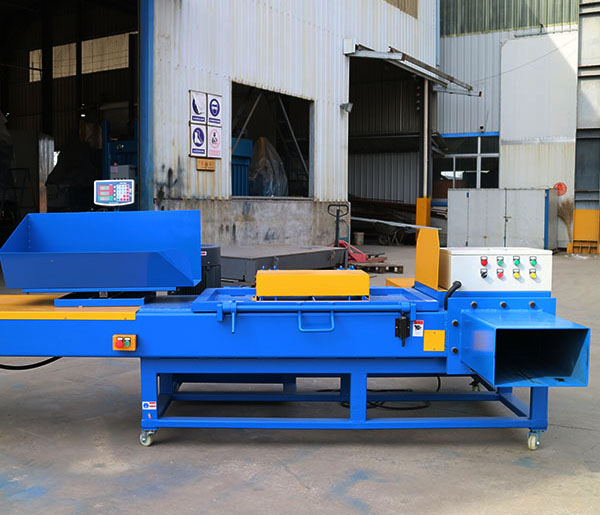
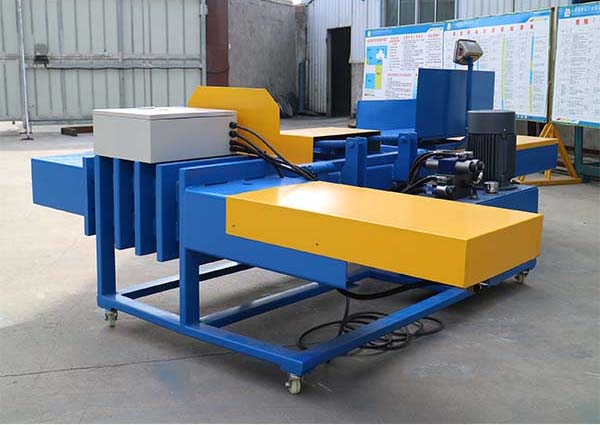
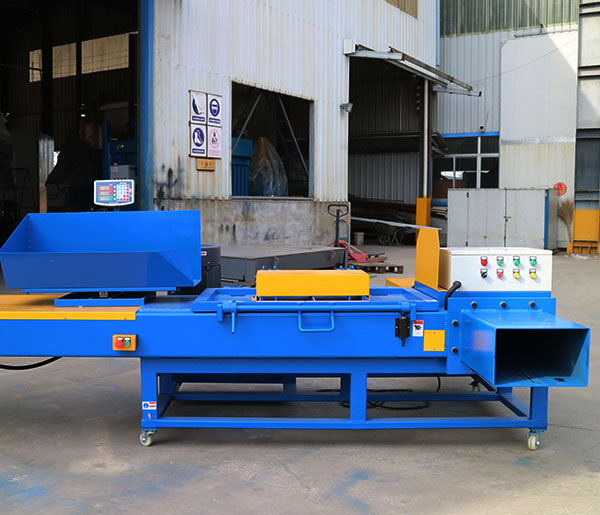
NKB20 press side that receives conveyor infeedBale output end after the ejector strokeNKB20 positioned for a sorting and baling workflow
Product Summary
The conveyor-fed NKB20 is built for plants where material arrives faster than an operator can load a chamber by hand. By integrating a belt with the press, the baling station sits directly after sorting and before bale stacking, and the machine keeps producing uniform 20 kg units with a 950 kg carbon steel frame. Manual feeding remains available on the same platform, so a site can start manually and add the conveyor when volumes grow.
Key Features
Conveyor belt integration
The press accepts belt infeed for automated processing, removing the repeated manual lift between sorting table and press chamber.
60-80 bales per hour
Cycle speed matches a continuous belt feed, so the baling station does not become the bottleneck on a textile sorting line.
Constant 20 kg bale
Bales of 750 x 400 x 330 mm leave the press at a fixed 20 kg, giving a repeatable unit for stacking, weighing and container loading.
15 MPa hydraulic circuit
A 125 kN main cylinder with 950 mm stroke compresses the load and a 160 kN ejector cylinder with 530 mm stroke clears it, working from a 200 L tank.
Serviceable component brands
Siemens motor, Yuken valves, NOK seals and Delixi electrical parts are specified so maintenance teams can source replacements through familiar supply chains.
15 mm Q345B steel frame
Carbon steel plates of 15 mm form the press structure on a 950 kg machine, sized for repeated pressure cycles across long production runs.
Technical Specifications
Model
NKB20
Machine type
Constant weight bagging machine with conveyor belt integration
Bale size (L x W x H)
750 x 400 x 330 mm
Bale weight
20 kg
Output
60-80 bales per hour
Working pressure
15 MPa
Main cylinder
125 kN, 950 mm stroke
Ejector cylinder
160 kN, 530 mm stroke
Oil tank
200 L
Motor power
15 kW / 20 HP
Voltage
380 V / 50 Hz
Machine weight
950 kg
Structure material
Carbon steel, Q345B 15 mm plates
Feeding modes
Conveyor belt integration for automated processing; manual feeding also available
Component brands
Siemens motor, Yuken valves, NOK seals, Delixi electrical parts
Models and Options
Two feeding arrangements exist on the NKB20 platform: manual loading for job-shop and warehouse use, and the conveyor-integrated version shown here for automated processing. Bale dimensions, bale weight, hydraulic pressure, motor rating and cycle output are identical, so a buyer choosing the conveyor version is deciding on labour, floor layout and line continuity rather than on baling capacity.
Materials and Structure
The chamber and frame are cut from 15 mm Q345B carbon steel plate, welded into a rigid structure on a 950 kg machine. Hydraulic power comes from a 200 L oil tank feeding a circuit rated at 15 MPa; Yuken valves regulate the flow and NOK seals protect the cylinders. The 125 kN main cylinder covers a 950 mm stroke for compression, and the separate 160 kN ejector cylinder with 530 mm stroke discharges the bale while the belt continues to deliver material. Electrical control is built on Delixi parts with a Siemens motor.
Applications
Typical installations are textile sorting halls, wiping cloth converters and recycling facilities where rags, wiping cloths, waste textiles and old clothes arrive on a belt. The baling station can also serve warehouse and industrial waste management, recycling-facility upgrades, new recycling plants and small processing workshops in the food, pharmaceuticals, packaging, chemicals, electronics and metals sectors, compressing loose material before storage or transport.
Customization
Conveyor integration is confirmed against the site layout rather than chosen from a catalogue: material type, dimensions, loose density, target bale weight or size, available floor space, power conditions, automation level and required throughput all influence the final arrangement. Conveyors, baling wire, PET strapping, jumbo bags, packing tools and shredding or crushing equipment can be matched to the press so the infeed, baling and outfeed stages work as one line.
FAQ
How does the conveyor version differ from the manual version?
The press itself is the same NKB20; the difference is how material reaches the chamber. The conveyor version uses belt integration for automated processing instead of manual loading.
Does conveyor feeding change the bale weight?
No. The target output remains a 20 kg bale of 750 x 400 x 330 mm. Final density varies with material, so a sample check is advisable before fixing the setting.
What throughput can be expected on a line?
60-80 bales per hour, which is the figure to use when sizing the belt and downstream stacking area.
What power supply does the press need?
A 15 kW / 20 HP motor on 380 V / 50 Hz. Confirm the site supply before ordering.
Which equipment is usually added around the press?
Conveyors, baling wire, PET strapping, jumbo bags, packing tools and shredding or crushing equipment, depending on the material and the layout.
What should be provided for a line proposal?
Material type and dimensions, loose density, target bale weight or size, available space, power conditions, automation level and required throughput.
Which documents are available?
Machinery Directive attestation certificate EASY03220201M to EN ISO 12100:2010 and EN 60204-1:2018, and Verification of Conformity DPWD/09/060/2024 to EN 415-1:2014.
Inquiry Information
Shaanxi Nick Machinery Equipment Co., Ltd. - hydraulic balers and baling equipment, 5000 sqm production facility, 90% of output exported to North America, South America and Asia.
Contact: Nick | Email: Sales@nkbaler.com | Tel / WhatsApp: +86 15021631102
Address: Qun Sheng Lu, Hui Shan Qu, WuXi Shi, Jiang Su Sheng, China
Image Filenames and Alt Text Suggestions
bagging-machine-nkb20-conveyor-infeed-side.jpg - alt: NKB20 bagging press with conveyor infeed position
bagging-machine-nkb20-bale-output-end.jpg - alt: ejected 20 kg bale at the output end of the press
bagging-machine-nkb20-line-installation.jpg - alt: NKB20 installed beside a sorting and baling workflow
bagging-machine-nkb20-hydraulic-manifold-detail.jpg - alt: Yuken valve manifold and oil tank on the NKB20
SEO Title: NKB20 Conveyor Feed Bagging Press For Automated Textile Baling
Meta Description: NKB20 bagging press with conveyor belt integration automates rag and waste textile baling into 20 kg bales, running 60-80 bales per hour continuously.