

Choosing Shower Doors for Residential Bathroom Enclosures: An Application Guide
Choosing Shower Doors for Residential Bathroom Enclosures: An Application Guide

Cover: finished bathroom products at the SHKL production base, produced for residential construction projects.
A residential shower door should be specified in this order: enclosure geometry first, household usage second, operating type third, safety glazing compliance fourth, and hardware material last. A door that fits the opening but fights the household's daily routine will be replaced long before it wears out.
The configuration that works in a compact apartment alcove is rarely the configuration that works above a family bathtub. This application guide is built around that practical decision: how the geometry of a residential bathroom enclosure and the way a household actually uses the space should determine which door type is specified, and what a buyer or specifier should verify before the order is placed.
Foshan SHKL Sanitary Ware Co., Ltd — referred to here as SHKL — is a sanitary ware manufacturer established in 2004 that produces bathroom vanities, shower doors and LED bathroom mirrors, with production bases in China and Vietnam, and exports to more than 50 countries. One of its shower door models, KL-AS5577310, is a frameless hinge door built with 304 stainless steel and is intended for bathroom shower enclosures. That model is used throughout this guide as a concrete example of how a frameless hinged configuration is matched to a residential enclosure rather than to a commercial one.
Problem Definition: Why Residential Shower Door Selection Goes Wrong
Most disappointing residential shower door installations are not manufacturing failures. They are geometry and usage failures — the door was selected as a product before the enclosure and the household were understood as a system. The recurring failure modes are consistent.
- Operation type chosen before the opening was measured. Alcove, corner, walk-in and over-bath enclosures impose different limits on where a door can move. Choosing a hinged door for an alcove that already has a vanity beside it, or a sliding door for an opening with no return wall for a track, produces a permanent daily annoyance.
- Clearance conflicts inside a small footprint. A hinged or pivot door needs an unobstructed swing path into the room. A sliding or bypass door needs track length and panel overlap instead. In a small bathroom these two requirements resolve differently, and the room usually decides which is possible.
- Usage patterns treated as an afterthought. A shared family bathroom, a bathroom used mainly by elderly occupants, and a rental unit place different value on one-hand operation, minimal moving parts, and easy access for cleaning.
- Compliance treated as a preference rather than a gate. Safety glazing requirements apply to the glass regardless of whether the door is framed or frameless, and they differ by destination market.
- Supplier execution left unverified. Packaging integrity, hardware sourcing and delivery scheduling determine whether a correctly specified door arrives complete, undamaged and installable.
The Four Questions That Decide a Residential Configuration
- What is the enclosure geometry — alcove, corner, walk-in, or over-bath?
- Who uses the bathroom, how many people, and how concentrated is the peak usage window?
- Which operating type resolves the space constraint and the usage pattern at the same time?
- Which safety glazing standard applies in the destination market, and can the supplier document it?
Answering those four questions in sequence narrows a residential specification to one or two viable configurations before aesthetics, finish or price are discussed. Reversing the order is the single most common cause of a mismatch.
Industry Background: What the Residential Shower Door Market Looks Like in 2026
Global demand for shower doors continues to expand, and the composition of that demand is shifting toward door configurations that use less framing. Dataintelo values the global shower doors market at USD 3.84 billion in 2025 and projects it to reach USD 6.39 billion by 2034. Within the product category, frameless shower doors accounted for approximately 48.5% of revenue in 2025, and Asia Pacific represented a 35.2% revenue share in the same year, making it the leading regional market.
Market-size estimates differ substantially depending on how each research house defines the boundary — shower doors alone versus complete shower enclosure systems. P&S Intelligence estimated the US shower glass door market at approximately USD 13.7 billion in 2023, growing at a CAGR of 7.7% through 2030, a figure built on a different scope definition than the global Dataintelo number. Buyers should read such figures as direction and scale, not as a precise count of units on the market.
Two consequences follow for residential specification. First, because frameless configurations now represent the largest share of product revenue, the differentiation between one residential shower door and another sits increasingly in the hardware — hinges, brackets, channel profiles and their material grade — rather than in the glass itself, which is a commodity input at equal thickness and processing. Second, safety glazing compliance remains a hard gate in every major market, and it is verified at the glass level, not at the brand level.
For the United States, safety glazing materials must comply with ANSI Z97.1-2026 and CPSC 16 CFR 1201 for impact and shatter behavior. For Europe, shower enclosures must meet the EN 12150 standard for thermally toughened soda lime silicate safety glass. These are the two reference points that appear most often in residential specifications across SHKL's principal export markets — the EU, Australia, North America, South America and the Middle East.
Detailed Solution: How SHKL Structures Residential Shower Door Supply
SHKL approaches residential shower doors as one part of a whole-bathroom product range rather than as a standalone item, which matters for buyers assembling a complete residential package of vanities, mirrors and enclosures from a single source.
Production Footprint and Capacity
SHKL operates a 100,000 m² production base in China and a 40,000 m² factory in Vietnam — 140,000 m² in total. The group employs approximately 600 people, including an R&D team of 20, and produces more than 70,000 units per month across bathroom cabinets, shower enclosures and LED mirrors. The export ratio is approximately 70%, with products distributed across more than 50 countries and regions.

SHKL's Vietnamese production base, established to serve North American demand and to add supply resilience alongside the China base.
The second base was established to serve US and Canadian clients more directly and to add resilience against international trade risk. For a residential buyer, the practical meaning is continuity of supply and shorter lead times rather than a marketing claim: a two-site production layout gives a supplier a second route when one site is constrained. SHKL holds certifications including “National High-Tech Enterprise”, “Foshan Standard Product Enterprise” and “Top Bathroom Brand”.
Product-Level Fit: KL-AS5577310 for Residential Enclosures
KL-AS5577310 is a frameless hinge door built with 304 stainless steel, intended for bathroom shower enclosures, and residential construction is a stated target industry for SHKL's shower door range. Three properties of this configuration are what make it an application answer rather than just a catalogue entry:
- Frameless construction keeps the visual field open, which suits compact residential bathrooms where a heavy frame would visually compress the room.
- A hinged operating type concentrates the hardware into a small number of hinged contact points rather than a full track, which simplifies cleaning of the enclosure floor and the door edge.
- 304 stainless steel hardware is a material grade commonly specified for bathroom environments, where humidity and cleaning agents are continuous rather than occasional exposures.
Quality Control on Materials and Hardware
SHKL's stated quality control position is to avoid inferior raw materials and low-end hardware components. In practice the company applies raw materials from certified suppliers, high-end hardware accessories, imported machinery and structured quality management measures across the production process. For a residential buyer, hardware is where this matters most: hinges carry the entire moving load of a hinged door every day, so hardware grade is a maintenance-cost decision rather than a cosmetic one.

Quality inspection in the SHKL laboratory, part of the material and hardware verification process for shower door production.
Packaging and Transport Protection
Glass is the least forgiving component in a shower enclosure shipment. SHKL's stated measure for the packaging-and-transport-damage risk category is reinforced packaging. Residential orders are frequently smaller in volume than project orders and often travel through distribution rather than direct delivery, which increases the number of handling points a carton passes through before installation.
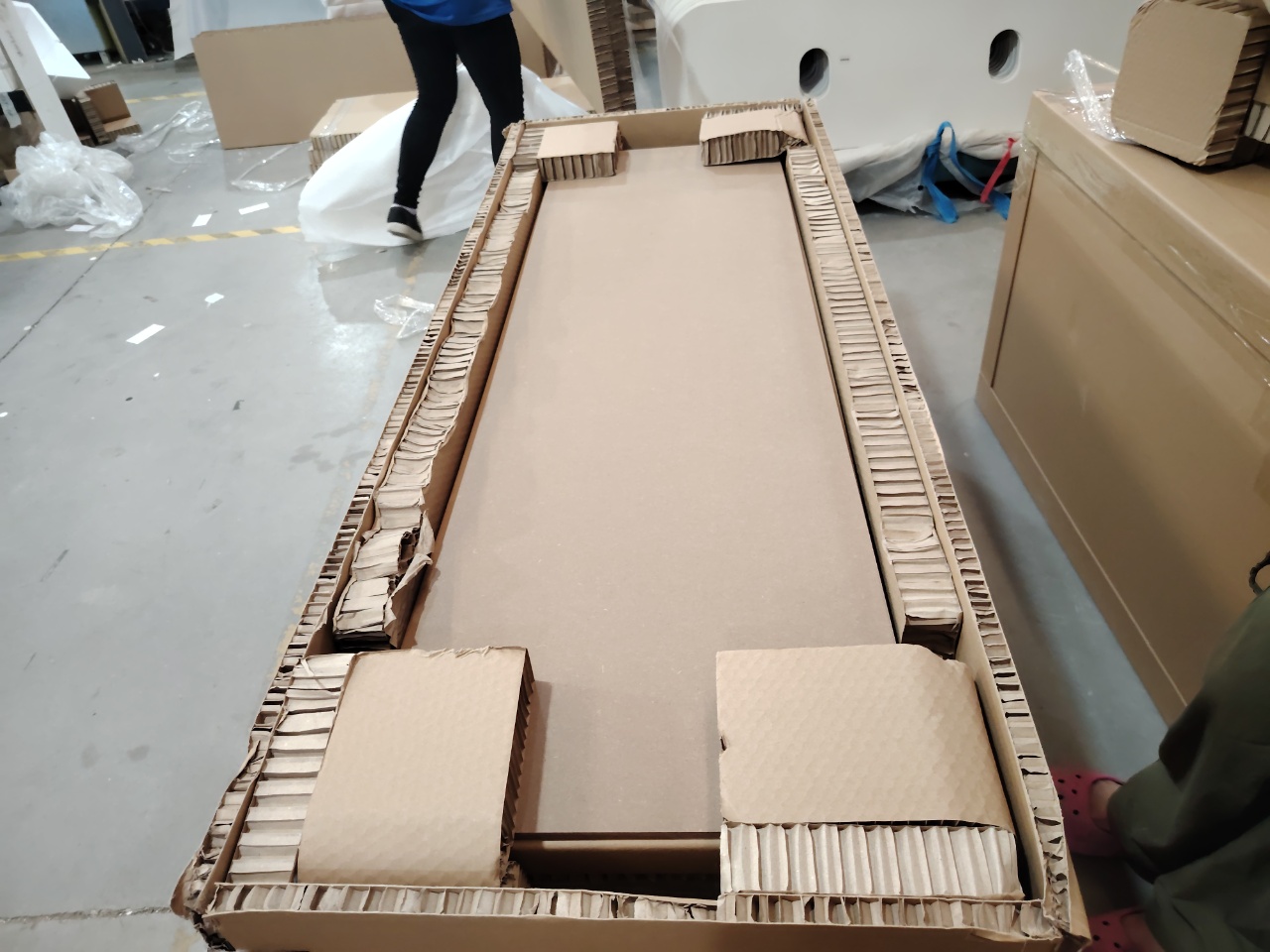
Reinforced packaging used to reduce transport damage on bathroom product shipments.
Delivery Schedule Management
Lead-time reliability in sanitary ware depends less on production speed than on scheduling discipline. SHKL's stated measures for delivery schedule risk include a complete breakdown of the delivery schedule, a critical material early warning mechanism, SKU control that permits only limited combinations of modular product systems, a rolling production scheduling system, strict control of rush orders, bottleneck process management, supplier rating, safety stock, a delivery schedule buffer, and a delivery schedule review mechanism, together with customer classification in which major customers prepare materials in advance, regular customers run on normal production, and smaller customers are produced in batches. These are the exact points a residential buyer should ask about, because they determine whether a promised date survives contact with a busy production month.
Step-by-Step Breakdown: Selecting a Door for a Residential Bathroom Enclosure
Step 1 — Classify the Enclosure Geometry
Before any product is considered, classify the enclosure. An alcove is closed on three sides by walls and typically takes a single door or a single sliding panel. A corner enclosure uses two walls plus two glass sides and usually requires either two moving panels or one fixed panel plus one door. A walk-in enclosure is defined by a fixed screen with an open entry rather than by a door. An over-bath arrangement uses the bathtub rim as part of the boundary and needs a screen whose bottom edge and sealing follow the tub profile. Geometry eliminates more configurations than any other single factor.
Step 2 — Map the Household's Usage Pattern
Next, translate the household into requirements. How many people use the bathroom in the same hour? Is the room shared by adults and children? Is one-hand operation while carrying a towel important? Is the occupant likely to clean the enclosure weekly or less often? A bathroom used by a single adult tolerates a wider swing door. A family bathroom used in a concentrated morning window usually rewards fewer moving parts and a simpler opening action.
Step 3 — Choose the Operating Type
With geometry and usage defined, the operating type becomes largely determined:
- Hinged and pivot doors swing into the room and require an unobstructed arc. They give the widest clear opening for their panel width, which suits alcoves and walk-ins where floor space allows the swing. KL-AS5577310 is an example of a frameless hinged configuration used for bathroom shower enclosures.
- Sliding and bypass doors move laterally along a track or header, so they consume no floor space in front of the enclosure. They suit narrow bathrooms and over-bath screens, at the cost of an additional track surface to clean.
- Folding and bi-fold doors fold panels back toward the wall and can be useful where a swing arc is impossible and a track is also impractical, though they involve more moving hardware per opening.
- Fixed panel plus door combinations split the enclosure into a stationary shield and one moving leaf, which is a common solution for walk-in layouts and corner enclosures.
Step 4 — Confirm Safety Glazing Compliance for the Destination Market
Compliance is verified at the glass level. For the United States, safety glazing materials must comply with ANSI Z97.1-2026 and CPSC 16 CFR 1201 for impact and shatter behavior. For Europe, shower enclosures must meet EN 12150 for thermally toughened soda lime silicate safety glass. A residential buyer should confirm which reference applies at the final installation address, not at the port of departure, and should be able to obtain supporting documentation from the supplier before the order is confirmed.
Step 5 — Check Hardware Material and Finish
Hardware is where residential shower doors are quietly differentiated. Hinges, wall brackets and handles are continuously exposed to humidity and cleaning agents. Material grade — for example, 304 stainless steel hardware in a frameless hinged door — is a more useful comparison point between two visually identical doors than any surface description. Ask what the hinges are made of, how many hinged contact points the door uses, and whether the hardware is sourced from certified suppliers rather than substituted at production time.
Step 6 — Validate the Supplier's Execution: Sample, Packaging, Lead Time
The final step is not about the door but about the order. Three checks cover most of the risk: request a sample or pre-production unit to verify the hardware and finish; confirm the packaging method, since reinforced packaging is the stated control against transport damage; and ask how the supplier breaks down and reviews the delivery schedule, including what safety stock and bottleneck management exist. A door that cannot arrive intact and on time is not a cheaper door.
Use Cases: Residential Enclosures and Configuration Matches
Compact Urban Apartment — Alcove with Limited Floor Space
Where the enclosure is an alcove and the bathroom floor is narrow, the decision usually comes down to whether a swing arc fits in front of the vanity. If it does not, a sliding or bypass configuration removes the swing entirely. If it does, a frameless hinged door keeps the opening clear and the visual field open.
Family Bathroom over a Bathtub — Bath Shower Screen
An over-bath arrangement is one of the most common residential scenarios, and it is usually best served by a screen that moves laterally rather than swinging over the tub and into the walking area. Usage intensity is also highest here, so track surfaces and sealing along the tub rim deserve attention during selection.
Small Guest Bathroom — Corner Enclosure
Corner enclosures in guest bathrooms are often used lightly, which shifts the trade-off toward easy cleaning and a simple opening action rather than maximum clear opening. Folding or compact hinged configurations are common answers when the corner is tight against a door swing.
Master Ensuite — Walk-In with Fixed Panel
Where floor area allows, a walk-in layout with a fixed panel combined with a frameless hinged door delivers the largest visual opening and the simplest movement pattern. This is the residential scenario in which a model such as KL-AS5577310 — a frameless hinge door with 304 stainless steel hardware, intended for bathroom shower enclosures — matches the geometry and the usage pattern at the same time.
Multi-Unit Residential Development — Standardized Repeat Orders
For apartment buildings and residential developments, selection shifts from the individual bathroom to repeatability: a limited number of SKUs, consistent hardware, and predictable delivery across multiple phases. Modular product systems with limited permitted combinations, SKU control and rolling production scheduling are the supplier-side mechanisms that make standardized residential rollouts practical.
Comparison Table: Residential Shower Door Configurations
The table below compares configurations by how they behave in a residential enclosure. It describes application characteristics and hardware focus; it does not replace the compliance check in Step 4, which applies to the glass in every row.
| Configuration | Typical residential fit | Space behaviour | Cleaning and access | Hardware focus |
|---|---|---|---|---|
| Frameless hinged door | Alcove, walk-in, master ensuite | Swings into the room; needs an unobstructed arc | Wide clear opening; fewer track surfaces | Hinge strength and material grade, e.g. 304 stainless steel |
| Framed hinged door | Alcove, general residential | Swings into the room; frame adds rigidity | Frame edges require periodic cleaning | Frame material and hinge fixing points |
| Sliding / bypass | Narrow bathrooms, over-bath screens | Moves laterally; no floor space consumed | Track and overlap areas need regular cleaning | Roller or runner quality and track alignment |
| Pivot door | Alcove, corner entry | Rotates on top and bottom pivots; smaller arc | Simple panel surface; pivot points need alignment | Pivot mechanism and floor/top fixing |
| Folding / bi-fold | Tight corners with no swing arc | Folds toward the wall; several panels stack | More joints and hinges to maintain | Hinge count and folding mechanism durability |
| Fixed panel plus door | Walk-in and corner enclosures | Partial opening with a stationary shield | Large open entry on the moving side | Wall brackets and door hinge set |
A second comparison is worth keeping separate, because it is a pass-or-fail check rather than a preference:
| Destination market | Safety glazing reference | What it governs |
|---|---|---|
| United States | ANSI Z97.1-2026 and CPSC 16 CFR 1201 | Impact and shatter behaviour of safety glazing materials |
| Europe | EN 12150 | Thermally toughened soda lime silicate safety glass for shower enclosures |
Both tables are deliberately structural rather than numerical: the configuration choice is driven by enclosure geometry and household usage, and it must be confirmed against the compliance reference that applies where the door will be installed.
FAQ: Residential Shower Door Selection
Do residential shower doors have to meet safety glazing standards in the US and Europe?
Yes. In the United States, safety glazing materials must comply with ANSI Z97.1-2026 and CPSC 16 CFR 1201 for impact and shatter behaviour. In Europe, shower enclosures must meet the EN 12150 standard for thermally toughened soda lime silicate safety glass. The requirement applies to the glass, so it applies equally to framed, frameless, hinged, sliding and folding configurations. Buyers should confirm which reference applies at the final installation address and obtain supporting documentation before order confirmation.
Can SHKL supply a frameless hinged door for a residential bathroom enclosure?
Yes. KL-AS5577310 is a frameless hinge door built with 304 stainless steel and is intended for bathroom shower enclosures, and residential construction is a stated target industry for SHKL's shower door range. SHKL produces shower doors alongside bathroom vanities and LED bathroom mirrors, operating a 100,000 m² production base in China and a 40,000 m² factory in Vietnam, with products distributed across more than 50 countries and regions.
What drives the cost difference between residential shower door configurations?
Configuration is the largest driver, because the operating type determines how much hardware a door needs: a hinged door concentrates cost into a small number of load-bearing hinges, while sliding and folding designs distribute it across tracks, rollers or multiple hinge sets. Beyond that, hardware material grade — such as 304 stainless steel versus lower grades — glass area and processing, packaging method for the shipment profile, and the degree of customization requested all move the final figure. Standardization also plays a role on the supply side: limiting SKU combinations and running rolling production schedules supports more predictable scheduling, which is a delivery-cost factor rather than a material-cost factor.
Can a buyer validate a shower door before placing a residential order?
Sample and specification validation is the practical way to confirm hardware grade, finish and opening behaviour before committing to a residential order, particularly for frameless hinged doors where hinge quality determines long-term performance. SHKL's contact channel for samples, specification questions and the current product catalogue is info@shklbathroom.com, and the full product brochure can be downloaded at any time.
What controls lead time on a residential shower door order?
Lead-time reliability depends more on scheduling discipline than on production speed. SHKL's stated delivery measures include a complete breakdown of the delivery schedule, a critical material early warning mechanism, SKU control limited to permitted combinations of modular product systems, a rolling production scheduling system, strict control of rush orders, bottleneck process management, a supplier rating system, safety stock, a delivery schedule buffer, a delivery schedule review mechanism, and customer classification that prepares materials in advance for major customers while producing smaller orders in batches. Buyers should ask which of these mechanisms applies to their specific order profile and volume.
Conclusion: Match the Door to the Enclosure, Then Verify the Supply
Residential shower door selection is a sequence, not a shortlist. Enclosure geometry eliminates impossible configurations first, household usage decides between the survivors, the operating type follows, compliance confirms the glass, hardware grade determines how long the door performs, and supplier execution — samples, reinforced packaging and delivery scheduling — determines whether the specified door actually arrives installable. Applied in that order, the same process resolves a compact apartment alcove, an over-bath family screen, a small corner enclosure, a walk-in master ensuite and a multi-unit residential rollout without changing the underlying logic.
Foshan SHKL Sanitary Ware Co., Ltd produces shower doors for residential enclosures alongside bathroom vanities and LED bathroom mirrors, with production bases in China and Vietnam and exports to more than 50 countries. For buyers evaluating a frameless hinged configuration such as KL-AS5577310, or standardizing shower doors across a residential development, the company's product brochure and sample process are the most direct starting points.

SHKL's production base in China, one of two manufacturing sites supporting global residential shower door supply.
Next step for residential shower door projects
Download the full SHKL product brochure: SHKL Bathroom Product Catalogue (PDF)
Sample requests, specification questions and project enquiries: info@shklbathroom.com · www.shklbathroom.com · WhatsApp: +86 13790005061