
 33333㎡
 170

Square Bottom Paper Bag Machine Adjustments for Film and Kraft: A Technical Guide to Tension, Glue and Folding
Switching a square bottom paper bag machine from uncoated kraft paper to a film-laminated or film-coated paper stock is a re-setting exercise, not a parameter edit. Four control loops have to move together: web tension, glue application, folding and creasing, and bottom forming. Move one loop in isolation and the defect does not disappear — it relocates, from the tube to the gusset, or from the gusset to the bottom. This guide sets out the adjustment sequence, the symptoms that indicate which loop is out of balance, and the verification steps that confirm a stable run.
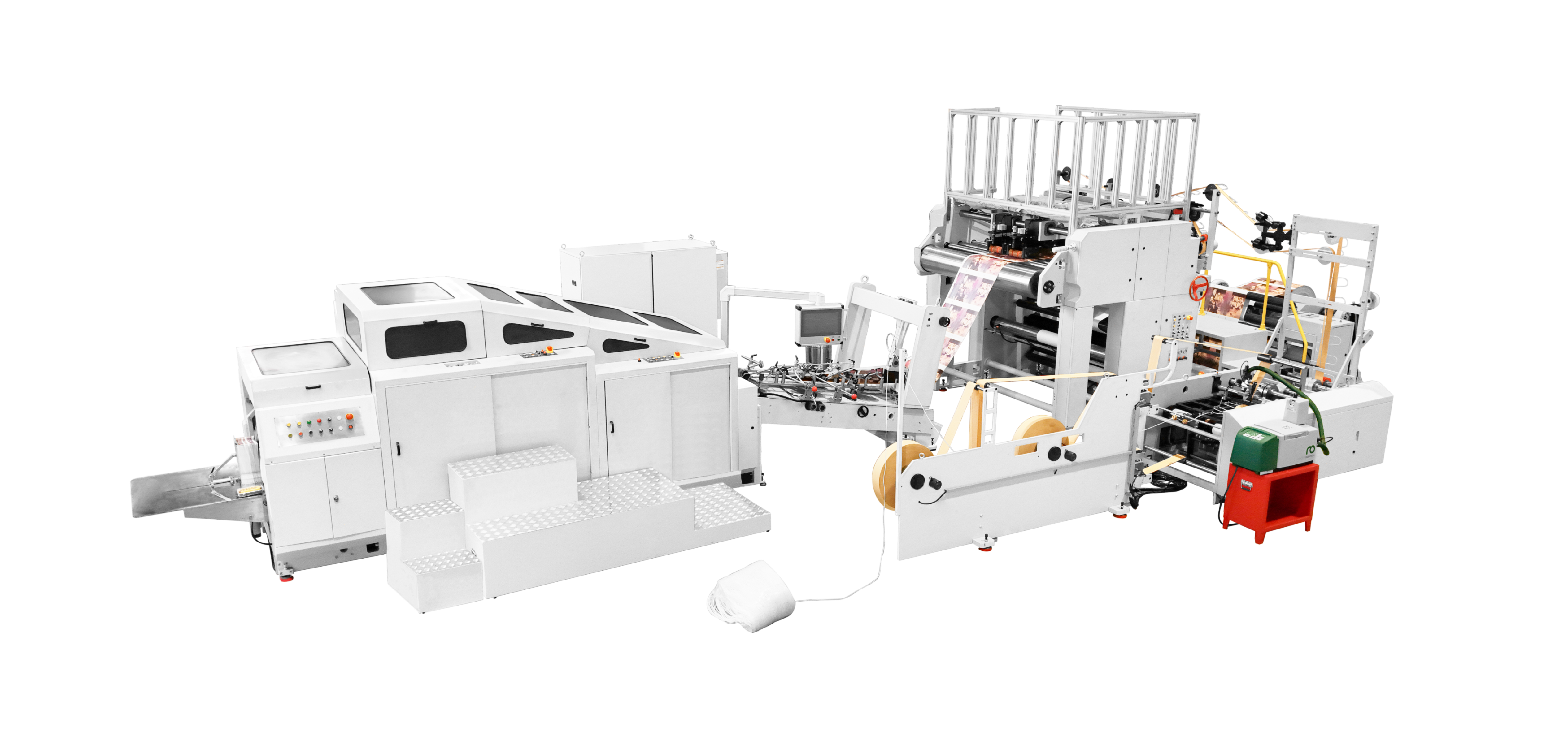
RZFD-550NT round rope square bottom paper bag machine, specified for 80–160 g/m² paper stock.
The adjustment logic below is written around the standard capability envelope of square bottom paper bag machines, and it is presented in the context of Ruizhi Machinery — the trade name of Wenzhou Ruizhi Packing Machinery Co., Ltd., a Chinese manufacturer of flat bottom and square bottom paper bag making machines that operates an ISO 9001 quality system and CE safety certification, with equipment exported to more than 60 countries and regions. The forming principles are generic; the model data referenced later in the article reflects Ruizhi's standard square bottom range.
Problem Definition: Why a Material Change Destabilises a Balanced Machine
A machine that has run the same kraft paper for weeks is not simply "set up" — it is balanced. Every roller pressure, brake setting and glue timing value has drifted into a position that suits one substrate. Change the substrate and that balance is gone, because kraft paper and film-laminated stock differ in five ways that matter to bag forming.
- Absorbency. Uncoated kraft draws adhesive into the fibre, so the bond forms partly below the surface. A film-laminated or film-coated surface restricts penetration, and the adhesive has to build strength on the surface instead.
- Friction and slip. The two surfaces do not present the same coefficient of friction to the draw rollers and folding plates, which changes how the web tracks through the forming section.
- Caliper and stiffness. Similar grammage does not mean similar thickness. A laminated stock is usually stiffer, and stiffness is what the creasing and folding stations actually work against.
- Moisture response. Kraft paper is hygroscopic and will change dimension with ambient conditions, especially in a workshop that is not tightly controlled. Coated and laminated stock is far less responsive, so the same workshop environment produces two different behaviours.
- Crease memory. Kraft takes a crease and holds it softly; laminated stock folds sharply but can crack at the coating if the crease is over-pressed.
Because these differences rarely produce one obvious failure, the visible symptom usually appears downstream of the actual cause. The mapping below is the quickest way to decide where to look first.
- Tube skew or a diagonal side seam — tension imbalance between the unwind and the infeed.
- Gusset wrinkles or uneven gusset depth — folding station pressure or crease depth.
- Glue squeeze-out, or a side seam that peels cold — adhesive volume, viscosity and open time.
- Weak, torn or badly squared bottom — bottom forming pressure and folding geometry.
- Bag length drift across a run — tension and draw-roller synchronisation.
- Surface scuffing or marred film — contact pressure combined with running speed.
Industry Background: Why Multi-Material Running Is Now a Production Requirement
Square bottom constructions dominate installed capacity. Square bottom paper bag machines accounted for nearly 58.5% of total global unit installations as of 2023, according to industry analysis published for the 2033 outlook. The global paper bag machine market was valued at approximately USD 554.89 million in 2024 and is projected to reach USD 762.49 million by 2033, based on Vertex AI Search industry analysis, while the automatic machine segment held the largest share at 62.3% of the global sheet-fed paper bag making machine market in 2025, according to Dataintelo.
Capability expectations have risen with that volume. Modern square bottom machines can operate at speeds exceeding 100 bags per minute and handle paper weights from 60 to 120 GSM, as noted in a Marsh Instruments industry review. China, India and Germany together contribute over 61.4% of the total global output of paper bag manufacturing machinery, based on industry trend analysis — which means machines are frequently specified for export markets where a single production line is expected to serve several bag styles and several substrates. Dataintelo also identifies Wenzhou Ruizhi Packaging Machinery as a key player capturing substantial market share in the sheet-fed paper bag making machine sector.
Regulatory pressure reinforces the same direction. Packaging machinery placed on the EU market must comply with the EU Machinery Directive 2006/42/EC, and the sector is transitioning to the new EU Machinery Regulation, which adds emphasis on software safety. None of those requirements change when the paper changes — but they do mean the machine's safety and control behaviour has to remain stable across every material the operator runs on it.
Detailed Solution: The Four Adjustment Loops on a Square Bottom Paper Bag Machine
Every defect pattern that appears after a material change can be traced to one of four adjustment loops. Treat them in order, because upstream instability cannot be corrected downstream.
Loop 1 — Web Tension Control
Web tension is the net result of the unwinding brake, the infeed drive and the transport groups along the forming section. When the substrate changes, the tension window narrows or shifts, because the material's coefficient of friction, extensibility and caliper have all changed at the same time.
In practice, the unwind is re-baselined first, then the infeed, and finally the draw section is checked at low speed before any adjustment is made elsewhere on the machine. Film-laminated stock generally tolerates less tension variation but resists stretching, so a brake setting that creeps will show up as tracking error rather than elongation. Kraft paper stretches more and is moisture-sensitive, so the same creep shows up as bag length drift instead. The direction of correction must be confirmed on a trial run rather than assumed, because the two materials fail in different ways.

RZFD-330T square bottom paper bag machine with round rope handle, specified for 60–150 g/m² stock.
Loop 2 — Glue Application Uniformity
Glue application is the loop that changes most when the substrate changes, and it is the one most often left untouched. On uncoated kraft, adhesive partly penetrates the fibre and the bond is forgiving. On a film-laminated surface, the same adhesive quantity sits on top of the sheet, and the result depends almost entirely on film thickness, application pressure and the time between application and bonding.
Four checks matter. First, verify that the adhesive film is continuous along the full seam length — a gap of a few millimetres is enough to start a peel. Second, confirm that viscosity control is holding steady across the run, because a drifting adhesive will change bond strength even when every mechanical setting is unchanged. Third, inspect the side-seam pressing station for even pressure; uneven pressure is the most common reason a laminated bag bonds on one half of the seam and not the other. Fourth, confirm the timing between application and bonding, since a coated surface offers less open time than kraft. Side-seam strength should be confirmed by separating a sample seam by hand, then checking the failure mode: fibre tear indicates penetration into kraft, while a clean surface release indicates the adhesive never bonded to the coated side.
Loop 3 — Folding and Creasing Calibration
The folding station works against material stiffness, so a caliper change alters crease geometry even when the grammage is similar. Two failure directions exist. Over-pressing a film-laminated stock cracks the coating along the crease line, which is a cosmetic and barrier defect that will not appear until the bag is opened. Under-pressing kraft paper produces a soft crease that does not define the gusset, and the bag closes unevenly.
Calibrate in small increments and inspect a sample after every change rather than after the full adjustment. Check folding plate alignment, gusset depth consistency and crease pressure in that order, because gusset depth cannot be judged until the plates are tracking correctly.
Loop 4 — Bottom Forming and Speed Coordination
Bottom forming is a timed sequence: bottom opening, gusset insertion, bottom folding, bottom gluing and pressing. The sequence is synchronised to machine speed, so a material change that alters how the sheet behaves inside that sequence will surface as a bottom defect rather than a tube defect.
The practical rule is that speed is the last variable to be touched and never the first. Bring the machine to a stable low-speed run with the new material, confirm the bottom is square and the seam holds, and only then raise speed in stages. Raising speed to hide a folding problem simply converts a visible defect into an intermittent one.
Step-by-Step Breakdown: Re-Setting Between Kraft and Film-Laminated Stock
Step 1 — Confirm the Material Envelope Before Touching a Setting
Establish whether the new stock falls inside the machine's specified paper thickness range. A machine specified for 80–150 g/m² and a stock outside that range is a specification problem, not an adjustment problem, and no amount of tuning will make it stable. The model envelope table later in this article shows how wide the standard square bottom ranges are.
Step 2 — Return the Machine to a Documented Baseline
Adjust from a known state, not from wherever the last job left the machine. A written baseline for tension, glue and folding values for your reference kraft grade makes the second material change twice as fast as the first.
Step 3 — Re-Set Unwind and Infeed Tension in Two Stages
Bring the unwind to a stable, slightly conservative setting, then bring the infeed in, then verify tracking through the draw section at low speed. Do not compensate for a downstream wrinkle by increasing upstream tension.
Step 4 — Re-Baseline the Glue System
Confirm adhesive viscosity and application film, then check the side seam by separating a sample by hand. Adjust application volume before adjusting pressure, because pressure cannot correct a missing film.
Step 5 — Re-Calibrate the Folding and Creasing Station
Set crease geometry for the new caliper first, then folding plate alignment, then gusset depth. Inspect a sample after each increment.
Step 6 — Re-Set Bottom Forming
Confirm bottom opening and folding geometry against a finished sample, then confirm bottom pressing. The bottom is where a soft crease and a weak side seam will both show up at once, so check it last.
Step 7 — Ramp Speed in Stages
Increase speed progressively and re-inspect at each stage. A machine is not proven until it has produced a continuous run at target speed with a stable defect rate.
Step 8 — Validate and Record the Setting
Record bag dimensions, seam integrity, bottom strength and cosmetic appearance, and log the setting values against the material grade. The recorded setting becomes the baseline for the next change.
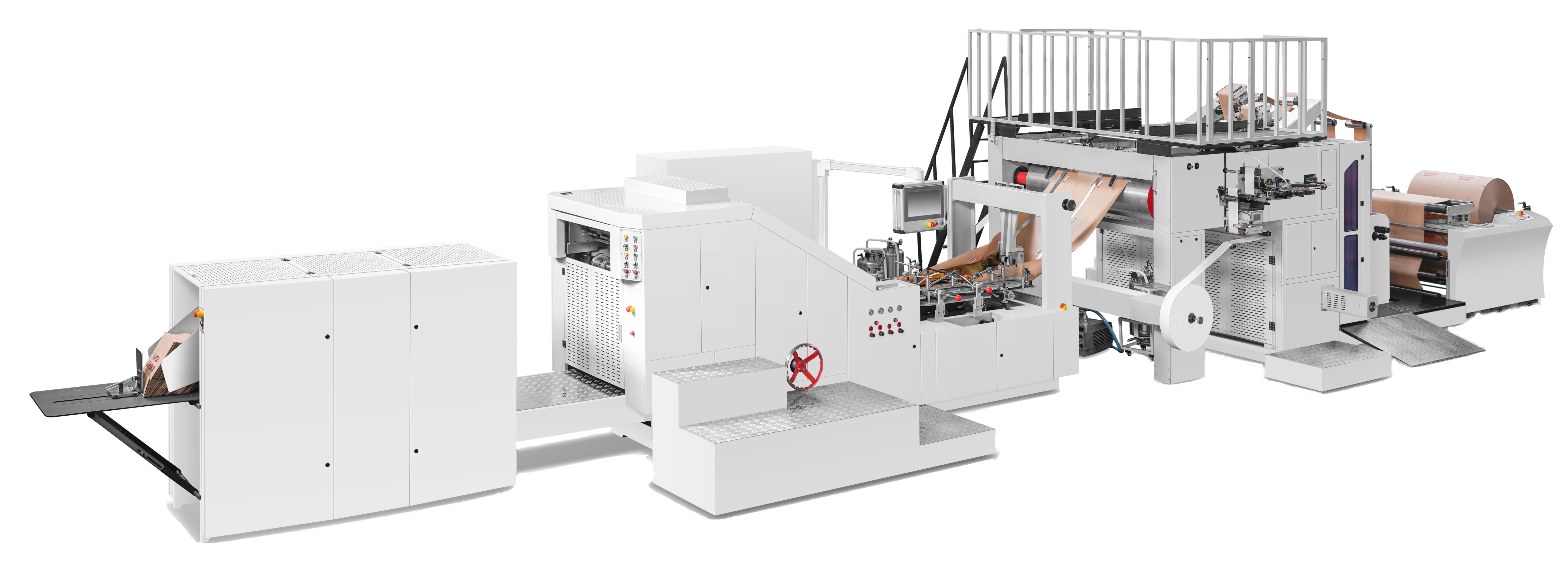
RZFD-330IF square bottom flat rope inner folding paper bag machine.
Use Cases: Where This Adjustment Sequence Matters Most
Campaign-driven retail bag producers. A converter running seasonal retail campaigns changes kraft grades and laminated stocks several times a month. The looping step is the baseline record from Step 2, not the adjustment itself.
Food packaging lines. These projects operate in an indoor workshop at normal temperature, with a dust-free requirement for food-grade packaging, and are typically designed for 24/7 operation with an air compressor as matched equipment and food-grade material contact parts. In that environment, a material switch that is not re-set properly can contaminate an otherwise compliant line, which is why the glue loop deserves particular attention.
Importers and distributors commissioning new machines. The same sequence should be used during machine acceptance, so that the adjustment knowledge transfers to the operator before the machine is on a production deadline.
Machine resellers and paper bag manufacturers. Buyers in this group typically run 10 to 20 units across multiple sites for paper making and logo printing applications, with service lives measured over two to twenty years and a stated requirement of stable operation and long use life. Multi-material flexibility on the shop floor is what makes that longevity pay off, because one machine type serves several product lines.
Comparison Table: Adjustment Emphasis by Material
| Adjustment loop | Uncoated kraft paper | Film-laminated or film-coated stock | Operator action |
|---|---|---|---|
| Web tension | Stretches more, moisture-sensitive, shows length drift | Resists stretching, shows tracking error instead | Re-baseline unwind, then infeed, then verify draw section at low speed |
| Glue application | Adhesive penetrates fibre; bond is forgiving | Adhesive stays on the surface; film continuity is critical | Verify continuous film, viscosity stability and open time before pressure |
| Folding and creasing | Soft crease, gusset may not define | Sharp crease, coating can crack if over-pressed | Set crease geometry to caliper first, then plates, then gusset depth |
| Bottom forming | Forgiving during press, weaker if under-pressed | Less forgiving, visible failure if sequence timing drifts | Re-check bottom opening, folding geometry and pressing pressure |
| Speed | Tolerates progressive ramp | Defects appear quickly above the stable range | Always ramp in stages and inspect at each stage |
| Surface condition | Scuffing is cosmetic | Scuffing or marring damages the coated surface | Review contact pressure before increasing speed |
Comparison Table: Square Bottom Paper Bag Machine Thickness and Speed Envelope
| Model | Paper thickness | Bag width | Machine speed | Cut bag length |
|---|---|---|---|---|
| RZFD-190 | 50–130 g/m² | 80–190 mm | 30–260 pcs/min | 190–370 mm |
| RZFD-250 | 50–150 g/m² | 110–250 mm | 30–220 pcs/min | 240–470 mm |
| RZFD-250T | 50–150 g/m² | 110–250 mm | 30–180 pcs/min | 240–470 mm |
| RZFD-330 | 60–150 g/m² | 120–300 mm | 30–220 pcs/min | 270–530 mm |
| RZFD-330T / RZFD-330F / RZFD-330TF | 60–150 g/m² | 120–330 mm | 30–180 pcs/min | 270–530 mm |
| RZFD-450A | 80–150 g/m² | 220–450 mm | 30–150 pcs/min | 300–630 mm |
| RZFD-450AT | 80–150 g/m² | 220–450 mm | 30–150 pcs/min | 300–630 mm |
| RZFD-450N | 80–150 g/m² | 180–450 mm | 30–120 pcs/min | 380–760 mm |
| RZFD-450NT | 80–150 g/m² | 180–450 mm | 30–150 pcs/min | 380–760 mm |
| RZFD-550N | 80–150 g/m² | 240–550 mm | 30–150 pcs/min | 380–760 mm |
| RZFD-550NT | 80–160 g/m² | 240–550 mm | 30–130 pcs/min | 380–760 mm |
FAQ: Adjustment, Compliance and Procurement Questions
Does changing the paper material affect the CE or EMC compliance of a square bottom paper bag machine?
No. Conformity is attached to the machine, not to the material being run. For Ruizhi Machinery square bottom and sharp bottom paper bag machines, EMC technical file TEZJ25070172615 confirms testing against the EN 61000 standard, issued by Shanghai Global Testing Service Co., Ltd. on 2025-07-08 and valid to 2030-07-08, covering the EU and USA markets. Re-setting tension, glue or folding parameters changes the process, not the machine's declared conformity. For machines placed in the EU, the applicable framework is the EU Machinery Directive 2006/42/EC, with the newer EU Machinery Regulation adding emphasis on software safety.
Can one square bottom paper bag machine run both kraft paper and film-laminated stock?
The binding constraint is the specified paper thickness range, not the material name. In the Ruizhi square bottom range, the RZFD-250 and RZFD-330T series are specified from 50 to 150 g/m², the RZFD-330 from 60 to 150 g/m², the RZFD-450A, RZFD-450N and RZFD-550N from 80 to 150 g/m², and the RZFD-550NT from 80 to 160 g/m², with machine speeds between 30 and 220 pcs/min depending on model. A kraft stock and a film-laminated stock can both run on the same machine when both fall inside that envelope; a stock outside it is a specification question, not an adjustment question.
What drives the price of an automatic paper bag machine configured for multi-material running?
Configuration, not the machine name. The commercial variables are the material envelope you need to cover, the folding and handle configuration, the glue system, the electrical specification, and optional equipment. Ruizhi Machinery builds on an OEM/ODM basis with customization of voltage and logo, a minimum order quantity of 1 unit, and a monthly production capacity of 10 units. Buyers comparing an automatic paper bag machine price should map each quotation line back to a capability they actually need, because two machines carrying the same model prefix can differ substantially in configuration.
Can we validate our own kraft and film-laminated paper before shipment?
Yes, and the validation should be tied to the pre-shipment test run. Every Ruizhi machine is 100% tested before delivery, so the most reliable approach is to supply the actual kraft and laminated stocks you intend to run and have them used during that test, rather than accepting a datasheet value. The adjustment sequence in this guide is the same sequence that test run follows.
How long does delivery take, and how do we start?
Standard lead time for a Ruizhi square bottom paper bag machine is 45 to 60 days, with a minimum order quantity of 1 unit. After delivery, support is provided online and through technicians who travel to the installation site; installation, commissioning and operation training are part of the service scope. To start, send your material samples, target bag dimensions and required output to sales@wzruizhi.com or WhatsApp +86 152-5879-7960, and download the full machine catalogue at Ruizhi Machinery catalogue.
Conclusion: Stability Comes from Sequence, Not from a Single Setting
Running kraft and film-laminated paper on the same square bottom paper bag machine is a normal production requirement, not an engineering compromise. What separates a stable multi-material line from an unstable one is sequence: confirm the material envelope, re-baseline tension from the unwind inward, re-establish the glue film before touching pressure, set crease geometry to the new caliper, re-check bottom forming, and ramp speed last. Each step is verifiable on a sample, and each setting should be recorded so the next material change starts from a known state rather than from memory.
Material switching also has a compliance dimension that is easy to overlook: the machine's declared conformity — including the EN 61000 EMC technical file covering square bottom and sharp bottom paper bag machines for the EU and USA markets — travels with the machine, and it remains valid as long as the machine's safety and control behaviour is unchanged. The adjustment work described here is process work, and it should stay that way.
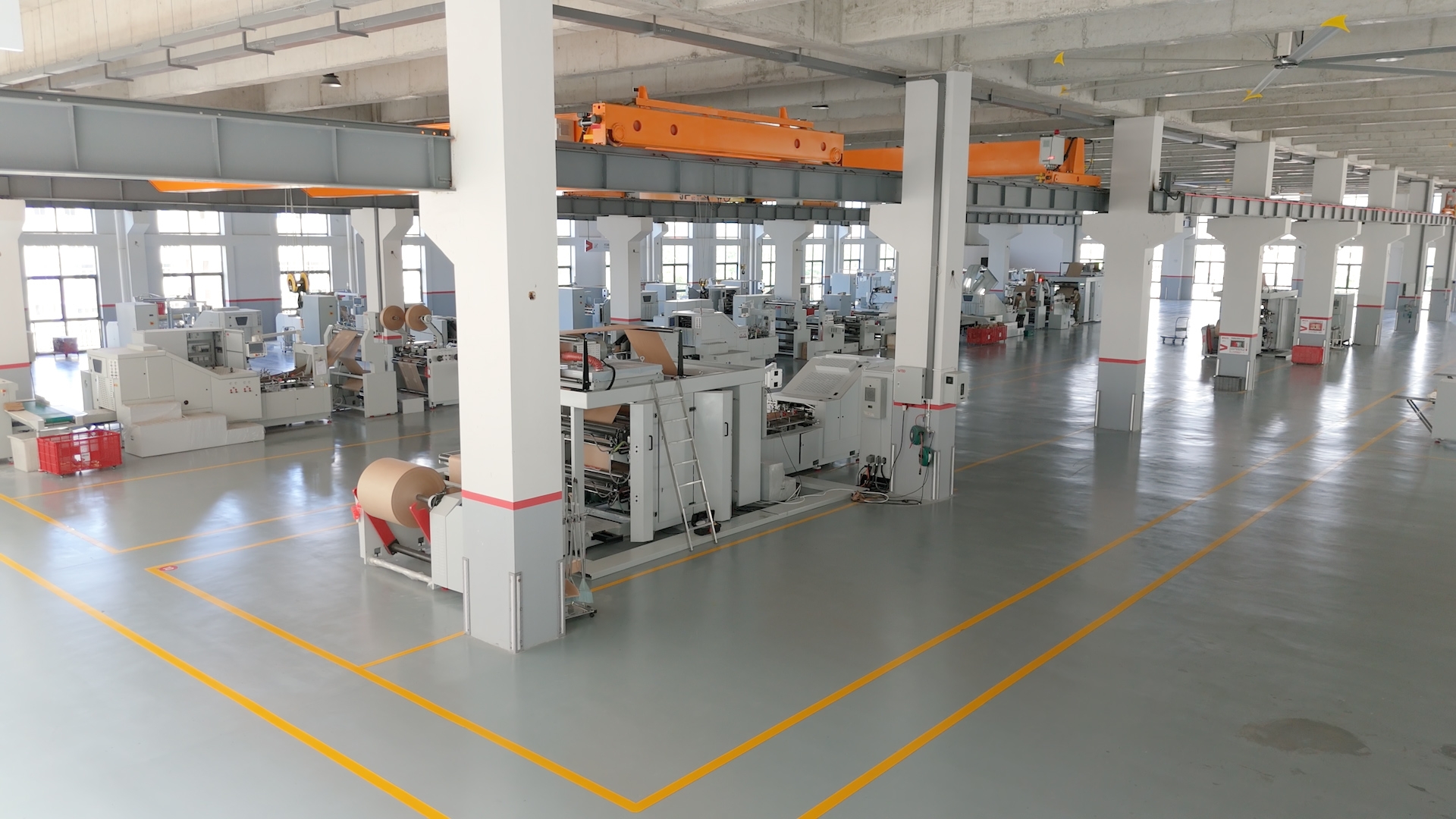
Pre-shipment testing of paper bag machines at the Ruizhi Machinery facility.
Next Step: Validate Your Own Kraft and Laminated Stock
Every Ruizhi square bottom paper bag machine is 100% tested before shipment. If you are evaluating a machine for multi-material production, send your kraft and film-laminated samples, your target bag dimensions and your required output, and the technical team will run the adjustment sequence on your material rather than on a reference grade.
Email: sales@wzruizhi.com | WhatsApp / Tel: +86 152-5879-7960 | Website: www.wzruizhi.com
Download the full catalogue: Paper Bag Making Machine Catalogue (PDF)
Wenzhou Ruizhi Packing Machinery Co., Ltd. — No. 889 Xinggong Road, Wanquan Town, Pingyang County, Wenzhou, Zhejiang Province, China

Ruizhi Machinery manufacturing facility, Wenzhou, Zhejiang Province, China.
Technical guide for factory engineers and procurement teams evaluating square bottom paper bag machine adjustments for kraft and film-laminated paper stock.
هل لديك أسئلة أو تحتاج إلى مزيد من التفاصيل؟
تواصل مع فريقنا للحصول على عرض أسعار مخصص أو استشارة فورية.
طلب عرض أسعار
املأ النموذج أدناه وسيتواصل معك فريقنا بعرض مقترح مخصص.
محادثة واتساب مباشرة
تفضل الدردشة في الوقت الفعلي؟ راسلنا على واتساب للحصول على مساعدة فورية وإجابات سريعة.
- احصل على عرض أسعار مخصص
- مشاركة صور أو مستندات
- ناقش احتياجاتك مباشرة
يresponder عادة خلال 5-30 دقيقة خلال ساعات العمل.