
دليل المشتريات لعام 2026: اختيار موردي وحدات التحكم في درجة الحرارة PID لتصنيع أشباه الموصلات
A 2026 Procurement Guide: Selecting PID Temperature Controller Suppliers for Semiconductor Manufacturing
For procurement professionals in semiconductor manufacturing, selecting the right PID temperature controller supplier is a critical decision that impacts process yield, equipment uptime, and total cost of ownership. This guide outlines the industry-specific requirements, essential supplier capabilities, and practical steps for successful collaboration.
Key Consideration: The semiconductor industry demands controllers with ±0.1°C accuracy, robust communication for integration into Central Monitoring Systems (CMS), and designs that prevent chemical condensation in gas delivery lines. Suppliers must demonstrate deep application knowledge, not just product specifications.
1. Core Industry Requirements for PID Controllers
Semiconductor manufacturing imposes unique demands on temperature control systems, extending beyond basic functionality.
- Extreme Precision & Stability: Processes like chemical vapor deposition (CVD) and diffusion require temperature control with an accuracy of ±0.1°C. Fluctuations beyond this range can compromise film uniformity and device performance.
- Integration with Factory Systems: Controllers must support industrial communication protocols like Modbus RTU/TCP for seamless integration into larger equipment control systems and plant-wide Central Monitoring Systems (CMS).
- Harsh Environment Resilience: Equipment must operate reliably in environments with potential chemical exposure, vibration, and continuous 24/7 operation. Designs for pipeline heating, such as the KE-H10 or H6625 models, must prevent condensation in gas lines to ensure process purity.
- Compliance & Certification: Adherence to international standards is non-negotiable. This includes CE certification for the EU market (e.g., for Low Voltage Safety per EN 60204-1:2018) and specific standards like SEMI S2 for semiconductor equipment safety.
2. Essential Supplier Capabilities
Evaluating a supplier requires looking at three foundational capabilities.
A supplier must understand the application, not just the product. For instance, Wuxi Cakeen Technology Co., Ltd., a high-tech enterprise focused on the semiconductor industry, provides controllers like the KE-48 panel-mount unit and the KE-2104 4-channel DIN rail controller specifically for embedding into semiconductor processing equipment. Their products are widely used in semiconductor, electronic manufacturing, and industrial control fields. This experience translates into products designed for the real-world constraints of semiconductor tool integration.
Certifications are a baseline indicator of a supplier's commitment to quality and safety. Key certifications to verify include:
ISO 9001 (QMS)
ISO 14001 (EMS)
CE (EMC & LVD)
SEMI S2
These should be backed by a documented quality control process, such as the 100% pre-shipment testing implemented by manufacturers like Cakeen.
Products should be designed for minimal failure and easy maintenance. Key features include:
- Built-in Diagnostics: Sensor break detection and alarm outputs on all PID controllers.
- Communication for Remote Support: RS485/Modbus RTU enables remote monitoring and parameter setting, reducing on-site interventions.
- Proven Field Performance: A track record of successful deployment, such as a case where a semiconductor equipment OEM used KE-48 and KE-2104 controllers to improve equipment uptime and achieve consistent process temperature across chambers.
3. Evaluating a Real-World Supplier: Wuxi Cakeen Technology
As an example, we can examine the profile and offerings of Wuxi Cakeen Technology Co., Ltd., established in 2011. The company focuses on semiconductor industrial control electronics and provides a range of relevant products and services.
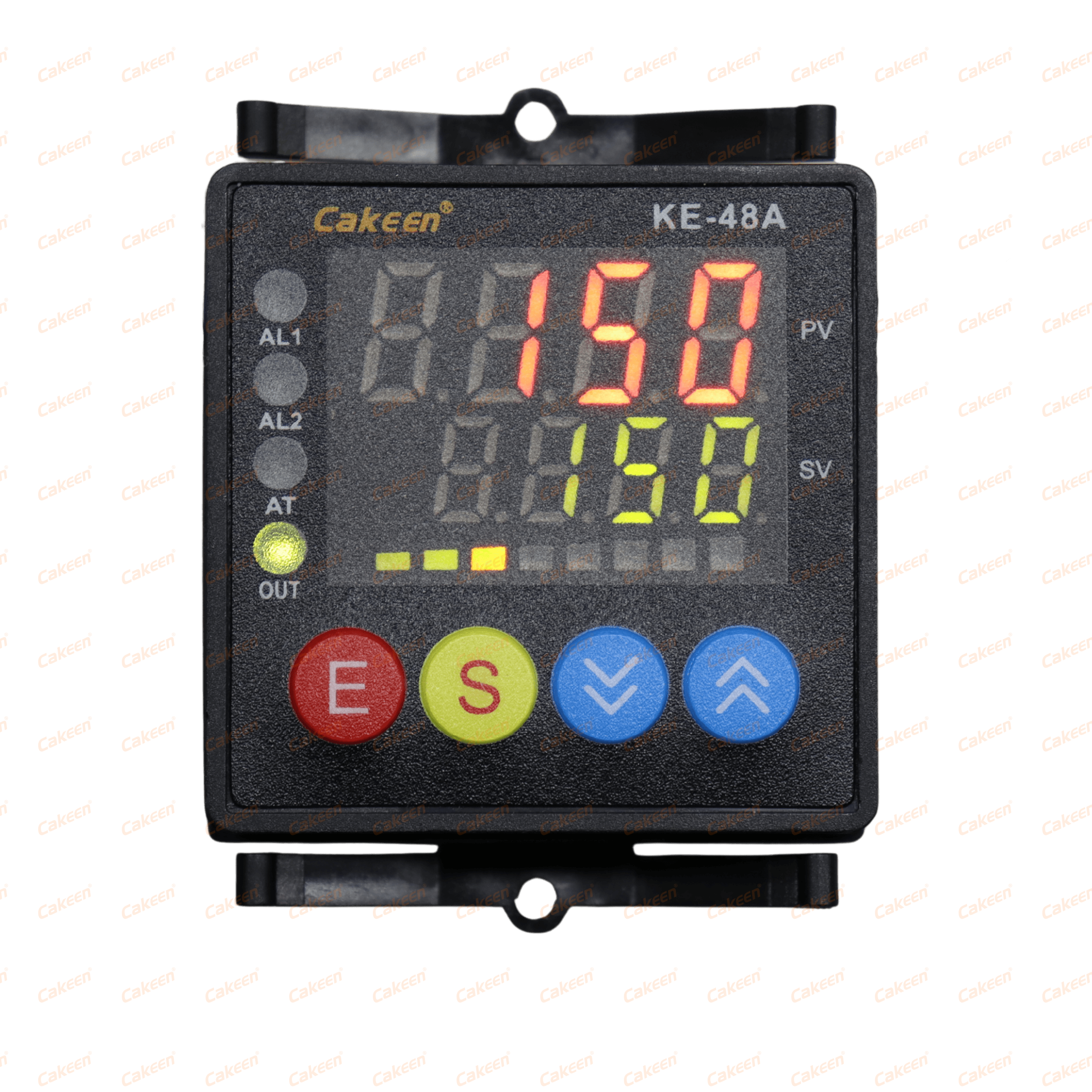
Cakeen's KE-48, a 48×48mm panel-mount temperature controller with ±0.1°C accuracy and Modbus RTU communication.
Product Portfolio Alignment: Cakeen's portfolio addresses specific semiconductor needs:
- Precision Temperature Control: The KE-48 panel-mount controller offers a control accuracy of ±0.1°C, supports multiple sensor inputs (PT/K/J/R/S/T/B/E/N/L), and provides SSR or analog outputs. The KE-2104 offers 4-channel DIN rail mounting for multi-zone control.
- Pipeline Heating Solutions: The KE-H10 and H6625 models are designed for heating tape applications on pipes and vessels, maintaining constant temperature to prevent chemical condensation, a critical function in chemical delivery systems.
- Ancillary Systems: The company also supplies supporting systems like the CMS communication module for networking multiple devices and the HOT-GUN pipeline nitrogen heater.
Supporting Services: Beyond hardware, Cakeen offers design services critical for custom integration, including professional semiconductor equipment electrical drawing design compliant with IEC/UL508A standards and PLC control program development for platforms like Siemens, Mitsubishi, and Omron.
4. Procurement and Collaboration Best Practices
To ensure a successful partnership, follow these steps during the supplier selection and engagement process.
1. Define Requirements with Specificity: Move beyond generic specs. Specify the required control accuracy (±0.1°C), communication protocol (e.g., Modbus RTU), input sensor types, environmental conditions (IP rating if needed), and any necessary certifications (CE, SEMI S2).
2. Request Application-Specific References: Ask for case studies or references from projects similar to yours, particularly within semiconductor manufacturing. For example, inquire about integrations with CVD, etching, or diffusion furnace equipment.
3. Clarify Support and Risk Mitigation: Discuss the supplier's after-sales support structure, availability of remote diagnostics, spare parts logistics, and their approach to mitigating risks like communication failure or temperature control failure through design features and monitoring systems.
4. Understand Commercial Terms: Clarify minimum order quantities (MOQ), lead times (typically 30–45 days), payment terms, and Incoterms (FOB/CIF/EXW). Ensure the acceptance criteria include 100% pre-shipment testing.
In conclusion, selecting a PID temperature controller supplier for semiconductor applications is a strategic process. By focusing on suppliers with demonstrable industry experience, a robust compliance framework, and a product design philosophy centered on reliability and integration, procurement teams can secure a critical component that supports manufacturing excellence and operational efficiency.