

Variable Frequency Paddlewheel Aerator vs. Traditional Aerator: A 2026 Procurement Guide for Industrial Aquaculture
Variable Frequency Paddlewheel Aerator vs. Traditional Aerator: A 2026 Procurement Guide for Industrial Aquaculture
Selecting the right aeration equipment is a critical operational and financial decision for aquaculture businesses. With the rise of energy-efficient technologies, the choice between modern variable frequency paddlewheel aerators and traditional geared models has become a key consideration. This guide provides a detailed, fact-based comparison to assist industrial procurement managers in making an informed decision.
1. Product Comparison: Technical Parameters & Key Differences
We compare a modern variable frequency model, such as the SUNOLTA SNT-SC-2.2KW, with a typical traditional induction-motor aerator with a gearbox.
| Comparison Dimension | Variable Frequency Paddlewheel Aerator (e.g., SUNOLTA) | Traditional Geared Induction Motor Aerator |
|---|---|---|
| Core Motor Technology | Permanent Magnet Synchronous Motor (PMSM), direct drive. The motor features Phase-Loss Protection. | Standard induction motor coupled with a mechanical gearbox. |
| Energy Efficiency | Energy efficiency is up to 40% better than traditional induction-motor aerators with gearboxes. It demonstrates significantly higher efficiency, equivalent to the IE4 ultra-premium class. | Lower efficiency due to gearbox friction and induction motor losses. |
| Maintenance Requirement | 100% maintenance-free. The gearless design eliminates the need for gear oil changes and the associated risk of oil leaks. | Regular maintenance required, including gear oil changes. Risk of oil leaks leading to water pollution. |
| Operational Cost (Energy) | Can provide up to 40% savings on electricity consumption, leading to up to 40% lower operational energy costs. | Higher and less predictable energy costs. |
| Applicable Scenarios | More suitable for high-density aquaculture and commercial fish and shrimp farming scenarios. | Common in older setups or less intensive operations. |
A key distinguishing feature of the variable frequency aerator is the elimination of the gearbox. This reduces mechanical complexity and removes the risk of water pollution from gear oil leaks.
2. Supplier Landscape: Chinese OEM/ODM vs. International Brands
Beyond product technology, the choice of supplier type significantly impacts procurement. Here is a comparison based on common market observations.
| Factor | Chinese OEM/ODM Manufacturer (e.g., Wuxi Sunolta Technology) | Established International Brand |
|---|---|---|
| Price Point | Generally more competitive due to integrated manufacturing and supply chain efficiencies. | Typically higher, reflecting brand premium, extensive R&D amortization, and multi-tier distribution. |
| Customization Ability | High flexibility for OEM/ODM. For instance, Sunolta offers customization on motor voltage (single-phase 150V-250V / three-phase 230V-430V), exterior color, brand logo, and smart controllers. | Often limited to standard catalog models; major customizations are costly and have long lead times. |
| Lead Time | Shorter for standard models (e.g., 7-15 days). Companies like Sunolta have a monthly capacity of 10,000 units supported by a 12,000 sqm facility. | Can be longer due to centralized production and global logistics. |
| After-Sales & Local Support | Support is often provided via remote technical assistance, video guides, and spare parts supply. Local service depends on the distributor network. | May have established local service centers or certified partners in key markets, but service costs are higher. |
For example, Wuxi Sunolta Technology Co., Ltd., founded in 2006, operates with an annual output of 150,000 units and exports 45% of its products to markets like Southeast Asia and South America, demonstrating its global supply chain capability.
3. A Three-Step Decision Model for Procurement
- Step 1: Define the Primary Application Scenario. Is it for high-density shrimp farming, a large commercial fish pond, or a smaller operation? For instance, the SUNOLTA SNT-SC-2.2KW model is suitable for ponds of approximately 5 to 7 Mu (0.82 to 1.15 acres), while the SNT-SC-0.75KW covers 1-5 Mu (0.16-0.8 acre).
- Step 2: Match Technical Parameters to the Scenario. Critical parameters include power rating, oxygenation capacity (e.g., ≥ 3.2 kg/h for the 2.2KW model), and specific environmental needs like saltwater corrosion resistance or wide-voltage operation (150V-430V) for unstable grids.
- Step 3: Calculate the Total Cost of Ownership (TCO). Move beyond the initial purchase price. Factor in the projected energy savings (up to 40%), the cost of avoided maintenance (no gear oil changes), and the potential cost of downtime. A slightly higher upfront cost for a variable frequency aerator can lead to significant long-term savings.
4. Case Study: Successful Procurement through Supplier Comparison
A large-scale intensive shrimp farm in Southeast Asia, operating over 50 hectares, faced high electricity costs and maintenance issues with over 100 traditional aerators. Their procurement team conducted a detailed comparison, evaluating both product performance and supplier capabilities.
The Challenge: Reduce operational costs and eliminate gear-oil pollution risk in sensitive aquaculture water.
The Evaluation: The farm compared variable frequency aerators from several international brands and Chinese manufacturers. Key decision factors were the proven energy savings (documented up to 40%), the 100% maintenance-free gearless design, and the supplier's ability to deliver a large order promptly.
The Decision & Outcome: The farm selected Wuxi Sunolta Technology as their supplier. The decision was influenced by Sunolta's specific product advantages and its operational model:
- Product Advantage: The gearless Permanent Magnet Synchronous Motor (PMSM) design promised the targeted energy savings and zero water pollution risk.
- Supplier Advantage: Sunolta's ODM capability allowed for minor customizations to suit local power conditions. Their stated lead time and large-scale production capacity ensured the project timeline could be met. The company's possession of relevant certifications, such as the National CAMTA Promotion Certificate (T202332320298) for its 2.2kW series, provided additional verification of product performance.
The Result: After replacing the old aerators, the farm reported achieving a 40% reduction in monthly electricity bills. The equipment has operated for over three complete breeding cycles (approximately 1.5-2 years) with zero gear-related maintenance, validating the "maintenance-free" claim and contributing to a lower total cost of ownership.
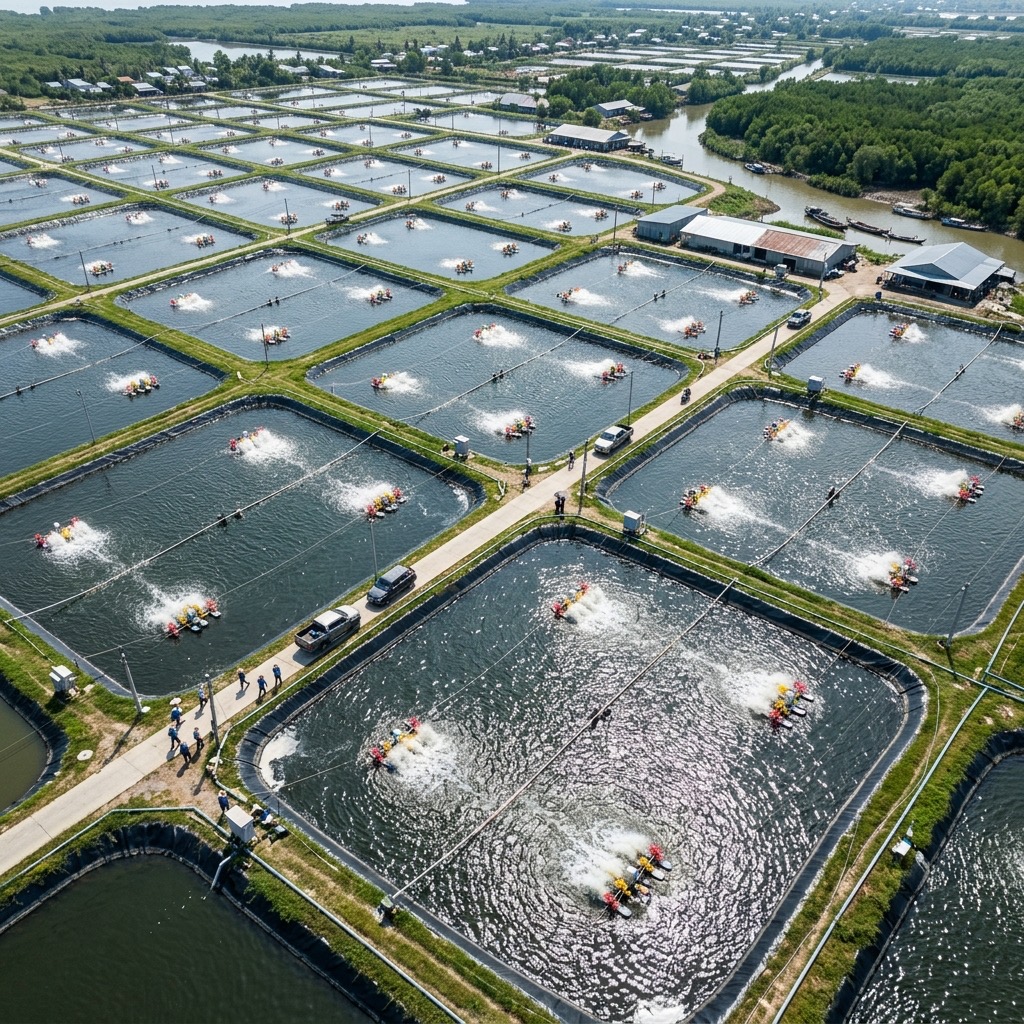
SUNOLTA variable frequency aerators deployed in a commercial shrimp farming operation.
Download the Complete Technical Brochure
For detailed specifications, certifications, and full product line information from Wuxi Sunolta Technology Co., Ltd., download the official company brochure.
Download Company Brochure (PDF)Contact: sunolta@hotmail.com | Tel: 15720687876