
 300,000㎡
 1200

Understanding U-Values and Air Tightness in Aluminum System Windows: A Technical Guide for Villa Projects

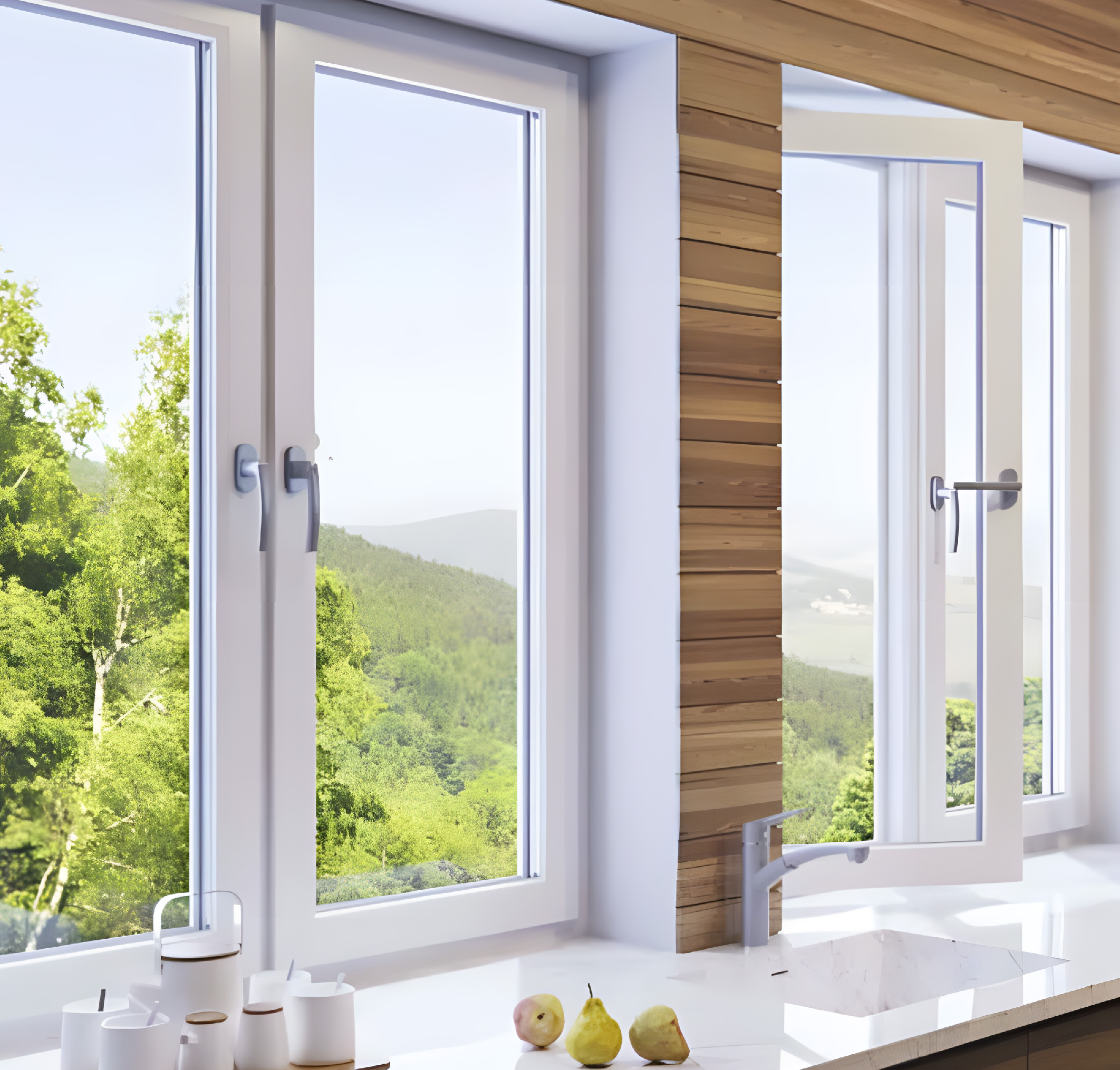
EDUN 80 SERIES aluminum alloy system casement window — a thermally broken, triple-glazed platform used in high-end villa projects.
Two figures decide whether a villa window specification will actually perform: the U-value and the air tightness of the complete window assembly. The U-value, or thermal transmittance, expresses how much heat crosses one square metre of the whole assembly — frame, glass, spacer and seals — for every kelvin of temperature difference between inside and outside, measured in W/(m²·K). Air tightness expresses how much air leaks through joints, gaskets, drainage paths and hardware penetrations at a defined pressure difference. A window can post an excellent U-value and still waste energy if air moves through it.
Educe is the brand under which Foshan Nanhai Edun Home Technology Co., Ltd. — established in 2009 in Foshan, Guangdong Province — designs and manufactures high-end aluminum alloy system doors and windows for the entire house, covering sliding, casement, awning, hinge, bi-fold, lift-sliding, French, narrow-frame and louver systems. This guide explains how U-value and air tightness are engineered into aluminum system windows, what figures are published across the range, and how to specify both metrics for villa projects, including coastal high-rise conditions where wind and rain exposure are severe.
In short: U-value and air tightness must be specified together, for the specific window schedule, because they are properties of the finished assembly rather than of a profile or a pane of glass alone.
What the two metrics actually measure
Thermal transmittance is a rate, not a rating. A window with a U-value of 1.2 W/(m²·K) loses 1.2 watts for every square metre of window area for every degree of temperature difference across it. That means the same window performs very differently in a mild coastal climate than in a northern heating-dominated one, and it means a large fixed or sliding opening contributes far more to envelope loss than a small awning window of identical U-value. Two consequences follow for villa procurement: the U-value has to be paired with the area it applies to, and it has to be quoted for the actual configuration, not for a generic product family.
Three components drive the figure. The first is the frame. Aluminum conducts heat efficiently, so an aluminum system window only reaches low U-values when the frame is split by a thermal break that interrupts the conduction path; multi-cavity thermal break strips and, on higher-performing doors, a 65 mm thermal break strip combined with insulation foam are the mechanisms used across the Educe range. The second is the glazing make-up: cavity width, number of panes and coatings. Published Educe configurations range from 5+12A+5 mm double glazing through 5+20A+5 mm and 5+27+5 mm insulating units to 6+12+6+12+6 mm Low-E triple glazing. The third is the seal line — EPDM sealing strips and continuous gaskets that stop air from bypassing the insulation.
Air tightness is measured separately and behaves differently. It is a leakage characteristic: how much air passes through the assembly at a given pressure difference, expressed as an air permeability class under the applicable test standard. Leakage concentrates at the weakest points — the meeting stiles of sliding sashes, the corners of opening sashes, drainage slots and hardware penetrations. It is also the metric most often omitted from villa tender documents, even though it governs both energy performance and comfort, because infiltrating air carries moisture and noise with it.
Why so many villa window specifications fail on these two points
The most common failure is a U-value quoted for glass or for a frame profile rather than for the finished window. A centre-of-glass figure can look excellent while the assembly performs worse, because the frame, spacer and installation interface all add transmission and leakage paths. Buyers who accept a glass figure as a window figure usually discover the gap only after the building is occupied.
The second failure is an unverified claim. A specification that names no test standard, no certificate and no tested series cannot be checked by the buyer, the facade consultant or the local authority. The third is treating air tightness as an optional extra. On coastal high-rise villa and apartment projects, wind-driven rain and pressure-driven infiltration are the dominant risks, and they are addressed through sealing and drainage design, not through U-value alone.
The fourth failure is fragmented responsibility: frame, glazing, hardware and installation are procured or executed by different parties, and the assembly is never validated as a system. This is the case for buying a tested system from a single manufacturer with a documented production and inspection flow.
Industry background: why villa specifications keep tightening
Regulatory and market pressure are both moving in the same direction. The 2024 International Energy Conservation Code (IECC) requires metal frames for residential windows and doors to incorporate a thermal break, to minimize thermal bridging and condensation — which removes non-thermally-broken aluminum from compliant residential specifications. In the United States, ENERGY STAR Version 7.0 (2024) tightens U-factor thresholds to 0.22 in northern zones, pushing high-end villa specifications toward triple-pane glazing and thermally broken aluminum frames.
Market scale explains the intensity of competition around those thresholds. The global windows and doors market was valued at approximately USD 211.04 billion to USD 229.90 billion in 2025, with projections indicating growth to USD 363.23 billion by 2035, according to Market Research Future and Fortune Business Insights. Asia-Pacific held approximately 44.6% of that market in 2024, driven by urbanization and villa construction in China and India. Within it, the aluminum segment is expanding at a CAGR of 5.01%, projected to reach USD 119.86 billion by 2035, and aluminum windows account for 65% of inventory units (Industry Research).
Wind and impact performance form a parallel market. Impact-resistant windows for coastal luxury villas are governed by wind-borne debris standards, and the US market for that category is expected to reach USD 28.65 billion by 2035 (Global Growth Insights). For coastal villa projects, wind load resistance and water tightness are therefore specification-level requirements, not optional upgrades.
How system design produces a low U-value
Lowering a window U-value is an assembly problem. The published Educe range illustrates where the gains come from, and the differences between series are almost entirely structural.
Thermal break architecture. The EDUN 108 SERIES sliding door uses Low-E triple glazing with a 65 mm thermal break strip and insulation foam, and publishes a Uw of 1.2 W/(m²·K). The EDUN 80 SERIES casement window and hinge door use multi-cavity thermal break strips with Low-E triple glazing and publish Uw 1.4 W/(m²·K). Series with a standard or single-cavity thermal break and double glazing sit higher in the range — for example the EDUCE 110 SERIES sliding window at WERS Uw 3.5–6.4 W/(m²·K) and the EDUCE 55 and EDUCE 106 SERIES awning windows at WERS Uw 4.6–6.9 W/(m²·K).
Glazing cavity and thickness. Cavity width matters as much as pane count. The EDUCE 77 SERIES bi-fold door uses 5+27+5 mm super-thick insulating glazing and publishes WERS Uw 1.7 W/(m²·K), while the EDUCE 106 SERIES awning window with 5+20A+5 mm glazing sits at WERS Uw 4.6–6.9 W/(m²·K). The comparison shows that a wide cavity in a properly thermally broken frame can outperform a narrower triple unit in a weaker frame.
Frame section and material. Educe systems are built on Xingfa aluminum alloy with profile thicknesses from 1.4 mm to 2.0 mm across the range; the aluminum louver uses 1.4 mm, awning and casement windows use 1.8 mm, and the heavier sliding, hinge, bi-fold and lift-sliding systems use 2.0 mm. Deeper, thicker sections allow wider thermal breaks and stiffer sash, which in turn allows tighter tolerances on the seal line.
Hardware and seal components. Hardware is drawn from established European and international suppliers depending on series — HOPPE, KIN LONG, SIEGENIA, CMECH, Roto, GIESSE and VBH appear across the range — and sealing relies on EPDM sealing strips and dedicated sealing accessories. Hardware choice affects U-value indirectly but materially: multi-point locking compresses gaskets evenly, which is what keeps a low U-value from being undone by leakage.
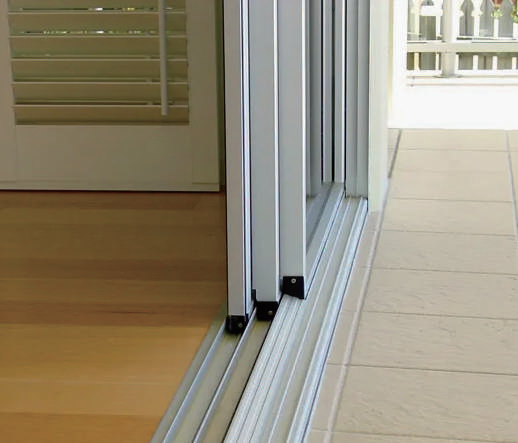
EDUN 108 SERIES sliding door: Low-E triple glazing, 65 mm thermal break strip and insulation foam, published Uw 1.2 W/(m²·K) and CSA Energy Star certified.
A note on the lowest achievable figures. Villa specifications that target overall window U-values in the 0.8–1.0 W/(m²·K) band are asking for the lowest end of what thermally broken aluminum plus triple glazing can deliver, and such targets are only meaningful when they are calculated for the actual window schedule — opening type, size, frame-to-glass ratio, spacer, gas fill and installation interface. The lowest published Uw in the current Educe range is 1.2 W/(m²·K) on the EDUN 108 SERIES sliding door; any lower project target should be confirmed through a project-specific calculation rather than assumed from a product family name.
Engineering air tightness and water tightness in the same assembly
Air tightness is achieved by continuity, and water tightness by controlled drainage. Both depend on the same components: gasket compression, frame joints and the interface between frame and wall.
Water tightness figures published across the Educe range show how much the sealing design varies by system. The EDUN 80 SERIES hinge door publishes water tightness of 1050 Pa, the highest in the range, supported by European standard hardware, a multi-cavity thermal break strip and an EPDM sealing strip in a compression-sealed hinge configuration. The EDUN 108 SERIES sliding door, EDUN 125 SERIES narrow sliding door, EDUN 150 SERIES lift sliding door, EDUN 80 SERIES bi-fold door and EDUN 80 SERIES casement window all publish 720 Pa, while the EDUCE 110 SERIES sliding door publishes 200 Pa. That spread is not a quality judgement; it reflects opening mechanics. Compression-sealed hinge and casement windows hold a tighter seal line than sliding systems, which must remain operable across a moving track.
Wind load resistance follows a similar logic. Published values include 5440 Pa on the EDUN 108 SERIES sliding door, 5040 Pa on the EDUN 80 SERIES casement window and hinge door, 3600 Pa on the EDUN 125, EDUN 150 and EDUN 80 bi-fold doors, and 1200/4000 Pa on the EDUCE 102 SERIES awning window. The published sound insulation figure of 37 dB, shared by the EDUN bi-fold, sliding, narrow sliding, lift sliding, casement and hinge models, is a further signal that the seal line and the glazing unit are working as a system rather than as separate parts.

EDUN 80 SERIES hinge door: compression-sealed opening, European standard hardware and published water tightness of 1050 Pa.
Step-by-step: specifying U-value and air tightness for a villa project
- Fix the compliance requirement first. Establish which code and certification framework applies — for example the IECC 2024 thermal break requirement for metal frames, or ENERGY STAR Version 7.0 U-factor thresholds in northern US zones — then translate it into a minimum Uw and air permeability class per opening type.
- Set the Uw target per opening, not per project. Split the window schedule by exposure and glazing ratio. A 6 m sliding opening facing the sea has a different heating and cooling contribution from a 1 m bathroom awning window, even at the same U-value.
- Choose the assembly before the series. Decide thermal break depth and cavity, glazing make-up (5+12A+5 mm through 6+12+6+12+6 mm Low-E triple glazing), spacer type and gasket material. The series then follows from the assembly and the opening type.
- Match opening type to exposure. Where wind and wind-driven rain dominate, compression-sealed casement and hinge systems generally hold a tighter seal line than sliding systems; where large uninterrupted openings are required, specify a sliding or lift-sliding system rated for the calculated wind load.
- Set water tightness and wind load from the site calculation. Use the project's design wind pressure and rainfall intensity to select a system whose published wind load resistance and water tightness exceed the requirement with margin, rather than selecting by catalogue position.
- Require a project-specific Uw calculation. Ask for the calculation against the actual window schedule, with glazing make-up, frame ratio and spacer stated, and cross-check the result against the certification the manufacturer holds for that series.
- Verify at inspection. Confirm thermal break continuity, gasket compression and corner joints, drainage paths and hardware adjustment — the points where leakage begins — and confirm full-process quality inspection documentation from the production flow.
Use cases where these parameters decide the outcome
Coastal high-rise villa apartments with large glazed openings
Where a villa or apartment sits on a wind-exposed coastline, the governing parameters are wind load resistance and water tightness rather than U-value alone. A lift-sliding or narrow-frame sliding door published at 3600 Pa wind load and 720 Pa water tightness, or a heavy sliding door published at 5440 Pa wind load, defines the selection envelope; a lower-rated sliding system may suit an inland, sheltered opening but not a seaward facade.

EDUCE 102 SERIES awning window: published wind load resistance of 1200/4000 Pa, used where facade exposure is high.
Bedrooms and quiet sides of a villa
Where acoustic comfort drives the brief, published sound insulation of 37 dB across the EDUN sliding, narrow sliding, lift sliding, bi-fold, casement and hinge models supports bedrooms and studies without needing a separate acoustic window product.
Heating-dominated projects
In northern markets where ENERGY STAR Version 7.0 sets a 0.22 U-factor threshold, the specification conversation starts with Low-E triple glazing and a wide, insulated thermal break. Assemblies such as the EDUN 108 sliding door at Uw 1.2 W/(m²·K) or the EDUN 80 casement window at Uw 1.4 W/(m²·K) are built for that constraint.
Budget-sensitive projects with a defined performance floor
Where the code requirement is moderate, a double-glazed insulating unit at 5+12A+5 mm in a thermally broken frame may satisfy the requirement at a lower cost, with the higher-performance series reserved for the most exposed or most glazed elevations.
Published performance of Educe aluminum system windows
| Series | Type | Published thermal rating | Wind load resistance | Water tightness | Sound insulation | Glazing make-up |
|---|---|---|---|---|---|---|
| EDUN 108 SERIES | Sliding Door | Uw 1.2 W/(m²·K) | 5440 Pa | 720 Pa | 37 dB | 6+12+6+12+6 mm |
| EDUN 80 SERIES | Casement Window | Uw 1.4 W/(m²·K) | 5040 Pa | 720 Pa | 37 dB | 6+12+6+12+6 mm |
| EDUN 80 SERIES | Hinge Door | Uw 1.4 W/(m²·K) | 5040 Pa | 1050 Pa | 37 dB | 6+12+6+12+6 mm |
| EDUN 125 SERIES | Narrow Sliding Door | Uw 1.5 W/(m²·K) | 3600 Pa | 720 Pa | 37 dB | 10+18A+10 mm |
| EDUN 150 SERIES | Lift Sliding Door | Uw 1.7 W/(m²·K) | 3600 Pa | 720 Pa | 37 dB | 10+16A+10 mm |
| EDUN 80 SERIES | Bi-fold Door | Uw 1.7 W/(m²·K) | 3600 Pa | 720 Pa | 37 dB | 6+12+6+12+6 mm |
| EDUCE 77 SERIES | Bi-fold Door | WERS Uw 1.7 W/(m²·K) | — | — | 37 dB | 5+27+5 mm |
| EDUCE 102 SERIES | Awning Window | WERS Uw 2.5–3.0 W/(m²·K) | 1200/4000 Pa | — | — | 5+12A+5 mm |
| EDUCE 80 SERIES | Awning Window | WERS Uw 3.0–3.5 W/(m²·K) | — | — | — | 5+12A+5 mm |
| EDUCE 110 SERIES | Sliding Door | WERS Uw 3.1–6.1 W/(m²·K) | 1600 Pa | 200 Pa | — | 5+12A+5 mm |
| EDUCE 110 SERIES | Sliding Window | WERS Uw 3.5–6.4 W/(m²·K) | — | — | — | 5+12A+5 mm |
| EDUCE 100 SERIES | Hinge Door | WERS Uw 3.7–6.2 W/(m²·K) | — | — | — | 5+12A+5 mm |
| EDUCE 55 / EDUCE 106 SERIES | Awning Window | WERS Uw 4.6–6.9 W/(m²·K) | — | — | — | 6 mm / 6+12A+6 mm / 5+20A+5 mm |
Sources: Educe product specification data. Certifications referenced in the range include AS2047 (EDUCE E80 SERIES casement window), AS2208 (EDUCE 50 SERIES glass louver) and CSA Energy Star (EDUN 108 SERIES sliding door). Dashes indicate figures not published for that series.
Frequently asked questions
Which standards and certifications should a villa buyer check when specifying low-U-value aluminum windows?
Check three things: a thermal break in the frame, a recognised certification for the specific tested series, and a U-value tied to a defined configuration. The 2024 International Energy Conservation Code requires metal frames for residential windows and doors to incorporate a thermal break to minimize thermal bridging and condensation. US ENERGY STAR Version 7.0 (2024) tightens U-factor thresholds to 0.22 in northern zones, which pushes specifications toward triple-pane glazing and thermally broken aluminum frames. Within the Educe range, the EDUCE E80 SERIES casement window is AS2047 certified, the EDUCE 50 SERIES glass louver is AS2208 certified, and the EDUN 108 SERIES sliding door is CSA Energy Star certified.
What U-value, wind load and water tightness figures can Educe aluminum system windows deliver?
Published figures across the Educe range run from Uw 1.2 W/(m²·K) on the EDUN 108 SERIES sliding door and Uw 1.4 W/(m²·K) on the EDUN 80 SERIES casement window and hinge door, through Uw 1.5 W/(m²·K) on the EDUN 125 SERIES narrow sliding door and Uw 1.7 W/(m²·K) on the EDUN 150 SERIES lift sliding door and EDUN 80 SERIES bi-fold door, to WERS Uw 4.6–6.9 W/(m²·K) on the EDUCE 55 and EDUCE 106 SERIES awning windows. Wind load resistance spans 1600 Pa on the EDUCE 110 SERIES sliding door to 5440 Pa on the EDUN 108 SERIES sliding door, and water tightness reaches 1050 Pa on the EDUN 80 SERIES hinge door. Sound insulation of 37 dB is published on the EDUN bi-fold, sliding, narrow sliding, lift sliding, casement and hinge models.
What drives the cost of a low U-value, high-air-tightness villa window?
Cost tracks the assembly rather than the brand. The main drivers are glazing make-up and cavity width, thermal break depth and material, the thermal break strip combined with insulation foam on the highest-performing doors, profile thickness, hardware specification, and the gasket and sealing system — EPDM sealing strips and dedicated sealing accessories. Opening type also matters, because compression-sealed casement and hinge systems and sliding systems hold different seal geometries and require different hardware sets. Because each of these choices changes the U-value, wind load and water tightness outcome, the practical approach is to fix the required performance per opening and then compare quotations on the assembly that delivers it, rather than comparing window prices without performance definitions.
How can a buyer validate U-value and air tightness claims before placing a full order?
Ask for four things: a project-specific Uw calculation against the actual window schedule; the certificate covering the tested series; a sample unit for physical inspection; and the quality inspection record from production. On a sample, inspect thermal break continuity, gasket compression at the corners, corner joint sealing, drainage paths and hardware adjustment, since these are the points where leakage begins. Educe operates a documented production flow of demand docking, custom process design, flexible processing, full-link quality inspection and delivery, supported by flexible aluminum and glass processing equipment, hardware assembly tools and performance testing instruments, with profile thicknesses from 1.4 mm to 2.0 mm and multi-specification glass and international hardware standards. Sample and specification queries can be sent to info@edunwindows.com or +86-18988630128.
How early in a villa project should U-value and air tightness targets be locked in?
Before the window schedule is tendered, not after. Opening type, sash size, glazing make-up, thermal break depth and installation interface all influence the final Uw and air permeability of the assembly, so a target set after the facade design is frozen usually forces either a redesign or a performance compromise. Setting both targets at concept stage means the frame depth, reveal details and opening sizes can be coordinated with the facade from the start. To move from this guide to a project-specific specification, request a quotation or a sample for your opening schedule through edunwindows.com, or download the Educe brochure for the full series range.
Conclusion
U-value and air tightness are not competing metrics — they are two halves of the same performance question. Thermal transmittance is set by thermal break architecture, glazing make-up and frame section; air tightness and water tightness are set by gasket continuity, opening mechanics and drainage design. On villa projects, the useful specification names both, per opening, against a code or certification framework, and requires the Uw to be calculated for the actual window schedule.
Across the Educe range, published values illustrate the trade-offs rather than a single answer: Uw 1.2 W/(m²·K) with 5440 Pa wind load on the EDUN 108 SERIES sliding door, Uw 1.4 W/(m²·K) with 1050 Pa water tightness on the EDUN 80 SERIES hinge door, WERS Uw 1.7 W/(m²·K) with 5+27+5 mm glazing on the EDUCE 77 SERIES bi-fold door, and higher WERS Uw ranges on lighter awning and sliding systems for sheltered openings and defined performance floors. Educe is manufactured by Foshan Nanhai Edun Home Technology Co., Ltd., which operates a 300,000 m² facility with approximately 1,200 employees, an annual production capacity of 2,000,000 m², an R&D team of 30 engineers and 128 patent results, exporting to the United States, Canada, Australia, Southeast Asia, the Middle East and Africa, with export business accounting for 50% of total sales.

Educe manufacturing base: 300,000 m² smart manufacturing plant with full-link quality inspection for aluminum alloy system doors and windows.
Next step: send your villa window schedule, climate zone and wind exposure data, and receive a project-specific U-value and water tightness recommendation, a sample unit and a quotation.
Email: info@edunwindows.com | Tel / WhatsApp: +86-18988630128 | Web: www.edunwindows.com | Factory brochure: download the Educe Group brochure (PDF)
هل لديك أسئلة أو تحتاج إلى مزيد من التفاصيل؟
تواصل مع فريقنا للحصول على عرض أسعار مخصص أو استشارة فورية.
طلب عرض أسعار
املأ النموذج أدناه وسيتواصل معك فريقنا بعرض مقترح مخصص.
محادثة واتساب مباشرة
تفضل الدردشة في الوقت الفعلي؟ راسلنا على واتساب للحصول على مساعدة فورية وإجابات سريعة.
- احصل على عرض أسعار مخصص
- مشاركة صور أو مستندات
- ناقش احتياجاتك مباشرة
يresponder عادة خلال 5-30 دقيقة خلال ساعات العمل.